Founder of ALLMEP
As Trump Meets Bibi, Poll Finds Global Desire to Invest in Peace Plan
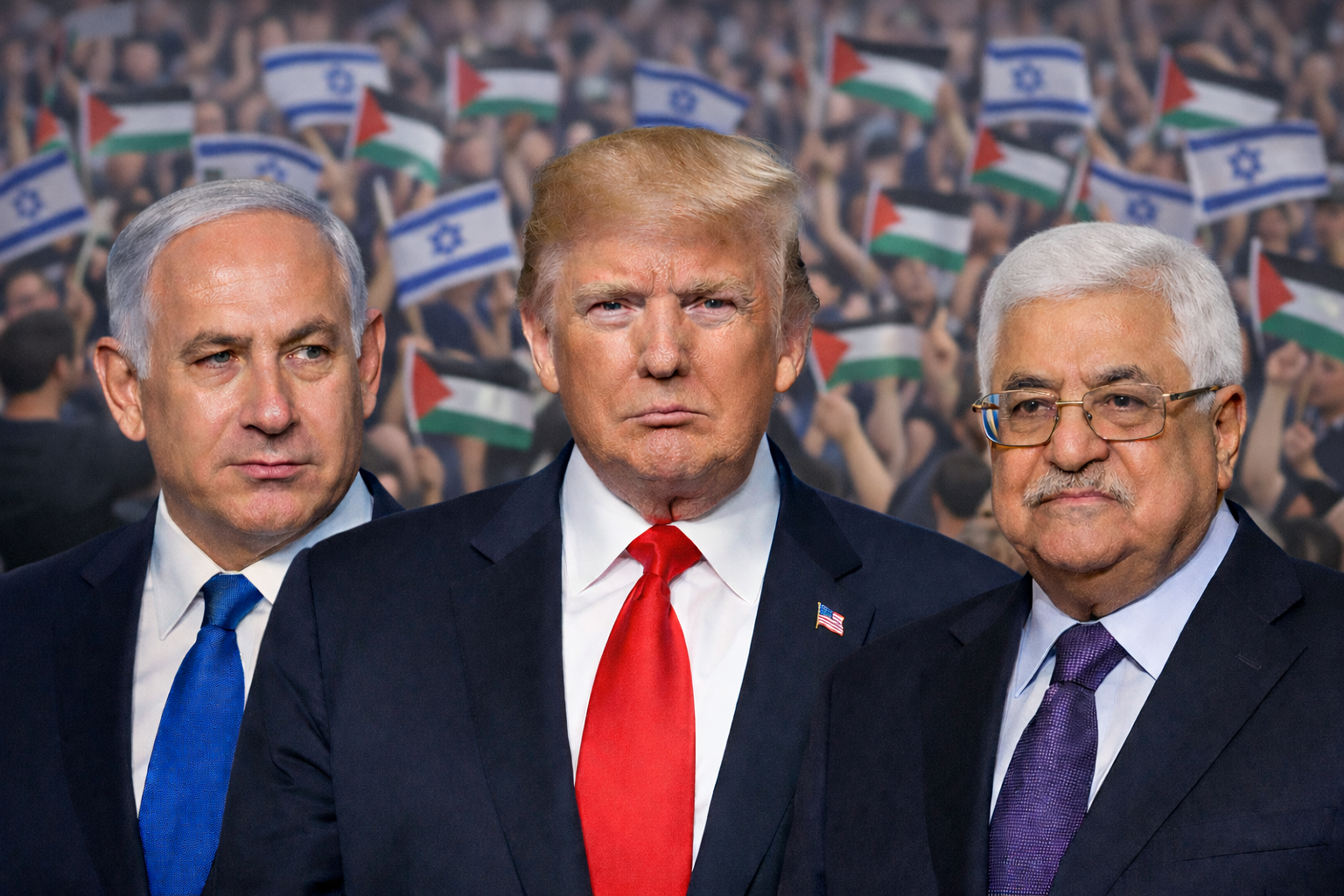
Illustration depicting Israeli Prime Minister Netanyahu, U.S. President Trump, and Palestinian President Abbas in front of supportive crowds.
As President Trump welcomes Prime Minister Netanyahu at Mar-a-Lago to discuss Phase II of his Middle East Peace Plan, facts on the ground rightly fuel ongoing skepticism: The IDF and Hamas each still control half of Gaza, death and humanitarian crisis continue, and the Board of Peace and International Stabilization Force remain in unknown stages of development.
Yet there is an international will to help Trump and the parties move forward. New polling across 64 countries suggests something unexpected: broad global support for a negotiated Israeli-Palestinian peace — and a readiness by people and governments around the world for their countries to help Trump make it happen.
According to a recent ALLMEP AI Pulse worldwide poll, the Trump Peace Plan’s formula — a regional peace deal with a Palestinian state peacefully existing next to Israel — enjoys overwhelming support. 85% of people globally say such a deal is essential, desirable, or acceptable. 73% of Israelis and 83% of Palestinians say they would support or tolerate such an agreement.
People worldwide want to help Trump succeed. 88% want their country to work with President Trump on the Plan. And their leaders are listening. As Trump said recently, “the kings, the presidents, prime ministers — they all want to be on the Board of Peace.”
The most surprising data in the new survey is that the global public doesn’t just want to provide food, medicine, and rebuilding after witnessing so much death and suffering; they want to go to further — to the root of the conflict. 61% want their governments to help by investing in Israeli-Palestinian peacebuilding — tackling the trauma, mistrust, separation, incitement, and zero-sum narratives that will fuel the next round of conflict and violence if left unaddressed.
This data surprises even those of us who know the power of peacebuilding best. How does such a little-known field of activity find so much resonance alongside humanitarian aid and reconstruction?
One key may be newfound awareness of the price of allowing this conflict to continue. After two years in which war in the Middle East has destabilized the region and sent shockwaves around the world, people see with fresh eyes how it not only costs Israelis and Palestinians dearly but also threatens global relations, security, travel, and commerce.
People also may have learned from decades of past failure. After each prior war between Israel and Hamas, the world invested massive resources to rebuild roads and buildings but left the conflict itself untouched. The result: whatever we built was simply destroyed in the next round of violence. Again and again and again.
Here, peacebuilding offers something rare: it addresses root causes of conflict, and it can begin immediately, deliver early wins, and start reshaping the environment in which challenging political decisions that come next will be made.
Recognizing how critical this work is, the UK announced that it will host a launch event in March for a new International Fund for Israeli-Palestinian Peace to invest in peacebuilding at scale. In the latest AI Pulse poll, 77% of people worldwide said they want their country to join the new Fund. France and Germany are positioned to do just that. What is missing — and what people worldwide are waiting for — is clear U.S. leadership to bring these efforts together under the Trump Peace Plan.
Trump’s plan and U.S. funding that’s waiting to be spent give him the perfect opening. Point 18 of the Plan calls for interfaith dialogue and work to change mindsets and narratives — the very work of civil society peacebuilding. And under the MEPPA program, Congress has already approved $50 million in FY25 and potentially another $50 million coming for FY26. Most Americans — and 74% of MAGA voters — say they want the U.S. to continue such investments.
These peacebuilding efforts can launch immediately. They don’t depend on final status agreements. They can work alongside, and reinforce, diplomacy and security measures, building the public engagement and legitimacy needed for later phases.
Rebuilding Gaza could cost $100 billion. With just a fraction of that, peacebuilding investments would pave the way for, and strengthen, reconstruction itself. They would be the insurance policy to keep the buildings standing. Rebuilding is not just a technical challenge; it requires stabilization. Without also addressing social cohesion, trauma, conflict narratives, and community trust, physical reconstruction will not last.
As President Trump prepares to press Netanyahu toward Phase II, the timing is now right. Other countries are eager to participate. President Trump could launch direct U.S. peacebuilding funding, with others to follow. Or he could summon world leaders to a pledging conference to commit resources for Point 18. Either way, he could instantly catalyze others to multiply the investment.
And most of all, people would see that Phase II is not in question, and it’s not just words on a page; it will be underway. People would stop asking if the peace plan is alive. They’d be seeing it come to life on the ground, by and for those who need it most.
Related Topics
Related Posts