CFO | Empower Society for Good I Author
Living With Uncertainty
Life is fragile.
We know this, but sometimes life forces us to feel it.
A neighbour who had recently made aliyah drops dead in his sixties. Someone we know from social media suddenly dies far too young. Another family is changed forever by cancer. A person suffers through illness or old age. A funeral is held. A few words are said. A family walks away carrying a memory that no one else can carry for them.
And sometimes the pain is almost unbearable.
A family goes on holiday to Slovenia. A father jumps into the water to save his son and drowns. His widow says she has no home to come back to. What can one even say in the face of that?
This is real pain. Life itself, in all its beauty and terror, reminding us how little we control.
And in Israel, this ordinary human fragility is intensified by the fragility of living in our land.
Netanel Shukrun, a father of six from Alei Zahav, was murdered in a shooting attack at Ein Raya spring. He had gone there with his 16-year-old son and had just immersed in the water ahead of Yom Kippur. When the terrorist opened fire, Netanel reportedly warned his son, saving his life.
One man is murdered while preparing for Yom Kippur with his son.
Then Neria Leiter, son of Israel’s ambassador to the United States, Yechiel Leiter, was critically wounded in a ramming attack at the Maccabim checkpoint on Route 443 near Modi’in. CNN placed the story within the familiar frame of the “West Bank.” But for many Israelis, this is not some distant or abstract place on a map. It is the main road between Jerusalem and Modi’in. It is a road I travel frequently. It is part of the ordinary geography of Israeli life.
That, too, is part of the shock.
First comes the terror itself. Then comes the framing. A familiar road is turned into an abstraction. The reader abroad is quietly guided to think “settlement” or “occupation” before thinking “human being,” “family,” “road,” “home,” or “terror attack.”
This is not just reporting. It is moral distancing.
And this is the world we live in. At UNGA, speaker after speaker lectures Israel as if the Jewish people are strangers in our own land. Britain boycotts. Norway condemns. The United Nations distorts. Syria, after years of civil war, massacre, ISIS and Iranian entrenchment, is welcomed back into the diplomatic arena and again speaks of the Golan. E1 is treated as the great moral danger of the Middle East, while terrorism, incitement and “pay for slay” are pushed into the background.
We are a hated state in a tough neighbourhood.
But this reflection is not only about Israel’s enemies. It is about life itself.
It is about the fact that we live exposed. Personally exposed. Nationally exposed. Humanly exposed.
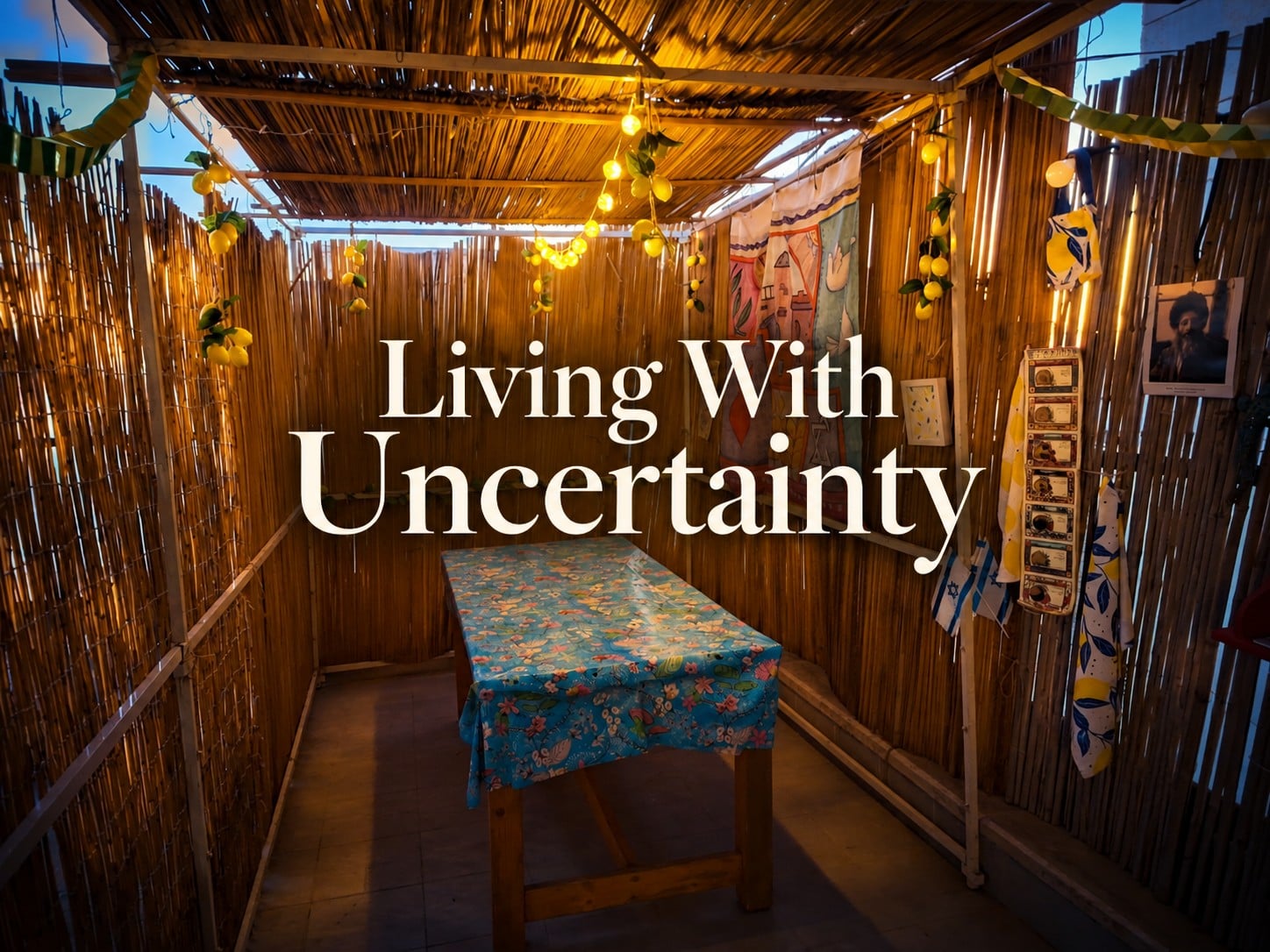
And then Sukkot arrives.
After Rosh Hashanah and Yom Kippur, after all the words about judgment, teshuvah, memory, forgiveness and responsibility, we walk outside and sit in a fragile hut.
Not a fortress.
Not a sealed room.
Not a place of control.
A sukkah.
For seven days, we are asked to leave the illusion of permanence and sit beneath a roof that does not fully protect us. We can see the sky through it. We feel the wind. We hear the world outside.
The sukkah tells the truth.
Life was never as secure as we pretended it was.
Perhaps that is why we read Kohelet on Sukkot. Not because it is cheerful, but because it is honest. Kohelet strips life down. Power passes. Wealth passes. Certainty passes. Strength passes. Even people we love can be here one moment and gone the next.
And after all its searching, Kohelet does not give us a neat explanation for suffering.
It gives us something harder and simpler:
סוֹף דָּבָר הַכֹּל נִשְׁמָע אֶת הָאֱלֹקִים יְרָא וְאֶת מִצְוֹתָיו שְׁמוֹר כִּי זֶה כָּל הָאָדָם
“The end of the matter, when all has been heard: fear God and keep His commandments, for this is the whole of man.”
And Kohelet also says:
וּרְאֵה חַיִּים עִם אִשָּׁה אֲשֶׁר אָהַבְתָּ
“Enjoy life with the wife whom you love.”
That may be the whole challenge of Sukkot.
Not to pretend life is coherent.
Not to pretend suffering makes sense.
Not to pretend the world is fair, or that history is being judged honestly, or that every tragedy can be explained.
But to sit inside fragility and still choose life.
To love your wife. To hold your family close. To be kinder to your children, your neighbours and the strangers you meet. To notice the small blessings. To make an impact where you can. To stop pretending that control is the same as meaning.
Sukkot is called zman simchateinu, the time of our joy.
That is almost shocking.
After all this fragility, after all this uncertainty, after all this pain, we are commanded to rejoice.
Not because we are naive.
Not because we are safe.
Not because everything makes sense.
But because joy is not denial.
Joy is defiance.
Joy is presence.
Joy is saying: I know life is fragile, and still I will build the sukkah. Still I will invite others in. Still I will eat with my family. Still I will remember those who are gone. Still I will thank God for what remains.
At the end of the day, what is left?
Family.
Faith.
Memory.
The people who carry us, and the people we carry.
The small acts of love that outlast the noise.
So this Sukkot, I do not want to run from uncertainty.
I want to sit inside it honestly.
With the pain of this year. With the names. With the funerals. With the terror. With CNN’s framing. With UNGA’s lectures. With the boycotts. With the private griefs that never make the headlines.
And still, we are not intimidated.
We are still here.
Still in our land.
Still building.
Still mourning.
Still remembering.
Still loving.
Still refusing to let hatred, tragedy or fear write the final chapter.
The sukkah is fragile.
So are we.
And still, beneath that thin roof, we choose faith, family, courage and life.
Related Topics