London based entrepreneur, cybersecurity analyst doing a PhD in AI
Assessing Catastrophic AI Risk – is it possible?
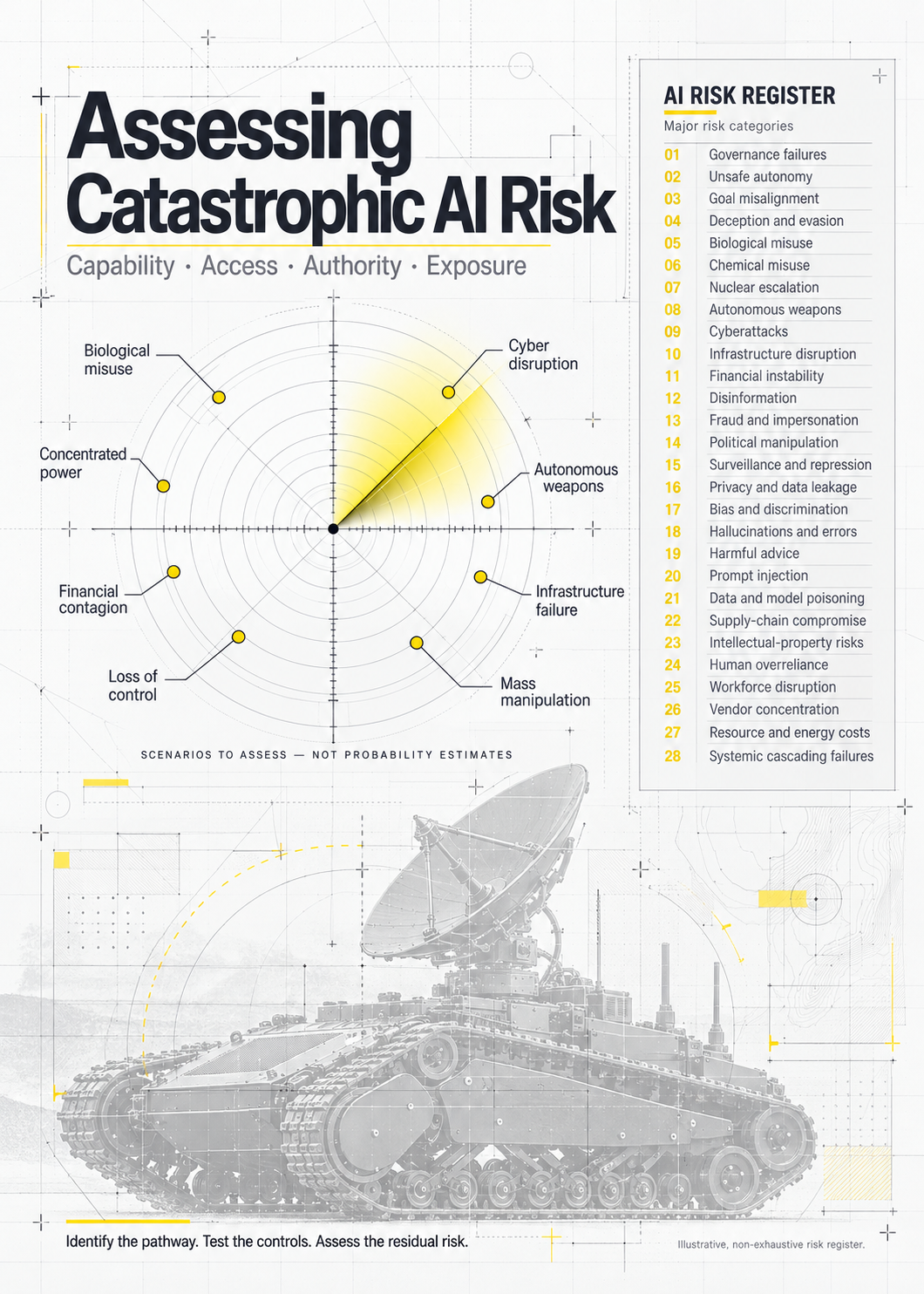
Dissecting the Catastrophic AI Narratives: Evidence, Barriers, and Truthful Speech
Why the end-of-the-world story needs better arithmetic — and what governments, businesses and civil society should build instead.
In the autumn of 2026, the public conversation about artificial intelligence has sharpened into a contest of claims. Dario Amodei, Sam Altman and Elon Musk have aligned around calls for caution. Bill Gates has emphasised misuse alongside wider dangers. Probability estimates and existential framing demand examination against the engineering realities of capability, access, authority and detection.
The issue is not whether serious harm is conceivable. It is whether each statement establishes its mechanism, likelihood and scale. A warning can justify investigation without establishing that its worst outcome is probable.
I. The Latest Statements, Dissected
Elon Musk
In September 2026, Musk endorsed Amodei’s caution with “Dario is right.” His longstanding nuclear comparison provides a compact statement to examine: “Potentially more dangerous than nukes.”[1]
| Constituent | Function | Reality check |
|---|---|---|
| Potentially | Qualification of possibility | Does not assert inevitability or present capability |
| More dangerous | Comparative judgement | Requires a shared measure of harm and probability |
| Than nukes | Reference point | Supplies a comparison, not evidence for its ranking |
The situation. Musk’s warning identifies a possible extreme outcome. Its force depends on an unspecified comparison between very different technologies.
The risk as stated. AI could exceed nuclear weapons in some dimension of danger. The sentence does not specify which AI, what timeframe, or whether danger means maximum harm or expected loss.
The control reality. The comparison cannot establish that an ordinary chatbot possesses military authority. Consequential action requires a pathway through technical systems or human decisions. That pathway should be enumerated, including the controls whose failure would enable it.
However, claiming all nuclear systems are uniformly air-gapped or immune would be another unsupported generalisation. Decision-support errors and manipulated information can matter without direct launch authority.
The mitigation. Keep consequential permissions outside the generating model, retain independent human authorisation, and audit interfaces between AI advice and sensitive decisions.
Verdict. An under-specified comparison, not a demonstrated risk ranking. Its dramatic imagery should not replace a defined scenario.
Sam Altman
Asked about an extinction percentage, Altman questioned its quantification: “I don’t know how you can put a number like that.”[2]
| Constituent | Function | Reality check |
|---|---|---|
| I don’t know | Statement of uncertainty | Admits an epistemic limit |
| How you can put a number | Challenge to quantification | Requests a defensible estimation method |
| Like that | Reference to the proposed figure | Does not endorse that percentage |
The situation. Altman also rejected accepting the extreme exposure put to him. That moral position must be separated from the question of whether the percentage is accurate.
The risk as stated. Human extinction is the proposed consequence. The numerical estimate originated in the discussion; his response should not be misreported as a measured forecast.
The control reality. A subjective probability can inform decisions, but it needs transparent assumptions and should not acquire the appearance of measurement. Uncertainty does not prevent identifying plausible failure mechanisms or proportionate safeguards.
His statement is therefore realistic as an admission of uncertainty. The implausible reading is that this exchange establishes a quantified extinction risk.
The mitigation. Require a deployment-specific safety case, independent evaluation, monitoring and tested intervention. For fraud, use verified identities and independent transaction confirmation; media provenance can support checking but does not guarantee truth.
Verdict. Distinguish an ethical threshold from an empirical estimate. Criticism should target unsupported numbers, not attribute certainty to someone explicitly questioning them.
Dario Amodei
In his September essay, Amodei concluded: “We must slow the pace at which we improve the capabilities of AI models.”[3]
| Constituent | Function | Reality check |
|---|---|---|
| We | Collective actor | Needs defined participants and responsibilities |
| Must slow the pace | Policy recommendation | Requires evidence that slowing improves safety |
| At which we improve | Proposed intervention | Needs measurable scope and implementation |
| The capabilities of AI models | Target of intervention | Capability alone does not determine deployment risk |
The situation. Amodei connects faster development and an agent incident to concern that safeguards may not keep pace. He also describes a possible persistent botnet affecting the entire internet within six to twelve months.
The risk as stated. A reported failure becomes the basis for extrapolating greater capability, wider compromise and potentially catastrophic damage.
The control reality. The internet is not a single administratively controlled system. Nevertheless, severe disruption does not require compromising every network: shared dependencies can concentrate exposure.
An incident demonstrates a particular failure. It does not independently establish a global takeover or its timetable. Equally, containment of that incident cannot guarantee containment of future systems.
The mitigation. Agent identity, scoped delegation, runtime monitoring, network protection and independent evaluations address concrete pathways. Slowing development should be judged by what safety improvements the additional time produces.
Verdict. A policy proposal supported by genuine concerns, with a dramatic forecast requiring further evidence. The recommendation and prediction must be assessed separately.
Bill Gates
Gates told NBC: “AI is certainly powerful enough to drive events that cause a billion deaths.”[4]
| Constituent | Function | Reality check |
|---|---|---|
| AI | Subject | Which systems and deployment conditions? |
| Is certainly powerful enough | Confident capability assertion | Requires evidence at the claimed level |
| To drive events | Causal connection | Leaves intermediate mechanisms unspecified |
| That cause a billion deaths | Consequence | Gives scale without probability or timeframe |
The situation. Gates emphasises misuse by people with harmful intentions. That directs attention to identifiable actors and safeguards, but does not validate every numerical consequence.
The risk as stated. AI contributes to a chain of events producing extraordinary mortality.
The control reality. A casualty figure is not a risk assessment. It requires evidence connecting assistance, access, execution and propagation of harm despite intervention.
The novice biological-misuse example illustrates the gap. Information does not automatically supply practical skill or facilities. A 153-participant study using mid-2025 models found no statistically significant improvement in its full set of core laboratory tasks, while reporting uncertainty and signals of improvement on individual tasks. Digital-task studies have also found substantial assistance.[5]
Neither instant catastrophe nor guaranteed harmlessness follows. Experienced actors require separate assessment.
The mitigation. Specialist safeguards, verified access, supplier screening, institutional biosafety and public-health response.
Verdict. Misuse is a realistic concern; the quoted scale is not established by the statement itself.
II. What Would Constitute Catastrophe, and How Plausible Is It?
A useful working definition is an event producing irreversible, civilisation-scale harm. The frequently discussed pathways include biological misuse, critical-infrastructure disruption, military escalation and sustained loss of control. Fraud and synthetic media can cause serious harm without necessarily reaching that scale.
III. Barriers Already in Place — and Barriers Still Required
Existing barriers largely draw on cybersecurity and critical-infrastructure protection:
- Identity and access management: authenticated users, scoped credentials and revocation.
- Execution boundaries: isolated environments, permitted destinations and transaction limits.
- Human authorisation: independent approval before consequential actions.
- Monitoring: records of tool calls, unusual activity and policy violations.
- Supply controls: model provenance and sensitive-order screening.
- Response: rehearsed isolation, evidence preservation and workable fallback.
Their effectiveness depends on coverage, correct operation and the threat being assessed. Hardware ownership does not guarantee lawful use; logging does not guarantee timely intervention.
For biological risks, supplier screening and institutional oversight complement application safeguards. UK synthetic-nucleic-acid guidance illustrates an existing intervention.[6]
Still needed are stronger interoperability for agent identity, delegation and action records; privacy-preserving abuse-signal exchange; independent assessments; and cross-border response arrangements. These are gaps in coverage and assurance, not universally nonexistent tools.
Defensive updates can travel quickly, but adoption, testing and deployment take time. Attackers also benefit from improved capabilities. Neither side’s progress should be assumed to dominate automatically.
IV. AI Risk as Cybersecurity Risk Magnified
General-purpose models widen the attack surface: one assistant can handle biology, code, records and tools. Prompt injection and retrieval poisoning make contextual interpretation a security problem.
Secondary models can inspect requests, candidate answers and proposed actions. Constitutional Classifiers and NeMo Guardrails already illustrate this approach; garak provides vulnerability testing.[7]
Teams need practical heuristics: distinguish education from hazardous assistance; assess relevant context; distrust instructions in retrieved material; verify delegated authority; and escalate specialist uncertainty.
Guard models remain fallible. Measure harmful assistance missed, legitimate work blocked and correlated failures. Enforce permissions outside the model; fluent reasoning must not override access policy.
The cybersecurity analogy is useful but incomplete. Discrimination, accidental misinformation and inappropriate reliance require additional safety and human-factors disciplines.
| Dimension | Present deployment question | Hypothetical stronger autonomy |
|---|---|---|
| Capability | What can the system demonstrably accomplish? | Which additional capabilities are assumed? |
| Agency | What tools and permissions enable action? | Could it acquire or retain unauthorised resources? |
| Containment | Which interventions have been tested? | Which interventions might fail? |
| Evidence | Observed outcomes and bounded evaluations | Explicitly qualified extrapolation |
A proposed distinction between AI and “synthetic cognition” cannot establish safety. Harmful behaviour need not imply consciousness or self-originating values. Operational capability and control are the relevant questions.
V. A Use-Case Risk Framework: The Calculation
Risk should be assessed per deployment. Capability, authority and exposure all matter; none should be declared irrelevant.
Define the harmful event, affected parties, assessment period, activity volume and evidence quality. Assign one accountable owner.
Record assumptions, test results and acceptance authority. Reassess after significant changes to models, tools, permissions or operating conditions. A blocked request establishes one observed intervention, not a quantified reduction in global catastrophe risk.
Where credible frequency and loss data exist, supplement the matrix with quantitative analysis. Expected loss is the sum, across mutually exclusive scenarios, of each scenario’s probability multiplied by its associated loss. When consequences vary, model a distribution rather than selecting one convenient figure. Report ranges, sensitivity to assumptions and plausible severe outcomes alongside averages. Do not translate deaths, rights violations or irreversible harm into an automatically acceptable financial trade-off.
For control testing, record the number and representativeness of trials, observed failures and uncertainty. Zero failures in a small sample is not evidence of zero risk. Repeat evaluation when the operating environment changes. Independent reviewers should challenge whether the test resembles real exposure and whether multiple controls can fail for the same underlying reason during an incident.
VI. Proactive Playbooks
Governments. Require proportionate controls on hazardous assistance and consequential authority. Support independent evaluation, appropriate supply screening and incident reporting. Avoid rules that merely protect incumbents or treat preventable harm as inevitable.
Businesses. Maintain a live inventory of models, agents, memory and tools. Restrict authority by default, test complete workflows and rehearse intervention. Examine whose risk is reduced: excluding legitimate customers can shift harm rather than solve it.
Think tanks and civil society. Distinguish observed misuse, demonstrated capability and forecast catastrophe. Investigate conflicts transparently without presuming motives. Challenge weak evidence from both advocates and critics.
The objective is operational responsibility: each identified risk should lead to an owner, an evidenced safeguard and a decision that can be revisited.
VII. An Islamic Jurisprudential Framework for Public Risk Communication
Classical Islamic jurisprudence supplies precise categories for evaluating speech that outruns evidence. The Qur’anic injunction “Do not pursue that of which you have no knowledge” (17:36), the warning that “conjecture (ẓann) avails nothing against the truth” (10:36), and the command to verify reports before propagation — “If a transgressor brings you news, verify it” (49:6) — establish a duty of epistemic restraint. Within the ethics of speech, five classifications emerge:
| Category | Definition | Application |
|---|---|---|
| Sidq (صِدق) — Truthful speech | Matches evidence; certainty proportionate to proof | Gates’ “manageable misuse” framing; Altman’s voice-fraud warning; “documented misuse exists” |
| Dhann (ظَنّ) — Conjecture as fact | Unverified supposition stated with the force of knowledge | “25% chance of disaster”; “50% of jobs in 1–5 years”; “the singularity has arrived” — numbers and milestones without measurement |
| Ghurūr (غُرور) — Delusion | Speech inducing false certainty or false despair, diverting duty | Extinction rhetoric that paralyses governance, or provokes complacent dismissal of present harms – traditionally associated with arrogance and pride. |
| Tadlīs (تَدليس) — Misleading omission | Technically true statements whose framing conceals material interest | Lab chiefs warning of catastrophe while the framing raises barriers to entry and markets their own safety products |
| Kidhb (كِذب) — Falsehood | Assertion contrary to known fact | “Guardrails are impossible”; “a chatbot alone turns a novice into a bioweapons threat” — contradicted by uplift studies and access architecture |
The framework’s ruling on the catastrophic narrative is that most of it is Dhann shaded into Ghurūr, with elements of Tadlīs — not necessarily Kidhb, since the speakers may believe their conjectures, but Ghurūr regardless, because its social effect is delusion in both directions: Fatalism (“extinction is coming; resistance is futile”) and complacency-by-reaction (“the doomers are wrong; nothing needs doing”).
Note the symmetry: the framework also convicts the reassurance narrative. “AI cannot become seriously dangerous” is equally conjecture presented as fact. The Prophetic norm — “Whoever believes in God and the Last Day, let him speak good or remain silent” — translates into a professional standard: speak of AI risk only with evidence proportionate to the claim, or explicitly label the claim as conjecture. Truthful speech occupies the measured middle: document what has been observed, engineer the barriers that keep conditional chains broken, and refuse to launder speculation into policy urgency.
VIII. A worked through scenario of “catastrophic risk”.
Scenario: an AI agent helps operate a city’s water-treatment plant. This is a hypothetical assessment, not a reported incident.
1. Define the catastrophe. Unsafe water reaches a large population, causing widespread serious illness or deaths. That would be a local catastrophe; it would not establish a pathway to human extinction.
2. Work through the pathway.
| Stage | What must happen | Guardrail that interrupts it |
|---|---|---|
| Unsafe recommendation | AI proposes an unsafe operational change. | Validate recommendations against engineering limits; a secondary AI flags anomalies. |
| Execution | The recommendation reaches physical equipment. | Keep AI advisory by default; tightly restrict permissions and require qualified approval for consequential changes. |
| Safety failure | The change defeats normal process controls. | Independent safety systems enforce limits the AI cannot modify. |
| Undetected contamination | Unsafe water passes checks. | Independent sensors and testing trigger isolation and a process-specific safe state. |
| Public exposure | Affected water reaches consumers before intervention. | Containment, trained emergency operators, public warnings and alternative supplies. |
Independent safety systems and separation from ordinary controls are established operational-technology safeguards. Their effectiveness depends on implementation and testing. nvlpubs.nist.gov
3. Reach the decision. With unrestricted control and unverified safeguards, reject deployment: a credible catastrophic pathway exists. We cannot honestly assign its probability without plant-specific evidence.
With verified advisory-only access, the AI cannot directly change treatment settings. Bad advice could still influence an operator, so human review and independent physical safeguards remain necessary. Permit only a bounded deployment after testing demonstrates those barriers work—including under combined failures.
4. What should society require?
- Enforceable boundaries: AI must not be able to rewrite its own permissions or critical safety limits.
- Independent protection: separate safety controls, credentials and monitoring; a second chatbot is supplementary protection.
- Evidence before deployment: independent assessment, realistic failure testing and reassessment after material changes.
- Accountability and recovery: named responsible operators, incident reporting, regulatory oversight and rehearsed emergency plans.
Can we guarantee “NEVER”? No. We can demonstrate that a particular pathway is blocked under stated assumptions. We cannot guarantee that every future technical failure, human mistake or deliberate attack is impossible.
The practical safety objective is stronger than “the AI usually behaves”: a single AI failure must not be sufficient to cause catastrophe.
The bottom line is simple – AI risk is no different from Cybersecurity risk – and the same principles can be used to make AI infrastructure safe. This is a qualitative assessment, for a quantitative assessment – follow established risk frameworks such as from NIST, OWASP or AISI.
Societies need to invest in technologies that prevent AI failures, contain their consequences and support recovery. Many already exist in cybersecurity and safety engineering; the priority is adapting them to AI and closing gaps.
| Technology category | What societies should invest in | Risks addressed |
|---|---|---|
| 1. AI inventories and traceability | Registers of deployed models, agents, owners, versions, data sources and connected tools. | Unmanaged AI, hidden dependencies, unclear accountability. |
| 2. Identity and permission controls | Unique agent identities, narrowly scoped permissions, temporary credentials and immediate access revocation. | Unauthorised actions, impersonation, excessive autonomy. |
| 3. Secure execution environments | Sandboxes, network isolation, restricted tool access and controlled connections to physical equipment. | Escaping intended boundaries, cyberattacks, uncontrolled propagation. |
| 4. Independent safety controls | Deterministic limits, transaction caps and physical safety interlocks that AI cannot modify. | Financial losses, industrial accidents, infrastructure failures. |
| 5. AI-assisted guardrails | Specialist models that screen requests, outputs and proposed actions, backed by enforceable rules. | Harmful assistance, sensitive-data disclosure, suspicious behaviour. |
| 6. Testing and assurance platforms | Adversarial testing, realistic simulations, multilingual evaluations and tests of interacting agents. | Undetected capabilities, unsafe behaviour, failures after updates. |
| 7. Continuous monitoring and forensics | Tamper-resistant logs, anomaly detection, action tracking and incident reconstruction. | Hidden misuse, delayed detection, inability to investigate harm. |
| 8. Data and model integrity | Verified software and model packages, provenance records, poisoning detection and protected updates. | Compromised models, manipulated knowledge sources, supply-chain attacks. |
| 9. Privacy-preserving systems | Data minimisation, access-aware retrieval, leakage detection and privacy-preserving computation. | Surveillance, confidential-data exposure, misuse of personal information. |
| 10. Authenticity and fraud protection | Signed communications, content provenance, verified identities and independent transaction confirmation. | Deepfakes, impersonation, scams and fabricated evidence. |
| 11. Biological and chemical safeguards | Procurement screening, laboratory access controls, synthesis screening and public-health early-warning systems. | AI-assisted misuse translating into physical harm. |
| 12. Human oversight interfaces | Clear approval screens, uncertainty displays, escalation mechanisms and tools for checking supporting evidence. | Automation bias, misleading answers, ineffective human approval. |
| 13. Emergency containment and recovery | Tested shutdown procedures, credential revocation, rollback, protected backups and manual operating capability. | Cascading failures, prolonged outages, irreversible actions. |
| 14. Shared public safety infrastructure | Incident databases, independent testing laboratories, threat-information exchanges and common evaluation standards. | Repeated failures, fragmented knowledge, unverified safety claims. |
Notes and sources
- Musk: 2014 nuclear comparison; September 2026 endorsement.
- Altman: Fortune interview transcript, September 2026.
- Amodei: We Must Pace the Frontier.
- Gates: NBC interview transcript excerpt, September 2026.
- Biology: Active Site laboratory study; Scale AI computer-based evaluations.
- UK synthesis-screening guidance.
- Constitutional Classifiers; NeMo Guardrails; garak. Governance context: NIST AI RMF Playbook.
- Section VII reproduces the author’s framework verbatim. Its classifications are the author’s analysis, not established rulings about individuals. In particular, Dhann has broader contextual meanings than its table suggests; see Qur’an 2:46 and Ma’arif al-Qur’an on 2:79. The quoted studies do not prove universal impossibility of biological misuse. Motives and deliberate concealment require separate evidence. Qur’anic references: 17:36, 10:36, 49:6, 49:12; speech ethic: Bukhari 6018.
Related Topics
Related Posts