Singing the song of self, peoplehood, and humanity—where every life still matters in the chorus of war.
At Hanukkah, We Cannot Let Our Elders Sit In Darkness
Elderly man in Ukraine
This Hanukkah, We Cannot Let Our Elders Sit In Darkness Alone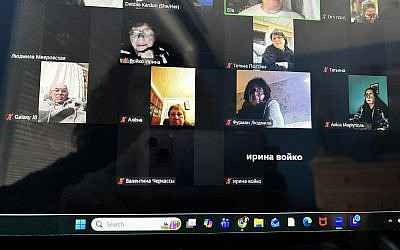
Hanukkah always brings me home. Not physically — but emotionally. It’s the holiday that weaves together memory, family, ritual, and the quiet reassurance of sitting together around a small, steady light. Each year as I take out my menorah, I remember the people who taught me how to create warmth even when the world outside felt uncertain.
But this year feels different.
This year, for me, the contrast between the light in my home and the darkness in Ukraine feels impossible to ignore.
As we gather with family and friends, thousands of Jewish elders across Ukraine will spend Hanukkah in cold, silent apartments, unsure when the lights will return. In many communities in the Dnipro oblast, blackouts stretch eight hours or longer. Pharmacies are damaged or empty. ATMs don’t work without electricity. Even boiling water becomes its own small crisis.
And these elders are not just elders.
They are the very people Action for Post-Soviet Jewry (Action-PSJ) — now in our 50th year — was created to support. Founded during the Soviet Jewry Movement, we began as a grassroots effort to ensure Jews behind the Iron Curtain were not forgotten. For nearly half a century, Action-PSJ has served as a bridge of care between Jewish communities here and Jewish communities there — through advocacy, partnership, and direct relationships.
These are Jews who have already lived through the end years of the Holocaust, Stalinist repression, decades of Soviet antisemitism, the collapse of the USSR, and years of economic and political instability. Their resilience is astonishing. But no one should have to rely on resilience alone in their 80s or 90s.
A few days ago, I was on a Zoom call with our Ukrainian care coordinators — the local team at the heart of our partnership with Action for Ukraine (AFU), our Ukrainian-run NGO. Every coordinator lives in the same communities as the elders they support.
Most joined from dim rooms lit by a single bulb. The internet blinked in and out. One coordinator walked to a neighbor’s home because it had a bit of power; another traveled across town just to connect.
And yet they showed up — ready to share what their elders were experiencing and what support was urgently needed.
They told me, again and again, that our guaranteed cash assistance — small, predictable monthly microgrants — is literally keeping people alive.
One widow used her stipend to buy a heating blanket so she could warm a single room during blackouts. Another elder finally bought warm socks and winter shoes. Others use it for food, batteries, flashlights, blankets, or repairs that make their homes safe.
These purchases may seem simple. But in wartime, they are acts of survival — and of dignity.
And they reflect something deeper in our work. Because Action-PSJ’s 50 years of listening and learning have taught us to recognize — and respond to — the aid gap: the places where traditional systems break down, where elders fall through the cracks, where help is needed now and not weeks from now.
Through AFU, we provide true wrap-around care:
- Telehealth, when traveling, is unsafe
- Emergency medication sourcing when pharmacies are empty or destroyed
- Home check-ins to ensure elders have heat, food, and connection
- Art-therapy sessions to ease trauma when words are too heavy
These are steady, relational interventions — the small flames that keep a life warm.
After that Zoom call, I sat quietly for a long time. I felt heartbreak for what our elders are enduring, and awe — deep awe — at the grace, strength, and dignity with which they continue to meet each day.
And I thought about Hanukkah.
Hanukkah is not about grand miracles.
It is about the choice to light one candle anyway.
To kindle hope when everything feels fragile.
To hold each other close in moments of fear.
To insist that light, even the smallest amount, matters.
The elders we support once carried the flame of Jewish life through years of Soviet repression, often quietly and at great personal cost. They protected our stories, our songs, our rituals, our memory.
They held the light for us.
Now it is our turn to hold it for them.
Jewish peoplehood and connection are not abstract or complicated, and they are not conflicted. They are lived in ACTION — in the way we show up for one another across continents and generations. It is the belief that the light we create here can reach someone sitting in darkness thousands of miles away.
This Hanukkah, as our menorahs brighten our homes, I hope we widen that circle of light. I hope we carry the elders of Ukraine with us — not as strangers, but as members of our Jewish family who once carried our story and now need us to carry theirs.
The miracle of Hanukkah wasn’t just that the oil lasted.
It was that someone, despite everything, decided to light the flame at all.
May we be that kind of light.
May our warmth reach those who need it most.
And may no elder — especially those who once carried our history — have to face the darkness alone.
Related Topics
Related Posts