Aurélien Bellanger Interview | Alexandre Gilbert #343
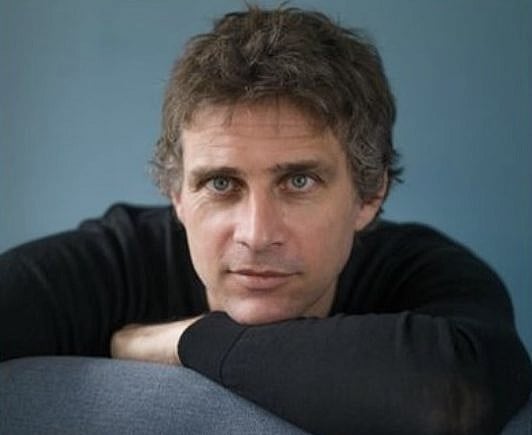
Aurélien Bellanger, cyclist, and marathon runner publishes The Architect of Notre-Dame with Actes Sud — first departure from Gallimard in over a decade, and a return to the historical-infrastructural novel that made his name.
Introduction: For fifteen years, Aurélien Bellanger has been building something like a Balzacian project for the present: a sequence of novels that each take a single technical or institutional object — a telecoms network, a stretch of high-speed rail, a political party, a cathedral — and use it as a lens onto the whole structure of French modernity. He announced the project’s ambitions early, with a 2010 monograph on Michel Houellebecq, before making it his own.
La Théorie de l’information (2012) turned the rise of the internet, and the biography of a Xavier Niel-like entrepreneur, into a history of the information age. L’Aménagement du territoire (2014), winner of the Prix de Flore, wove high-speed rail, property speculation, and buried Breton history around a Francis Bouygues-like figure. Le Grand Paris (2017) followed a young suburban operator, Alexandre Belgrand, through the cynicism and grandiosity of the Grand Paris Express — a Nicolas Sarkozy-like’s metro project — as a way of narrating the fracture between the capital and its banlieues. Le Continent de la douceur (2019) took on Bernard-Henri Lévy; Téléréalité (2021), Stéphane Courbit’s world of media and territory; Le Vingtième Siècle (2023) reimagined Walter Benjamin as a messiah. In 2024 Bellanger shifted register again, moving to Seuil for Les Derniers Jours du Parti socialiste, a satirical roman à clef about the collapse of French socialism into what he calls an “Orwellian left” — a current that presents itself as left-wing while functioning, in his account, as something closer to its opposite.
Abstract: The Architect of Notre-Dame returns to the old method and follows Viollet-le-Duc, accompanied by a country priest in the Bas-Maine who doubles as an informal watchman over the revolutionary activities of a group of Germans in Paris, among them a young Karl Marx. The other strand, set essentially in the present, follows Ancelin de Gorré, a young stonemason, a compagnon du devoir old guild tradition of itinerant craftsmen — under a mason who will himself go on to work on the Notre-Dame restoration after the 2019 fire.
You make Viollet-le-Duc a nineteenth-century architect, “the one who stays up latest”, haunted by a Middle Ages that he invents as much as he restores it. Can we speak of postmodernism here?
Aurélien Bellanger : That’s really the whole question. Architecture is normally the field in which these concepts take shape — it is almost the matrix of our regime of historicity. And yet Viollet-le-Duc oscillates, swings back and forth like a door that won’t quite close, between the old, which he venerates, and the modern, which he champions and which defines his method. I wanted to look closely at this anomaly, to see what it might tell us about our own present. Where are we now, overrun on every side by reaction, pursued by fascism? Are we still modern? Were we ever really postmodern?
The novel’s plot runs “from the fall of the Second Empire to the appearance of Islamic State” and Trump. Why is this huge temporal span necessary to tell the story of a cathedral?
Aurélien Bellanger: Two timelines complement each other. One belongs to Viollet-le-Duc, caught near the end, during his last journey. The other belongs to a contemporary stonemason who will find himself caught up both in the brief episodes of contemporary vandalism and in the fire at Notre-Dame. What links them is that the mason grew up in a manor house restored by the master.
Ancelin de Gorré, the stonemason in the grip of a “drift toward fascism,” embodies a form of the guild tradition that tips over into conspiracy theory. Should this conspiracism be traced back to the burning of the Talmuds in the thirteenth century?
Aurélien Bellanger : I didn’t go quite that far back — only as far as Rousseau’s paranoid episode at Notre-Dame.
On Rousseau at Notre-Dame. This is a famous episode from the end of Jean-Jacques Rousseau’s life (around 1776) that illustrates the intensification of his persecutory delusions. He recounts it himself in a text known as the Histoire du précédent écrit, associated with his Dialogues (Rousseau juge de Jean-Jacques). The context: By this point, Rousseau was convinced that a vast conspiracy — orchestrated by his former friends among the philosophes (linked in his mind to circles around Diderot, Grimm, and even the earlier falling-out with Hume) — was working to discredit him and falsify his image for posterity. Consumed by this conviction, he wrote a text addressed “To every Frenchman who still loves justice and truth,” a desperate appeal asking whether a single honest man still existed in France who might do him justice. The Notre-Dame episode: Rousseau decided to place this text on the high altar of the cathedral, believing that such a sacred and public place would guarantee it would be read and passed on impartially. But upon arriving, he found the choir screen (the gate separating the choir from the nave) closed — something he claimed he had never seen in all his years of visiting the church. This simple architectural coincidence (likely due to routine closure or ongoing work) shook him profoundly: he interpreted it as a sign that even Heaven itself had joined the conspiracy against him, since Providence seemed to be blocking his access to justice. This episode is often cited by critics and biographers as a striking example of Rousseau’s persecutory thinking during this period — a brilliant man psychologically at the end of his rope, unable to distinguish an ordinary coincidence from a cosmic sign directed personally at him. It’s also echoed in certain passages of the Reveries of the Solitary Walker, where Rousseau tries to make peace with this solitude and his conviction of being universally persecuted.
On the other hand, I did try to use the cathedral as an instrument to examine an eminently novelistic question: the relationship between the Church and Judaism — through the fantasy of the old Jew disguised as an astrologer, through the figure of Lustiger, through the relics of Christ’s Passion.
Cardinal Jean-Marie Lustiger (1926–2007) was Archbishop of Paris from 1981 to 2005. Born Aaron Lustiger to a Polish-Jewish immigrant family in Paris. His mother was murdered at Auschwitz during the Holocaust. As a teenager during the German occupation of France, he converted to Catholicism in 1940, taking the name Jean-Marie, though he continued to identify himself as Jewish throughout his life, seeing his Catholic faith as an extension rather than a rejection of his Jewish heritage. Ordained a priest in 1954, he spent years as a chaplain to students at the Sorbonne in Paris. Pope John Paul II appointed him Bishop of Orléans in 1979, and just two years later made him Archbishop of Paris, a major and unusual promotion. He was created a cardinal in 1983. Involved in the sensitive and contentious debate over a Carmelite convent established at Auschwitz in the 1980s, he worked to resolve tensions between Catholic and Jewish communities over the site. Considered by some to be a possible candidate for the papacy after John Paul II’s death, though Joseph Ratzinger (Benedict XVI) was ultimately elected in 2005. At his request, the words “Panem de coelo dedisti eis” (a Latin psalm verse) and the Kaddish (a Jewish prayer for the dead) were recited at his funeral at Notre-Dame Cathedral.
You evoke the “powerful men of Haussmannian Paris.” Can we speak of a continuity between the Masonic networks of the nineteenth century and the persistence of the architects behind the “Axe Historique”?
Aurélien Bellanger: In any case, it works as a story, and my hero’s master will certainly not fail to initiate him into it…
On the Axe historique (historical axis). A roughly nine-kilometer line of monuments and boulevards running through Paris, stretching from the Louvre, through the Tuileries Garden, the Place de la Concorde, the Champs-Élysées, and the Arc de Triomphe, out to La Défense and its Grande Arche. It developed over several centuries rather than being planned as a single project starting during the 17th century, when André Le Nôtre extended the sightline of the Tuileries gardens westward. Later urban projects — Haussmann’s boulevards in the 19th century, and the construction of La Défense as a modern business district in the 20th century — extended and reinforced the same line, culminating in Johan Otto von Spreckelsen’s Grande Arche, completed in 1989. It’s called the Triumphal Way.
Romans developed opus caementicium using volcanic ash, lime, and water, a technique robust enough that structures like the Pantheon’s dome still stand two thousand years later. In the nineteenth century, Viollet-le-Duc experimented with iron reinforcement. Lafarge supplied material for the Suez Canal, the Atlantic Wall, and the Islamic State. In the Gulf, slip-form technique now allows the concrete cores of the world’s tallest towers such as Borj e Milad or Burj Khalifa and cement earned the nickname “grey gold”. How did concrete become a recurring character?
Aurélien Bellanger: I had fun applying to it some of the theories people sometimes apply to the pyramids — the idea that their construction was somehow faked. There is, notably, that theory about liquid stone. I indulged in it. I already knew that for conspiracy theorists almost anything is possible, up to and including denying that men walked on the moon, or that the Middle Ages ever existed. But the idea that the stones themselves might be fake — stones so tangible that churches were built on them! That was genuinely dizzying.
The spire built by Viollet-le-Duc, which was rebuilt identically after the fire, was itself only a nineteenth-century invention. In choosing to rebuild it as it was, didn’t France choose myth over authenticity?
Aurélien Bellanger: The trap laid by the old architect worked all too well: France ended up becoming medieval again. Not directly, but by accepting — against modern historiography, which distinguishes carefully between periods and treats copies as inauthentic — that the false can be a moment of the true. That was the historiographical regime of medieval Christendom itself, full of replicas of the Holy Sepulchre, endlessly multiplied grottoes of Lourdes, and Last Suppers perpetually reenacted. It is significant that France found nothing else to say, no other gesture to make, than this one. Or perhaps it is simply France’s way of finally making peace with an architect who was, for a long time, poorly loved.
See also:
*Aurélien Bellanger et Le Continent de la douceur