
CEO of Time to Stand Up for Israel
One Jewish State. Why Is That Too Much?
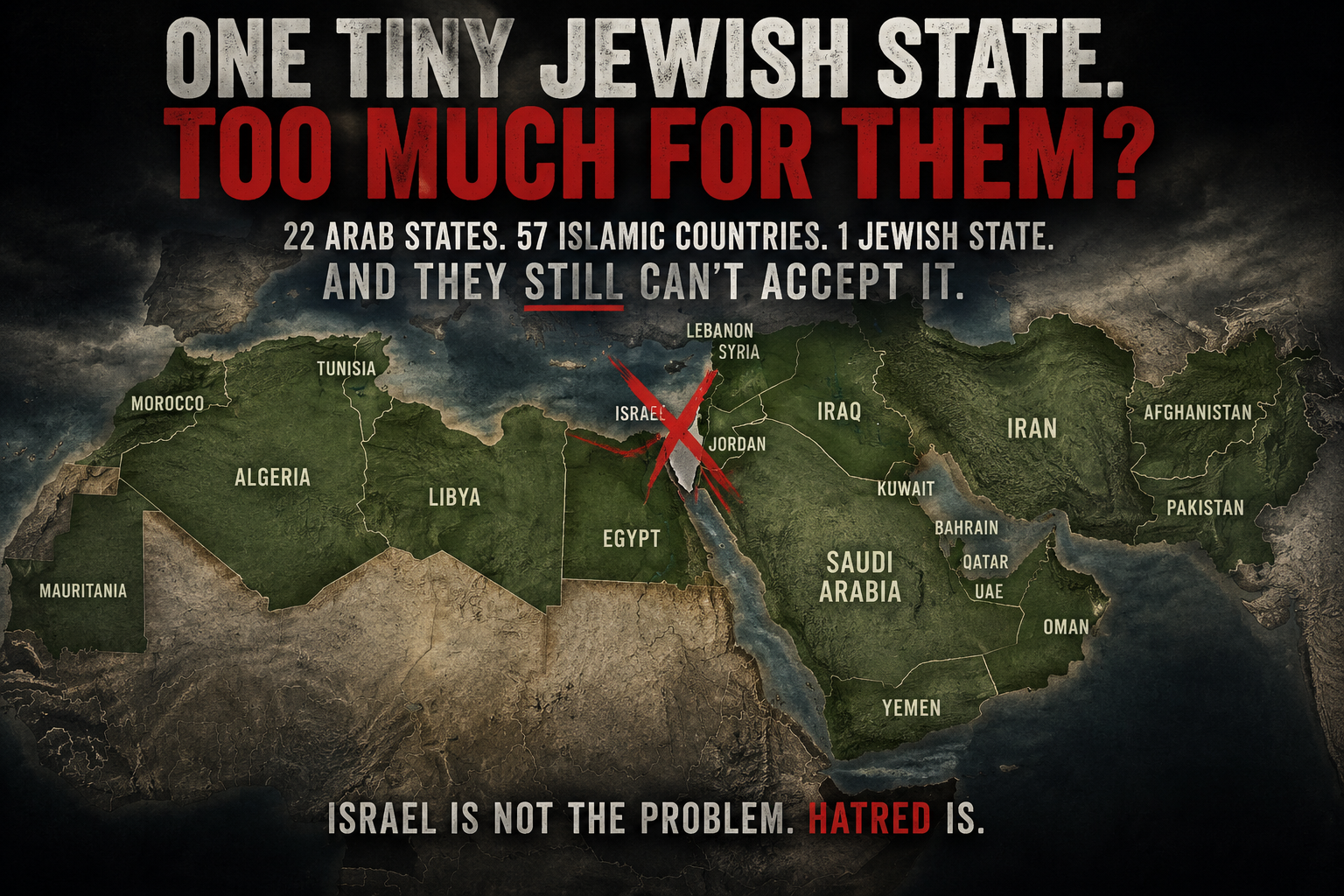
Photo Credits: Sabine Sterk ( AI)
Why Is One Tiny Jewish State Too Much?
There is a question that is rarely asked because asking it makes people uncomfortable.
Why is the existence of one Jewish state considered such an unbearable problem by so much of the Arab and Islamic world?
Look at a map.
Israel is tiny. You can cross significant parts of the country in the time it takes to drive between two major European cities. Yet this small strip of land has occupied an astonishing amount of political attention across the Middle East for generations.
The Arab League represents 22 members. The Organisation of Islamic Cooperation represents 57 states across four continents.
And then there is Israel.
One Jewish state.
That contrast should at least make us willing to ask difficult questions.
Of course, the conflict cannot simply be reduced to Muslims having many countries and Jews having one. Nations are not interchangeable pieces of real estate. An Arab living in Ramallah cannot simply be told that Saudi Arabia, Morocco or Algeria is Arab too, therefore any one of those countries should become his home. National identity, family history and attachment to land matter.
But precisely the same principle must be applied to Jews.
Jews are not interchangeable with Europeans, Americans or anybody else. Jewish history did not begin in Poland, Germany or Russia. Jerusalem, Hebron, Safed, Tiberias, Judea and the wider Land of Israel are woven throughout Jewish history, religion, language and collective memory.
The Jewish demand for national self determination therefore cannot honestly be dismissed as uniquely illegitimate while national self determination is defended almost everywhere else.
This is where the discussion surrounding the “Palestinians” becomes deeply uncomfortable.
The question should not be whether Arabs are entitled to dignity, security, prosperity and political rights. Obviously they are. The question is why achieving those things has so often been presented as requiring the elimination, dismantling or fundamental transformation of the Jewish state.
Those are two entirely different propositions.
You can support Arab prosperity without opposing Jewish sovereignty.
You can advocate political rights for “Palestinians” without denying Jewish history.
You can criticize an Israeli government without questioning Israel’s existence.
You can want peace without demanding that Jews surrender the one country in which Jewish national self determination is the organizing principle of the state.
Israel’s own Declaration of Independence explicitly promised equality of social and political rights regardless of religion, race or sex. Even while war surrounded the newborn state, the declaration appealed to Israel’s Arab inhabitants to participate in building the country on the basis of full and equal citizenship. It simultaneously extended an offer of peace and good neighborliness to the surrounding states.
That is an important historical fact because Israel’s existence does not require the Middle East to become Jewish.
Israel does not demand that Egypt abandon its Arab identity. Israel does not demand that Saudi Arabia cease being an Islamic kingdom. Israel does not demand that Jordan erase its Hashemite character or that dozens of Muslim majority societies transform themselves to accommodate Jewish nationalism.
It asks for something remarkably modest in historical terms.
Acceptance that the Jewish people also have a homeland.
And perhaps that is exactly why Israel has become such a powerful symbol.
Israel represents the return of a people who survived exile, persecution, expulsions, pogroms and ultimately the Holocaust, yet refused to disappear. Hebrew was revived as an everyday national language. Ancient cities became part of a modern country. Refugees arrived from Europe, North Africa, the Middle East and elsewhere and built institutions, universities, farms, companies, hospitals and an army capable of defending them.
The Jewish people stopped waiting for others to guarantee their survival.
That independence matters.
There is also a broader political dimension that should not be ignored. The Palestinian question has been elevated for decades into a cause extending far beyond the immediate Israeli Palestinian conflict. The OIC itself describes Palestine and Al Quds among its institutional priorities, illustrating how deeply the issue has become embedded in wider Islamic politics.
Yet turning Israel into the permanent explanation for the region’s frustrations has never built a Palestinian economy, strengthened democratic institutions or created peaceful coexistence.
Hatred is not a development strategy.
Rejectionism is not state building.
And destroying Israel would not create another Singapore. It would simply destroy Israel.
The future should therefore begin with a different question.
Not how the Jewish state can eventually be removed, weakened beyond recognition or pressured into apologizing for existing, but how Arabs and Jews can build their futures without requiring the disappearance of the other.
The Middle East is enormous. The Islamic world stretches across continents. The Jewish state occupies a minute piece of territory, but for the Jewish people its significance cannot be measured in square kilometers.
It is the place where an ancient people recovered sovereignty.
There is room in this world for Arab nations.
There is room for Muslim nations.
There is room for Christian nations and secular nations.
And yes, there is room for one Jewish state.
Israel does not need permission to exist.
But peace will become far more achievable when its neighbors and its opponents finally understand that accepting Israel does not diminish them.
It simply acknowledges that Jewish self determination deserves the same legitimacy they demand for themselves.
Related Topics
Related Posts