The views expressed herein are solely mine.
Australia Has Chosen. Jews Should Too.
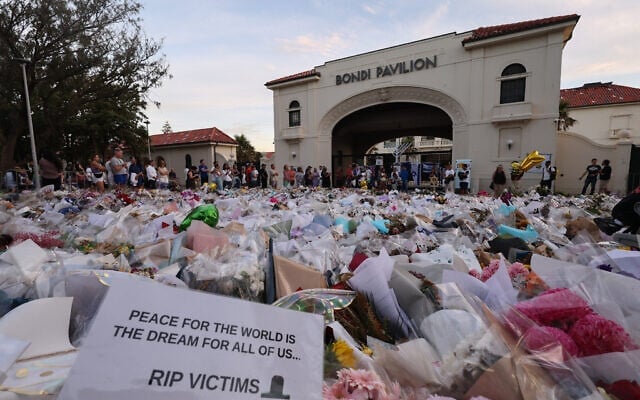
A note is pictured next to floral tributes laid at Bondi Pavilion in memory of the victims of a terror shooting targeting a Jewish event days earlier, at Bondi Beach, in Sydney, Australia, on December 20, 2025. (DAVID GRAY / AFP)
Bondi Beach still glows at sunset. The cafés hum. The ocean rolls in as if nothing has changed. Jews know better than to confuse scenery with safety. Normal life can look perfectly intact—right up until it is not.
Australia is nearing that moment.
Since October 7, 2023, antisemitism there has not merely risen; it has exploded. Official figures show a more than 300% surge in antisemitic incidents nationwide, with peaks exceeding 700% in the immediate aftermath of Hamas’s massacre. On the other hand, thousands of threats, assaults, and acts of vandalism have been logged.
Clearly, this is not online noise. This is real-world hostility forcing synagogues and Jewish schools into permanent police protection. Thus, when armed guards become routine, society has already crossed a line.
The danger is no longer symbolic. Kosher businesses have been firebombed. A Melbourne synagogue was burned in what police immediately treated as terrorism. And Australian intelligence has since confirmed something even darker: foreign-linked involvement, including ties to the Iranian regime, in attacks on Jewish targets. Jews are not collateral damage here. They are the prey.
And still, the political response hesitates.
Jewish leaders warned early. They asked for decisive action, for a national reckoning. Instead, they got statements, task forces, and lectures about “balance.”
But, “balance” between whom? Between Jews and those calling for their erasure? In moments like this, balance is not moderation—it is evasion.
At the same time, universities, unions, and cultural institutions have played their role. Across campuses, Jews are recast as colonizers, Zionism as original sin, and intimidation as “activism.”
In light of this, “Zionist” becomes the acceptable substitute for “Jew.” Language softens. Lines blur. Moral permission is granted. This is how societies prepare the ground—long before blood is spilled. However, Australia went a step further.
Today, Canberra’s demographic reality matters here, not because migrants are inherently dangerous, but because mass migration imports unresolved conflicts.
Demographically, Australia has absorbed hundreds of thousands of new arrivals in just two years, while assimilation has given way to grievance politics. Islamist extremism and far-right radicalism thrive in that vacuum, amplified online and tolerated offline. The result is predictable: Jewish life becomes a pressure point in someone else’s war.
None of this arrives all at once. Hate never does. It escalates, is explained away, normalized, and then defended. Jews are reassured they are safe—while living behind bollards, guards, and locked gates.
Nevertheless, history is brutally consistent on this point. Jewish danger begins with dismissal. Governments urge patience. Communities are told not to overreact. Those who wait do so at their own risk.
To suggest that Australian Jews seriously consider leaving is not panic. It is historical literacy. Zionism itself was born from this recognition: diaspora safety is conditional, and it expires quietly before collapsing violently.
Bondi will remain beautiful. The ocean will keep rolling in. Politicians will keep talking.
None of that is a guarantee.
When warning signs align—exploding incident rates, arson and terror, ignored intelligence, ideological hatred dressed up as justice—Jews should not wait for certainty. Certainty usually comes too late.
Leave early. Leave deliberately. Leave on your own terms.
Choose strength. Choose sovereignty. Choose self-defense.
Choose Israel—or choose somewhere safer, before safety becomes a memory explained away by officials and mourned too late.
Related Topics
Related Posts