
"I'm the spokesman for the OK Boomer generation"
Ayn Rand Revisited
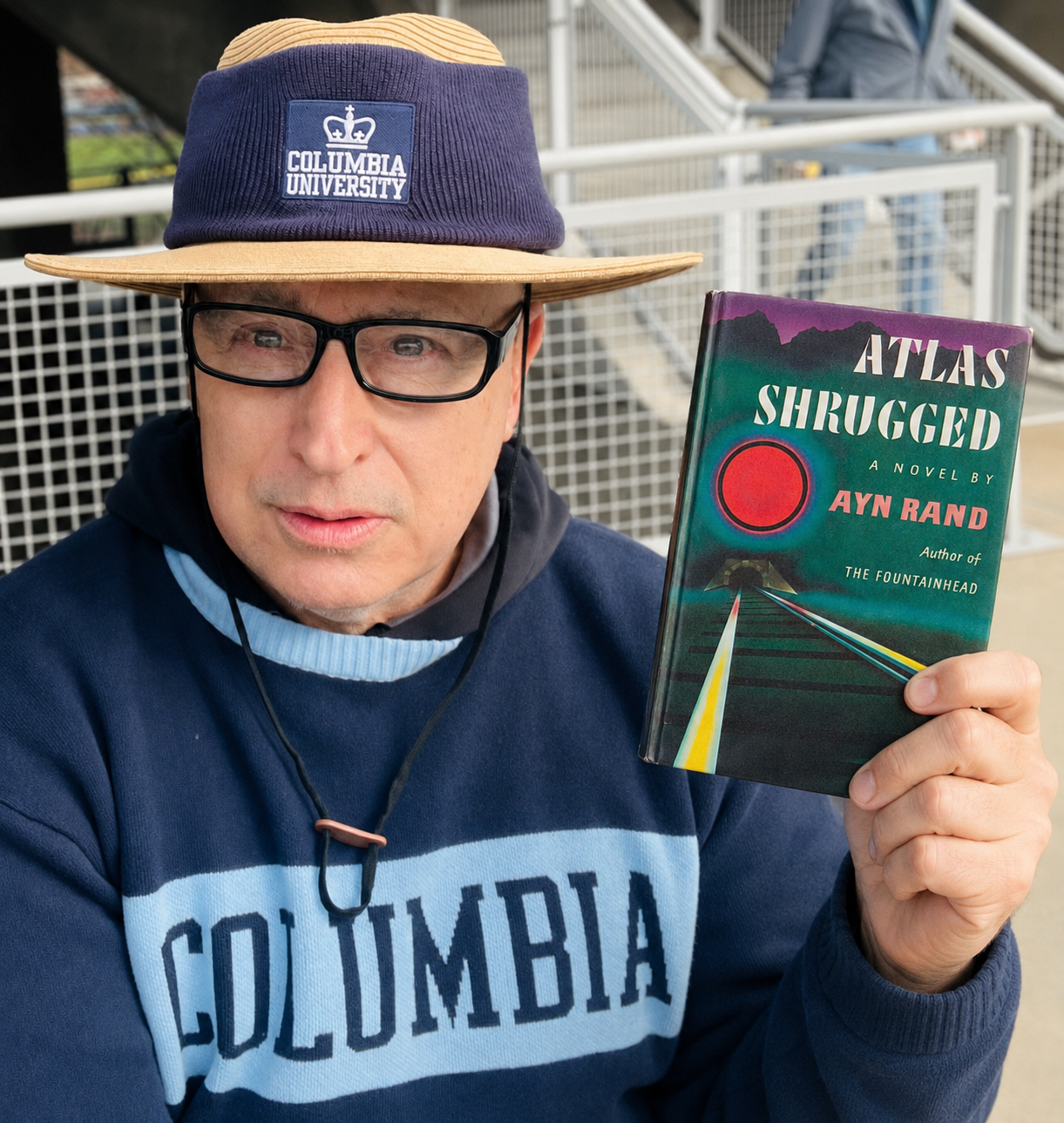
Photo: Tony Senatore: all rights reserved
Objectivism, the individual-centric philosophy of Ayn Rand, often gets a bad rap for being cold and heartless. In his National Review article, Whittaker Chambers wrote that Rand’s worldview replaces Christian morality with a cruel system where the strong owe nothing to anyone. He asserted:
“Randian man, like Marxian man, is made the center of a godless world… [Her system] commands: ‘Be selfish!’… It makes a virtue of what the rest of mankind has found to be a vice.”
Rand remains one of the most polarizing thinkers of the twentieth century: admired by many readers for her moral defense of individual achievement and independence, and criticized by others for what they see as an overly rigid ethical framework and an insufficient appreciation of interdependence and social obligation. I don’t profess to be an expert on Ayn Rand and Objectivism. Still, I believe criticisms that she rejected altruism outright are misguided and are often advanced by individuals more concerned with denigrating her than understanding her philosophy and her specific interpretation of what altruism means.
People often praise someone by saying “He’d give you the shirt off his back” as the ultimate example of selflessness and morality. If you believe the man giving his shirt to someone who doesn’t have one is a moral exemplar, you would be adhering to a definition of altruism coined by French philosopher Auguste Comte, who believed that the moral purpose of your life is to live for others rather than yourself. Under this definition, self-sacrifice is the highest virtue, pursuing your own happiness is morally suspect, and the greater the sacrifice, the greater the virtue.
My knowledge of Objectivism, combined with two real-life experiences that I will elaborate on later, helped me understand Rand’s rejection of Comte’s definition and the importance of an individual’s moral right to pursue their own life and happiness. Many people equate kindness and altruism (as defined by Comte). Rand separated these concepts. She believed you could be extraordinarily generous without believing your life belongs to others. The thing she wished to debunk was the idea that self-sacrifice is the standard of morality. Rand never argued that people should never help others. She believed in helping people you value, helping friends and family, or voluntarily giving money to charity. The key word is voluntary. Helping someone because you love them is not, in Rand’s view, a sacrifice. It is an expression of your own values.
I believe Ayn Rand restored dignity to the individual by insisting that people have a moral right to pursue their own flourishing, rather than living under perpetual guilt or obligation. Understanding this distinction explains why Rand devotees see her not as an advocate of callousness, but as a defender of the individual’s right to live for their own rationally chosen values rather than the whims of society or as a means to an end for others. Thus, an action can benefit millions of people or just one, without being altruistic in the Comtean sense, if it also serves your own chosen values.
Elon Musk’s current battle with the prominent Washington politicians is an ideal place to see Rand’s philosophy on altruism in action. When reports suggested that Elon Musk had become the world’s first trillionaire, progressive politicians responded with outrage rather than admiration. Senator Bernie Sanders called Musk’s wealth an “absurdity.” Senator Elizabeth Warren complained that “the typical American household would have to work more than 11 million years to make Elon Musk’s level of wealth.” Senator Ed Markey called it “disgusting,” while Maine Senate candidate Graham Platner declared, “Let’s make sure he’s also the last.” Ayn Rand would have seen these remarks as expressions of the morality of sacrifice—a philosophy that judges achievement not by the value it creates but by how much of it can be claimed for others.
Musk did not become wealthy by force, but by building companies that millions of people freely chose to support. His fortune is not proof of exploitation; it is evidence of productive ability rewarded through voluntary exchange. Rand rejected the idea that success creates a moral debt, and I agree with her. The producer is not obligated to surrender the rewards of his mind simply because others demand them or because politicians believe they can spend his wealth more wisely. To punish achievement through confiscatory taxation is to discourage the very innovation that makes prosperity possible. Government should protect the freedom to create wealth—not treat its creators as an inexhaustible source of revenue to remedy problems government itself has often helped create or to relieve individuals of responsibility for their own lives.
A society that vilifies its greatest producers should not be surprised when fewer people aspire to become them. On the surface, Wikipedia, the online encyclopedia that provides knowledge to individuals all over the world for free, seems like the ultimate expression of Comtean self-sacrifice. Still, the story of Wikipedia made me realize there is more to altruism than meets the eye. You might be surprised to learn that Jimmy Wales, the co-founder of Wikipedia, considers himself a disciple of Rand, taking what he likes from her philosophy and discarding the things he dislikes, as I do. On his personal Wikipedia page, he asserts that objectivism “colors everything he does and thinks.”
Many years ago, when Wikipedia was doing a fund drive, I received an email from Wales himself asking for donations. At the time, my understanding of Rand’s philosophy was not as formidable as it is now. I emailed Mr. Wales asking him why a self-professed objectivist would put together a free online encyclopedia, ask for money to support it, and give anyone in the world the power to make edits. It didn’t sound like something Howard Roark, Hank Reardon, or any character from a Rand novel would do. I was surprised when he emailed me back with an explanation.
Our email conversation was about fifteen years ago, but I still remember his most important points. I asked Mr. Wales how someone who believes in rational self-interest and the tenets of Objectivism can create something that everyone can use for free, and do so as part of a team. Wales replied that free was not the opposite of self-interest. He wanted to build the greatest encyclopedia in history because he believed knowledge was valuable, and that voluntary productive achievement was one of humanity’s greatest virtues. He was neither forced nor coerced, nor surrendering to a moral obligation to humanity. Under Rand’s framework, voluntary generosity or open access is entirely compatible with rational self-interest if it reflects the creator’s own values.
Wales concluded that an open encyclopedia was the best realization of this vision. That was his choice as the creator. The conversation got me to reflect on the heroes of Ayn Rand’s novels. Howard Roark built buildings. John Galt invented revolutionary technology. Hank Reardon created a new type of metal. These individuals improved everyone’s lives, yet Rand did not portray them as altruists in the Comtean tradition, because they create first and foremost. After all, creating fulfills their own rational value. The fact that millions benefit is simply a consequence, and not the catalyst for their actions. Looking at it from this perspective, I had a newfound understanding of Rand’s philosophy and was able to apply her framework to my personal life.
In 1993, my sister had a child and was not able to care for her. I made the decision to raise her, and she is getting married on September 6th, which fills me with great pride and a sense of fulfillment. I used to think that I sacrificed myself because being moral demands it, but Rand made me realize I had more in common with Wales, Roark, Galt, and Reardon than I ever imagined. Caring for my niece was an expression of the life and relationships I have rationally chosen to cherish. I was not acting from guilt, but from loyalty to what I personally value as well as my Catholic faith.
In the case of Jimmy Wales and my own, our actions benefited others. The philosophical disagreement between Rand and her detractors is not about the action itself but why it was performed. Rand would argue that an action can be generous, compassionate, and profoundly beneficial to others without being altruistic in the traditional sense. The moral value comes from acting in accordance with one’s rationally chosen values, not from the degree of sacrifice involved. Whether one ultimately embraces or rejects Ayn Rand’s philosophy, it deserves to be fully understood before it is condemned. My hope is that this discussion of her views on altruism has encouraged readers to look beyond the caricature of Rand as cold or heartless and instead see a thinker who challenged us to reconsider the relationship between achievement, generosity, and individual responsibility.
Even if you disagree with her conclusions, perhaps you now see that her philosophy was far more nuanced—and far more human—than its critics often suggest. It is probably safe to say that civilization would continue much as it always has without Bernie Sanders, Elizabeth Warren, Ed Markey, or Graham Platner. The same cannot be said for Elon Musk, Jimmy Wales, Steve Jobs, Bill Gates, or Jeff Bezos. Remove those innovators, and the world loses reusable rockets, Wikipedia, the iPhone, the personal computer revolution, and the revolution in online commerce and cloud computing. Their fortunes were not created by political decree or redistributive policy, but by producing values that millions—and in some cases billions—of people voluntarily chose to use. This is the moral point Ayn Rand insisted upon: wealth honestly earned in a free market is not evidence of exploitation but of value creation. A society that treats its greatest producers as villains instead of benefactors risks discouraging the very minds upon which its prosperity depends. Rather than asking how much of their success should be taken away, we should be asking how to cultivate more individuals capable of achieving it.
Related Topics
Related Posts