From Yemenite tradition to the coming Beith HaMikdash
Babel in the Nine Days
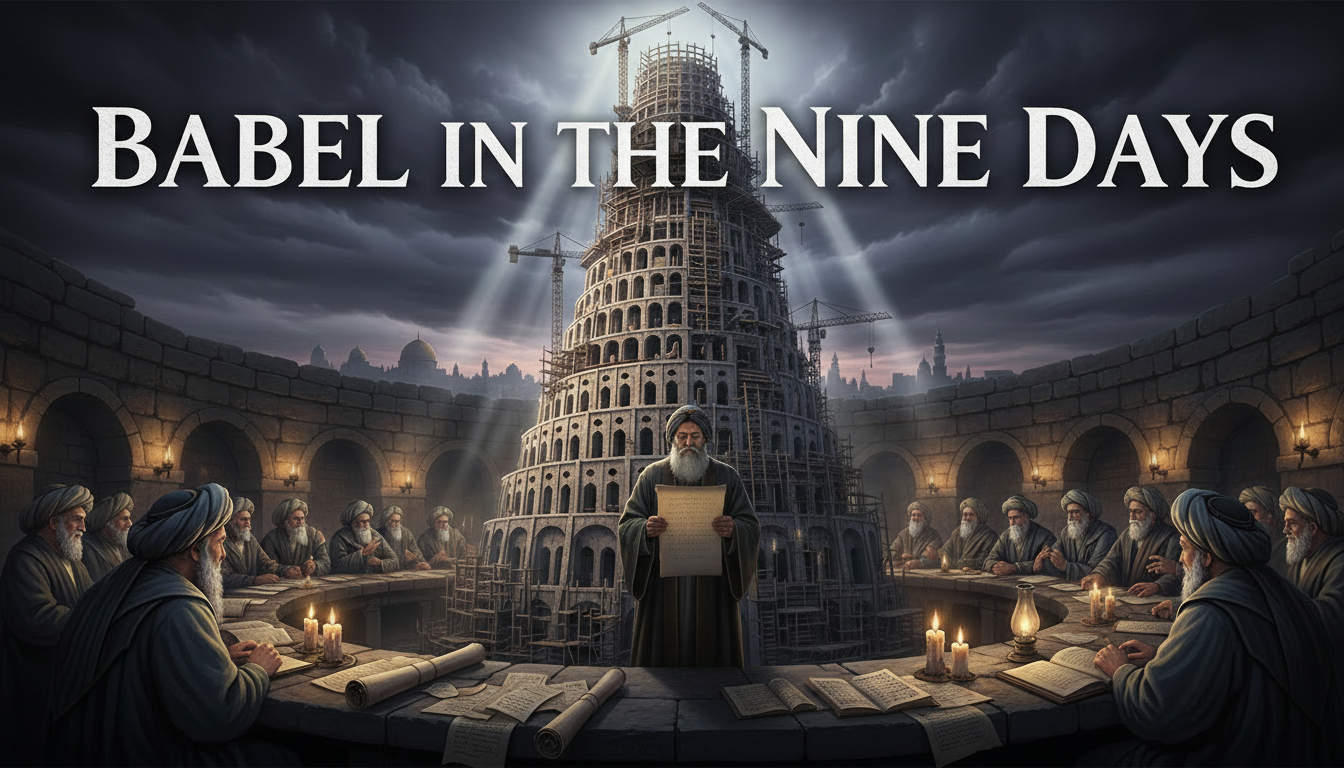
Are we reaching Heaven...or the People? (image generated using AI)
The Sanhedrin’s written ruling is dated 6 Menachem Av.
Hold that date for a moment before anything else. Three days before Tisha B’Av. Inside the nine days when we do not build, do not celebrate, do not so much as launder a garment, because we are sitting in the ruins of the thing the court has now ruled must be rebuilt. In those exact days a reconstituted Sanhedrin convened for several hours, passed two resolutions, and asked that the Holy One remove and erase every obstacle so that we may build the Beit HaMikdash.
I want to be careful here, because the impulse is not contemptible. It is the opposite. It takes a certain kind of broken heart to sit in the Nine Days and refuse to sit quietly. Anyone who has said v’techezenah eineinu and meant it knows the feeling that produced this document.
Shinar was also built by people who wanted to be closer to Heaven. That is the part of the story we skip.
The Nine Days are not an accident of scheduling. They are the tradition’s answer to exactly this question. We were told why the House fell and we were told what rebuilds it, and neither answer has ever involved a filing.
What the Ruling Actually Says
Let me state the court’s position fairly, because the weakest version of this critique attacks a decree that was not issued.
The operative formula is careful: “And just as the court below has ruled, so we ask that the court above rule the same, and so may it stand.” That is not a command. The verb is ask. Anyone who characterizes this ruling as ordering God around is misreading the Hebrew and should stop.
And yet. Look at the structure the request is bolted onto. The asking happens only after the ruling happens, and the asking is that Heaven ratify what the court has already determined below. The court is not petitioning as a supplicant. It is petitioning as a lower court transmitting a decision upward with the expectation of affirmation. The premise is that a beit din’s psak has standing in that jurisdiction. A binding ruling ordinarily attaches to someone who must now obey it. This one is addressed upward. That alone should tell us we have left the normal world of halakhah.
That premise is the whole matter. Everything else is detail.
It Is Not in Heaven Means What It Says
“It is not in heaven, that you should say, ‘Who will go up for us to heaven and bring it to us, that we may hear it and do it?'”
That verse is not consolation. It is a jurisdictional statement. The Torah came down and it stayed down, and it was placed in the mouth and in the heart precisely so that no Jew would ever again need to climb.
Heaven does honor the earthly court — the oven of Achnai settles that permanently. Once the Torah is given, the majority of the human court determines the halakhah and a heavenly voice does not overrule them. But read what that story protects. It builds a fence around human deliberation. It does not install a lever attached to the throne of glory. God laughs and says my children have defeated me about a dispute over ritual purity, not about the date of the redemption.
The court has mistaken the fence for the lever.
Their Proofs, Taken Seriously
To the court’s credit, it did not argue in a vacuum. It brought sources. They deserve answers.
Rabban Gamliel and the new moon. In Rosh Hashanah 25a the head of the court accepts testimony that appears defective and fixes the month anyway, and the festivals fall where he says they fall. This is presented as a case of Heaven conforming to the court. But look at why. The calendar was explicitly delegated: these are the appointed times which you shall proclaim — atem, you, even mistaken, even deliberately. The court holds the calendar because the Torah handed it the calendar. Show me the verse that hands it the End. The tradition says the reverse, and says it bluntly: blasted be the bones of those who calculate the end.
Abraham at Sodom. The court reaches back past every beit din to Abraham arguing over the fate of a city, and it is a beautiful choice. But notice the posture. Abraham is standing before the Lord. He does not rule; he asks, and he asks in the interrogative — shall the Judge of all the earth not do justice? He haggles downward from fifty like a man who knows he has no standing at all except the audacity God granted him. And then he loses. The city burns. Abraham is the model of the supplicant, and the supplicant is precisely what a court is not.
The tzaddik decrees and the Holy One fulfills. Honi draws his circle and will not step out until the rain falls. But Honi is one man in the dirt with nothing but his own burning soul, and the Sages preserved his story with open ambivalence — Shimon ben Shetach’s response to him was not applause. A tzaddik’s plea is a fire that cannot be institutionalized. It has no quorum, no docket, no procedure. The moment you can convene it, it is something else.
Underneath all three proofs is a category error. The maxim achishena — I will hasten it — comes with its condition attached in the same breath: if they merit it, I will hasten it; if not, in its time. The acceleration exists. It is real. It has always been indexed to what Israel does, never to what a court declares.
The Clause That Should Trouble Us
The first resolution asks the Holy One to remove “hostile forces from the Jewish people and the Land of Israel.” Later, the article connects that language to erev rav – “the mixed multitude” – and glosses it as corrupting elements. That framing is not perfectly clear. It may be aimed at internal subversion, external enemies, or some fusion of the two.
That ambiguity is itself the problem.
A court should be terrified of invoking charged categories without defining them, especially when the request is directed upward rather than through any earthly procedure. No names, no standards of evidence, no legal test, no defense, no appeal – only a spiritually loaded category and a plea for Heaven to remove it. Even the insertion of berachamim suggests that those present understood the risk: if one speaks this way toward Heaven, one had better plead for mercy.
If the target is foreign enemies, the wording is imprecise. If the target includes Jews, the wording is worse than imprecise. In either case, this is not how a court should speak if it wants to model the discipline of Torah rather than the heat of apocalyptic imagination.
And it was written in the Nine Days. We know what the tradition says destroyed the Second House. One does not have to flatten this ruling into an explicit attack on Jews to say that language like this should make a Jewish court tremble before it signs.
The Plain of Shinar
Scripture keeps telling this story and never softens it.
On the plain they said let us build a city and a tower with its top in the heavens. The sin was never masonry. It was the conviction that standing before Heaven is an engineering problem. They wanted access and they wanted a name, and they had the sincerity and the labor and the unity to attempt it, and what they lacked was permission.
Nadab and Abihu were not outsiders. They were consecrated, appointed, already inside the service, and they brought fire which He had not commanded. Their zeal was real. Their design was their own.
Saul asked, and the prophets did not answer, and the Urim did not answer, and Heaven went silent — so he found a woman at En-dor who could reach where he could not. He never stopped wanting God’s word. He only refused to accept that the given channels had closed.
Three men who wanted access. Three who took the route not given. The temptation never arrives dressed as rebellion. It arrives dressed as devotion in a hurry.
The Psak That Was on the Table
Here is what actually stings. A court could have spoken in those same hours, with full authority, and shaken the country.
It could have ruled the nation into coordinated teshuva. Into fasting and prayer in the spirit of the ma’amadot. Into concrete physical preparation for the avodah. Into rooting out corruption through the legal and communal instruments that already exist and are already binding. Into a measurable strengthening of observance as the groundwork the sources actually name as the condition of achishena.
Every one of those rulings binds someone genuinely subject to the court — us. Every one is enforceable by the only means a beit din has ever possessed. And every one keeps the order the Torah has held from the beginning: Israel acts, Heaven answers.
Issued on 6 Av, a ruling like that would have been a thunderclap.
What the Nations Are Reaching For
Ten men from the nations of every tongue shall take hold of the robe of a Jew, saying, let us go with you, for we have heard that God is with you.
Look at what they grab. Not a mystic. Not a technique. A hem — the edge of an ordinary garment on an ordinary Jew who keeps the commandments given through Moses. The prophecy assumes the nations will finally see something they have never seen anywhere else: a people whose God is present because that people lives inside a covenant, on the earth, in daylight.
Every religious civilization already has upward reach. Ladders, ascents, procedures for moving Heaven. Rendered in Hebrew and filed by a court, it is still the same thing, and the watching nations see a mirror rather than a revelation. There is nothing left to take hold of.
The Tower Can Be Left Unfinished
The scaffolding is still up. Nothing has been completed. A ruling can be withdrawn, superseded, or simply allowed to go quiet while a better one is drafted — one aimed at the people, where a court’s voice actually carries.
The builders on the plain never finished either. Theirs stopped in confusion; this one can stop in a better ruling.
And there is something almost merciful in the timing. The document is dated to the days when we sit on the floor. Tradition says the Mashiach is born on Tisha B’Av, in the middle of the mourning, which is the tradition’s way of insisting that the rebuilding starts inside the grief rather than around it. Not upward. Downward, into the ruins, where the work is.
The commandment is not distant. It is not across the sea and it is not in heaven. It is in your mouth and in your heart, that you may do it.
That is still the whole assignment. It always was.
Related Topics
Related Posts