
Jewish Animal Chaplaincy: Restoring Sacred Dignity
The Doctrine of Jewish Animal Chaplaincy is founded upon the principle of cultural and theological restitution: restoring to Jewish religious consciousness the dignity, respect, and moral consideration that Hashem bestowed upon animals from the beginning of Creation. This doctrine does not seek to grant animals a new spiritual status or introduce values foreign to Judaism. Rather, it seeks to recover and reaffirm what is already embedded in the Torah, the teachings of Chazal, and the wider Jewish spiritual tradition. Its purpose is not theological innovation for its own sake, but the restoration of a neglected dimension of Judaism’s own sacred heritage.
From Bereshit to Noach, from Rav Pappa to the golden cat of Shlomo HaMelech: Why recovering Judaism’s forgotten teachings about animals is an act of spiritual restoration.
Before humanity entered the world, animals were already living within it. This simple observation, found in the opening chapter of Bereshit, carries a theological significance that deserves greater attention. On the fifth day of Creation, Hashem brought forth the creatures of the waters and the birds of the heavens. On the sixth day, the animals of the land appeared before humanity was created (Bereshit 1:20–27). The sequence matters. Animals did not need human beings to establish their place in Creation. Their existence was already recognized as good by their Creator.
Humanity was subsequently entrusted with a unique responsibility, expressed through b’tzelem Elokim, the divine image. But the divine image should not be interpreted as permission to disregard the dignity of other living beings. It is a responsibility to reflect the qualities of the Creator. And among those qualities is rachamim, compassion. As Tehillim 145:9 declares, “Tov Hashem lakol, ve’rachamav al kol ma’asav” — “Hashem is good to all, and His compassion extends to all His works.” Not only to humanity. Not only to animals permitted for consumption. To all His works. This is one of the foundations of what I propose to call the Doctrine of Jewish Animal Chaplaincy.
The Torah’s account of Gan Eden presents a world in which human beings and animals belong to one divinely ordered Creation. In Bereshit 1:29–30, plants are designated as food for humanity and for living creatures. Permission for human consumption of animal flesh appears explicitly only after the Flood, in Bereshit 9:3. Jewish commentators have explored the meaning of this distinction for centuries. One theological reading sees in the original order a vision of harmony, before violence and mortality came to dominate human experience. The point is not to impose a modern dietary ideology upon the Torah. It is to recognize that the Torah itself invites us to consider the relationship between humanity, animals, and the moral structure of Creation.
When the world descended into corruption, Hashem instructed Noach to preserve living creatures within the Ark. The command was not limited to animals considered useful, beautiful, or ritually permissible. After the Flood, Hashem established a covenant extending beyond humanity: “I establish My covenant with you and with your descendants after you, and with every living creature that is with you” (Bereshit 9:9–10). The covenant is not exclusively human. Animals are explicitly included within the divine promise concerning the future of the world. For Jewish Animal Chaplaincy, this establishes a fundamental principle: animals possess a place within the divine moral order that precedes and exceeds their economic value to human beings.
One of the most important distinctions in Jewish theology is the difference between the laws governing human conduct and the spiritual dignity of the creatures affected by that conduct. Kashrut establishes what Jews may and may not eat. It does not establish which animals Hashem loves. A cat is not kosher. Neither is an eagle or a lion. Yet Jewish tradition repeatedly presents such animals as bearers of moral and spiritual meaning. In Pirkei Avot 5:20, Rabbi Yehudah ben Teima teaches, “Hevei az kanamer, vekal kanesher, veratz katzvi, vegibor ka’ari, la’asot retzon Avicha shebashamayim” — “Be bold as a leopard, light as an eagle, swift as a deer, and strong as a lion, to do the will of your Father in Heaven.” The leopard, eagle, deer, and lion become teachers of human character.
In Eruvin 100b, Chazal explain that even without the giving of the Torah, human beings could have learned certain virtues by observing animals, including modesty from the cat. A creature that some might dismiss as religiously insignificant becomes a source of moral instruction. The distinction between kosher and non-kosher animals is real and important, but it must not be confused with a division between creatures worthy and unworthy of divine compassion.
Another remarkable Jewish text, Perek Shirah, presents Creation as a vast chorus of praise to Hashem. The heavens, the earth, the waters, the birds, and the animals each have their own verses. The work is associated in traditional accounts with David HaMelech, although its historical authorship is uncertain. Among its many voices is the cat. Its song draws upon Tehillim 18:38, a verse concerning the pursuit of enemies. Within the literary and spiritual world of Perek Shirah, the cat is not a silent or meaningless presence. Its characteristic behavior becomes part of the language through which Creation praises its Maker. This is not a claim that animals recite human prayers. It is a theological vision in which Creation itself bears witness to Hashem.
The Talmud offers another striking example. In Pesachim 112b, Rav Pappa discusses the presence of cats in a household and the danger posed by snakes. One version of his teaching warns against entering a house containing a cat while barefoot, because a cat might kill a snake and leave behind dangerous small bones. Another version warns against entering a house without a cat in the dark, because a snake might be present without being noticed. Both versions recognize the cat’s practical relationship to human safety. The second is especially revealing: the absence of a cat becomes a reason for caution.
In conversations with members of Orthodox Jewish communities, I have sometimes encountered the response that Rav Pappa’s advice belonged to another time and is no longer relevant. But this raises an important question. No one should assume that the environmental conditions of Crown Heights, Borough Park, Monsey, or London represent the conditions of every Jewish community in the world. Rav Pappa lived in Babylonia, and his advice addressed circumstances in which snakes were a recognizable household danger. Similar dangers can remain relevant in other regions, including parts of Eretz Yisrael. The teaching does not create a universal obligation to own a cat, nor does it replace modern precautions against dangerous wildlife. But it demonstrates that Chazal recognized the protective role of cats within human life. Why should that recognition disappear from our religious consciousness simply because our own neighborhoods have changed?
Perhaps the most beautiful image of the cat within Jewish literary tradition appears in Targum Sheni to Megillat Esther. The text preserves an elaborate account of the magnificent throne of Shlomo HaMelech, whose wisdom became a defining symbol of Israel’s royal heritage. The biblical account in Melakhim Alef 10:18–20 describes an extraordinary throne with six steps and figures of lions. Targum Sheni expands this imagery into a magnificent arrangement of golden animals and birds. On the fifth step stood a golden cat, opposite a golden hen. This detail deserves to be remembered. The cat appears not as an object of contempt, but as part of the symbolic magnificence of the throne associated with Israel’s wisest king and the builder of the First Beit HaMikdash.
The description belongs to a later Jewish interpretive tradition; it is not an archaeological record of the historical throne. Its importance lies in what it reveals about Jewish religious imagination and cultural memory. The throne brings together creatures of different kinds within one ordered vision of kingship. For me, the golden cat has become a particularly meaningful symbol. It invites us to reconsider the place of an animal whose significance has sometimes been overlooked in contemporary Jewish religious life. If Jewish tradition could place a golden cat upon the throne of Shlomo HaMelech, why should the presence of a living cat in a Jewish home be regarded as inherently foreign to Jewish spirituality?
Jewish communities have preserved their identities through centuries of exile by maintaining customs handed down from generation to generation. These minhagim deserve respect. They have sustained Jewish continuity through persecution, displacement, and enormous historical change. Yet another question must be asked: can an inherited communal attitude sometimes obscure an earlier teaching?
In discussions with Orthodox Jews, I have encountered objections to keeping companion animals based upon communal tradition or concerns about Shabbat observance. Some have argued that the authority of established rabbinic custom should settle the question, even when earlier Jewish texts offer a more welcoming perspective toward cats. I respect the seriousness with which these communities approach their inherited practices. But respecting minhag does not require us to stop examining the Torah, the Talmud, and the broader Jewish literary tradition. Nor should every local custom be mistaken for a universal prohibition. Halakhic authorities have differed over questions involving household pets, including their status with respect to muktzeh on Shabbat. A practical disagreement about handling an animal on Shabbat is not equivalent to a theological declaration that the animal has no place in Jewish life.
Jewish communities in medieval Europe did not live in cultural isolation. They inhabited societies shaped by Christian institutions, local customs, social pressures, and prevailing beliefs about the natural world. In certain European settings, cats became associated with witchcraft and superstition. Historical accounts describe hostility toward cats and episodes of persecution, even as these animals continued to be valued for their practical role in controlling rodents. This raises a question worthy of historical investigation: could some negative attitudes toward cats within particular Jewish communities have been influenced by the surrounding European cultural environment? And could such attitudes have survived as inherited communal habits even after the original social conditions changed?
These possibilities should not be confused with established historical conclusions. The origins of particular Jewish customs must be demonstrated through documentary evidence, and the popular claim that cat persecution caused the Black Death is not established historical fact. Nevertheless, cultural adaptation is a legitimate subject of Jewish historical inquiry. It is possible for a community to preserve a practice long after the circumstances that once made it understandable have disappeared. A practice may even have served a protective social function under conditions of persecution without necessarily expressing an eternal theological principle.
The deeper issue is therefore not whether the rabbis of the Diaspora deserve respect. They do. The issue is whether contemporary Jewish communities can distinguish between the enduring foundations of Judaism and local attitudes shaped by particular historical circumstances. We should preserve the wisdom of the Galut without allowing the conditions of the Galut to define the full limits of Jewish compassion. This is not a rejection of Jewish continuity. It is an invitation to recover its neglected dimensions.
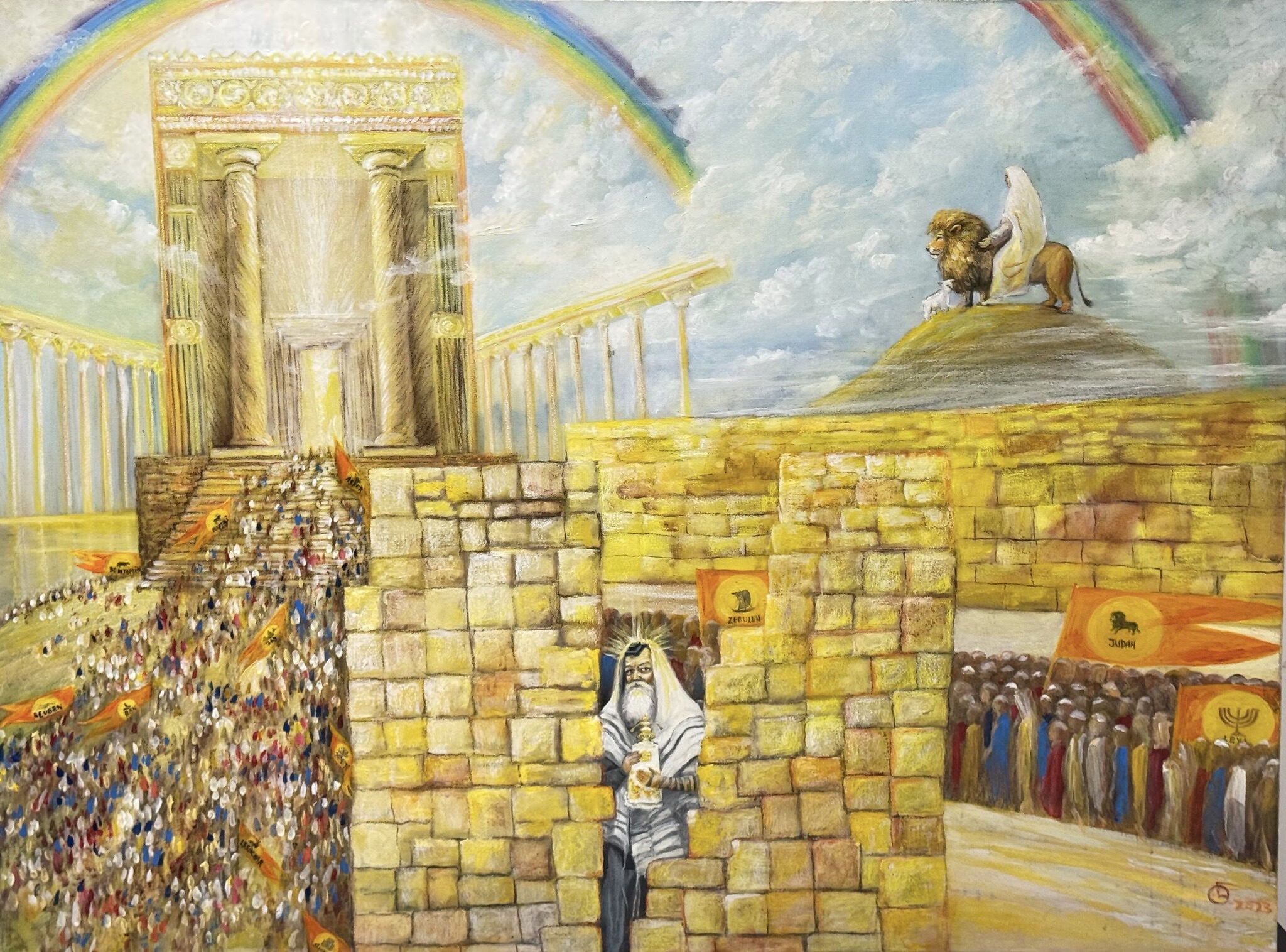
The vision of Creation does not end with Bereshit or the covenant of Noach. It continues through the prophetic vision of Yeshayahu. In Yeshayahu 11:6–9, the wolf dwells with the lamb, the leopard lies beside the young goat, and a small child leads creatures that once represented danger to one another. The lion eats straw like the ox, and throughout Hashem’s holy mountain, creatures neither harm nor destroy.
Jewish commentators have interpreted this prophecy differently. Rambam, in Mishneh Torah, Hilkhot Melakhim uMilchamot 12:1, understands the imagery allegorically, relating it to the peaceful condition of the messianic age. Ramban, in his commentary to Vayikra 26:6, offers a perspective more receptive to the restoration of peace within the natural order itself. My own theological reading gives particular weight to the possibility that the prophetic vision concerns not only political peace among human beings, but also the healing of humanity’s relationship with the animal world.
Across these sacred texts, a coherent theological movement emerges: Creation, preservation, and restoration. In Bereshit, animals enter the world before humanity. In the account of Noach, their preservation becomes part of the divine command, and they are included in the covenant. In Yeshayahu, the prophetic vision presents a world in which violence gives way to peace. Together, these texts provide a powerful foundation for a theology of compassion extending beyond the human community.
If humanity is created b’tzelem Elokim, what does that demand of us? Jewish tradition teaches the importance of walking in the ways of Hashem, vehalakhta bidrakhav. In Sotah 14a, Chazal explain this principle through acts of compassion: clothing the vulnerable, visiting the sick, comforting mourners, and burying the dead. These teachings address human obligations, but they also establish a wider ethical principle: divine compassion is something human beings are called to imitate.
The Torah already contains obligations concerning animal welfare, and the rabbinic principle of tza’ar ba’alei chayim recognizes the moral seriousness of animal suffering. Jewish Animal Chaplaincy builds upon this existing foundation. It asks how the spiritual responsibilities of human beings might be expressed in their relationships with companion animals, particularly in moments of vulnerability, illness, aging, separation, and death. This is not an attempt to invent ancient commandments where none exist. It is an effort to develop a contemporary pastoral practice rooted in authentic Jewish teachings.
The doctrine I am developing rests upon two interconnected ideas: Cultural and Theological Restitution and Tikkun. By restitution, I mean the recovery of spiritual meanings already present within Jewish sources but sometimes neglected in contemporary religious consciousness. By Tikkun, I mean the repair of attitudes and practices that have not always fully reflected those teachings. The purpose is not to accuse Judaism of lacking compassion toward animals. Such a claim would ignore the Torah’s own teachings and centuries of rabbinic concern for animal welfare. Rather, the purpose is to bring those teachings into fuller expression in modern Jewish life.
In practical terms, Jewish Animal Chaplaincy begins with recognizing the spiritual and moral significance of animal life within Creation. It calls for protecting animals from unnecessary suffering, honoring the responsibilities that arise through companionship, and offering compassionate pastoral support when beloved animals become ill, grow old, or die. It also recognizes the importance of remembrance: allowing individuals and families to honor the lives of animals that have shared their homes and affections. Such practices must be developed thoughtfully, without confusing contemporary pastoral care with established Jewish mourning obligations or claiming halakhic authority they do not possess.
I return, finally, to the image of the golden cat. On the fifth step of the throne described in Targum Sheni, the cat stands within an ordered vision of royal wisdom. In Pesachim, Rav Pappa recognizes its protective role. In Eruvin, Chazal recognize its capacity to teach. In Perek Shirah, the cat has its own place within the praise of Creation. And in Bereshit, we encounter the deepest foundation of all: the living world was precious to Hashem before human beings existed.
These sources do not tell every Jewish family that it must own a cat. They tell us something more fundamental. Animals have never been absent from Jewish spiritual thought. Perhaps what has sometimes been absent is our willingness to recognize how much our own tradition has already said about them.
The task of Jewish Animal Chaplaincy is to restore that recognition: not to abandon tradition, but to return to its sources; not to diminish the human soul, but to deepen the responsibility entrusted to humanity; and not to invent compassion, but to rediscover the compassion that has always belonged to the divine order of Creation.
For if Hashem’s compassion extends to all His works, ours should not end at the threshold of the human home.