The views expressed herein are solely mine.
Bahrain’s Silent Ride into Trump’s Arsenal
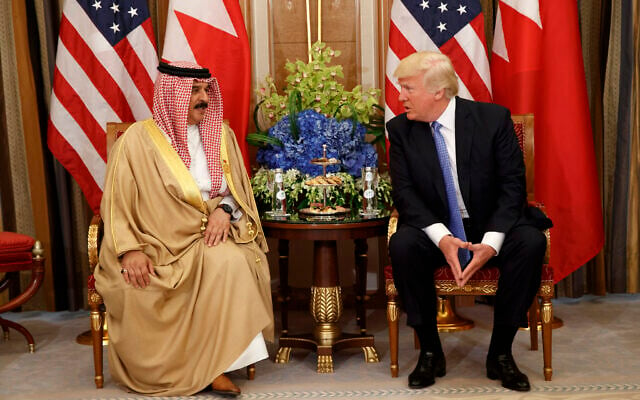
US President Donald Trump holds a bilateral meeting with Bahrain's King Hamad bin Isa Al Khalifa, Sunday, May 21, 2017, in Riyadh. (AP Photo/Evan Vucci)
Forget the polite diplomatic scripts.
Since Trump walked back into the Oval Office, Bahrain has quietly vaulted into one of the most aggressively upgraded U.S. allies in the Gulf—faster, deeper, and more strategically than anyone in Washington dares to admit.
What looks like “routine cooperation” is, in reality, a major geopolitical pivot: a tiny island turning into one of Trump’s sharpest instruments of power projection in Iran’s backyard.
The centerpiece is Bahrain’s acquisition of the F-16 Block 70—America’s newest, most lethal version of the fighter jet.
Clearly, these are not “symbolic toys”. They are the backbone of a new Trump-era balance of power, equipped with AESA radars, new mission computers, improved weapons packages, and survivability upgrades that RAND, CSIS, and IISS have all identified as game-changers for small states facing missile-rich adversaries like Iran.
Ergo, Bahrain is no longer buying equipment—it is buying deterrence and showing loyalty to America.
And this is not random.
Trump is stacking allies, not spreading them thin. He knows Bahrain is an unsinkable U.S. outpost—home of the Fifth Fleet, perched 20 miles from Iran, permanently exposed to Tehran’s drones and missiles.
Hence, strengthening Bahrain protects every U.S. operation in the Strait of Hormuz. It reinforces the Abraham Accords’ quiet intelligence-sharing arc. And it shuts the door on China’s creeping ambitions in Gulf ports and telecom networks.
Accordingly, this is classic Trump: fortify the allies who matter, ignore the ones who do not.
But the real dynamite is Bahrain’s internal reality—a Sunni royal family ruling over a Shia-majority population. That demographic fault line is not a side note; it is the regime’s existential weakness, and Iran’s favorite pressure point.
For years, Tehran has tried to radicalize Bahraini Shia groups, moving money, training cells, and pumping propaganda.
Scholars like Laurence Louër and countless State Department assessments have documented this chronic Iranian push to collapse Bahrain from within.
Evidently, Trump’s team knows the stakes: if Bahrain cracks, the entire U.S. Gulf posture caves with it.
The answer? Arm the monarchy to the teeth and deny Iran the vacuum it wants.
This is why the F-16s matter. Why the deeper U.S.–Bahrain cooperation matters. Why Bahrain’s role as an Abraham Accords signatory matters.
Patently, it is not about prestige—it is about blocking Iran, containing China, and stitching together a U.S.–Israel–GCC security triangle that keeps the region in America’s orbit.
Bahrain might look small on a map, but Trump’s second-term strategy has turned it into a forward-deployed fortress, an intelligence relay, a deterrence node, and a test case for how Washington chooses winners in a fractured Middle East. The academics see it, the military data proves it, and the geopolitics speak for themselves.
The island is not drifting. It is marching—quietly, deliberately—straight into Trump’s arsenal.
Related Topics