
Bangladesh Changes Governments, but Hindus Keep Losing Their Homes
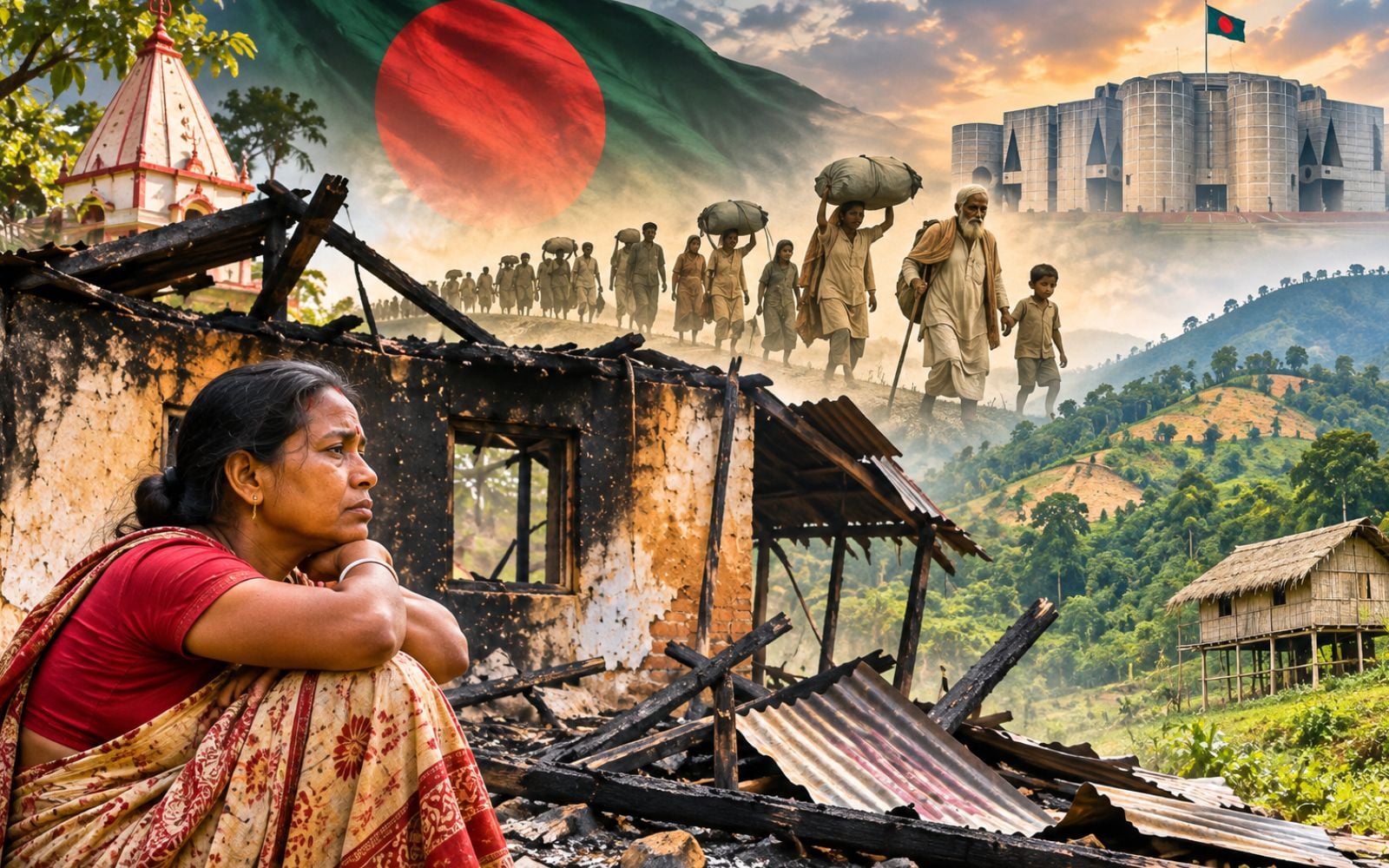
On November 20, homes burned in Narail, southwestern Bangladesh. The violence followed the killing of two men associated with the ruling Bangladesh Nationalist Party (BNP). According to local reports, between 20 and 30 homes linked to Awami League leaders and supporters were attacked or set on fire. One belonged to Krishnapada Ghosh, a Hindu politician and former local chairman.
A second battle began immediately. Social media posts claimed that hundreds of Hindu homes had been destroyed; local Hindu leaders disputed those accounts. Reports pointed chiefly to political retaliation, not a broad attack on Hindu neighborhoods. Yet the destruction of a Hindu family’s home was real. Political motive and minority vulnerability can coexist.
This is a recurring tragedy in Bangladesh. The Awami League and BNP compete for power while Hindu and other minority citizens struggle to protect their homes. Their suffering is repeatedly invoked in the fight for votes and international sympathy. Who will protect them when the headlines fade?
As former prime minister Sheikh Hasina says she intends to return from exile in India in December 2026, and Prime Minister Tarique Rahman’s BNP government faces fresh unrest, that question has renewed urgency.
Consider the numbers. In 1951, East Bengal, then part of Pakistan, had approximately 42 million people. Hindus represented about 22 percent, Muslims nearly 77 percent. In 1974, three years after independence, Hindus accounted for 13.5 percent of Bangladesh’s population of around 71.5 million.
By the 2022 census, Bangladesh had approximately 165.2 million people. About 13.1 million were Hindu, representing 7.96 percent; Muslims accounted for about 91 percent. The Hindu proportion had fallen from more than one in five to fewer than one in twelve.
The absolute Hindu population nevertheless grew. Migration, differences in birth rates, Partition and war all affected the changing proportions. The census alone cannot tell us how many people left under threat. Refugee history, however, shows that large-scale flight was real.
Historian Uditi Sen cites official estimates of 4.1 million to 5.8 million refugees who went from East Bengal to India between 1946 and 1970. Many were Hindu families escaping persecution, instability and dispossession. They left property, places of worship and family history behind.
The 1971 war caused an even greater exodus. Nearly 10 million people fled East Pakistan to India. A contemporary American government assessment estimated that 80 to 90 percent of those fleeing were Hindu. Many returned after independence; the refugee total is not a measure of permanent emigration. But it reveals how disproportionately Hindus were exposed to danger.
The legacy crosses generations. Biplab Kumar Deb, a former chief minister of the Indian state of Tripura, has said that his father migrated from what is now Bangladesh in 1967 and his mother in 1971. His family illustrates that upheaval, although migration alone does not prove why anyone left.
Hindus were not the only displaced people. In the early 1960s, the Kaptai Dam flooded ancestral land in the Chittagong Hill Tracts and uprooted tens of thousands of Indigenous residents. Many Chakma families eventually sought refuge in India. The cause differed, but the loss of ancestral land was familiar.
The fear of flight did not end in 1971. United Nations investigators recorded testimony that, after attacks in August 2024, an estimated 3,000 to 4,000 Hindus from affected villages sought refuge near the Indian border and were reportedly turned back. What does it say about citizenship when families believe safety may lie on the other side of a frontier?
Bangladesh was founded in 1971 with secularism as a constitutional principle. Yet Islam became the state religion in 1988. Hasina’s government restored secularism as a constitutional principle in 2011 while retaining the state-religion provision. The promise of equality still collides with religious and political power.
Land theft makes the problem tangible. The Enemy Property Act, later carried forward as the Vested Property Act, enabled the seizure of property particularly from Hindus. Although laws changed and restitution was promised, families have struggled to recover plots held by influential people. A lost homestead can become the reason children grow up across the border.
The BNP cannot escape its history. After its coalition won the 2001 election, Amnesty International documented attacks against Hindus perceived as Awami League supporters. Families reported threats, assault, sexual violence and property destruction. A supposed political preference became grounds for collective punishment.
The Awami League cannot claim that minority persecution disappeared under Hasina. Hindu homes and temples were attacked during unrest in 2013 and 2014 and during Durga Puja violence in 2021. Even when opposition groups or religious extremists were responsible, the government still had the duty to protect citizens and bring offenders to justice.
After Hasina was forced from office in August 2024, attacks on Hindu homes, businesses and places of worship again drew attention. Investigators found overlapping motives: religious prejudice, revenge against presumed Awami League supporters and conflicts over land. No political label can diminish the fear of a family whose house is attacked.
The danger continues. The Human Rights Support Society documented at least 56 attacks on minority communities during January–September 2026. Separately, the Bangladesh Hindu Buddhist Christian Unity Council reported 257 incidents in the first six months, including 44 killings. The organizations’ figures are not court findings, but demand investigation rather than dismissal.
I judge Hasina more favorably than many critics. In my view, she was among Bangladesh’s most consequential prime ministers, and her willingness to reach a political settlement in the hills distinguished her from predecessors. I also believe her secular political identity offered minorities an important counterweight to religious hardliners. That is not to pretend that everyone was safe during her administrations.
Her life has been marked by violence. In 1975, assassins killed her father, Sheikh Mujibur Rahman, and many members of her family. She survived because she was abroad and spent years in exile before returning in 1981. In August 2004, a grenade attack at an Awami League rally nearly killed her and left 24 people dead. She fled to India again in August 2024, after mass protests and a deadly crackdown that a United Nations investigation later linked to serious abuses by her government and security forces.
In southeastern Bangladesh, the Chittagong Hill Tracts(CHT) is home to Indigenous Jumma communities, many of whom are Buddhist, Christian, or follow other minority religions. Their struggle concerns ancestral land, cultural survival and political rights.
Hasina’s most important contribution there was the 1997 Chittagong Hill Tracts Peace Accord with the Parbatya Chattagram Jana Samhati Samiti (PCJSS). It offered a political route away from insurgency and promised regional institutions, rehabilitation and remedies for land disputes. Signing it required courage; implementing it meant confronting entrenched interests.
That work remains unfinished. State-sponsored settlement of Bengali Muslim families in the late 1970s and 1980s intensified disputes over Indigenous land. Even during Hasina’s long tenure, major questions about land restitution and local authority persisted. The BNP government says 65 of the accord’s 72 provisions have been implemented; Indigenous leaders argue that core promises remain unfulfilled.
On November 10, residents of Joysen Para in Khagrachhari said soldiers installed no-entry signs on land claimed by Indigenous Chakma families. Military officers said the restrictions were intended to preserve peace during a dispute. The residents saw another obstacle to working land they regard as ancestral property.
On November 21, police reported an exchange of fire between an army patrol and alleged armed PCJSS members at Machalong in Sajek, Rangamati. A PCJSS source denied its members were present. Indigenous sources alleged that soldiers fired blank rounds to create the appearance of a clash and justify an expansion of military camps. The competing accounts deepen a longstanding crisis of trust.
For Jumma families, peace is not simply the absence of gunfire. It means access to their fields, respect for customary rights and real authority under an agreement signed almost three decades ago.
Hasina’s experience and the peace accord still matter to Bangladesh’s future. But neither nostalgia nor a BNP victory can replace functioning institutions. No one leader can return every stolen acre or ensure every officer protects the law rather than political interests.
This is not an accusation against all Bangladeshi Muslims. Muslim neighbors, journalists and activists have defended minorities, sometimes at personal risk. The central failure is impunity: powerful people can exploit religious prejudice and political rivalries to seize property or silence families they consider vulnerable.
Tarique Rahman’s government must protect a Hindu household even if its members support the Awami League. Hasina and her party must acknowledge the abuses that occurred on their watch. Both sides should be judged by prosecutions, the return of stolen land, protection of worship and meaningful implementation of the Hill Tracts accord.
For international readers, including in Israel, the question is not which party can produce the most shocking photograph. It is whether a victim can recover a home, whether a child can worship freely and whether an Indigenous farmer can cultivate ancestral land without fear.
Millions once crossed into India seeking safety. Some returned, while others rebuilt their lives in exile. But displacement from Bangladesh has not ended. Hindu families and other minorities continue to face insecurity that forces some to flee their ancestral homes.
On November 20, 2022, hundreds of Indigenous Bawm people fled the Chittagong Hill Tracts for India’s Mizoram state amid military operations. Further displacement followed in April 2024. Some have returned, while others remain displaced. More than half a century after independence, Bangladesh’s minorities still struggle for the right to live safely in their own homeland.
Today, Bangladesh is facing another serious crisis. Political violence, killings, arson and growing insecurity have shaken public confidence. Factory closures and labor unrest have disrupted livelihoods, while religious and Indigenous minorities continue to fear attacks on their homes, places of worship and ancestral land. The country urgently needs stability, economic recovery and the restoration of law and order.
In my view, Sheikh Hasina remains central to finding a way out of this crisis. Despite the failures of her government, her political experience, secular outlook and historic role in the Chittagong Hill Tracts Peace Accord cannot simply be erased. I believe her return to the political process offers Bangladesh an important opportunity for reconciliation and stability. But lasting peace will require accountability, the protection of minorities and institutions that serve every citizen, regardless of political loyalty.
A government changing hands is not proof of freedom. Bangladesh has changed rulers repeatedly since independence, yet its minorities continue struggling for security and equal rights. The country does not need another political victory built on fear and revenge. It needs peace, justice and leadership capable of bringing a divided nation together.
For me, Hasina’s return is an essential part of that answer. But the ultimate test of any government is whether Bangladesh’s smallest communities can trust the law more than the party in power.
November 23, 2026
Tokyo, Japan