The views expressed herein are solely mine.
Featured Post
Barghouti is a loaded gun Israel cannot ignore
Releasing the imprisoned Fatah terrorist could resurrect diplomacy, or spark a deadlier uprising and sell Israeli concessions as proof that violence works
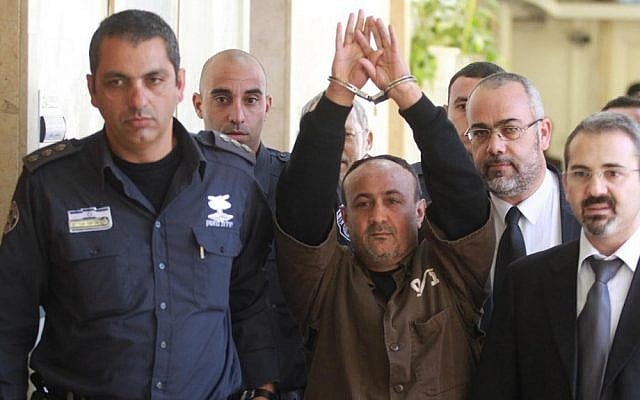
Fatah terror chief Marwan Barghouti, serving five life terms for murder during the Second Intifada, is escorted by Israeli police into Jerusalem's Magistrate Court to testify as part of a US civil lawsuit against Palestinian leaders, in January 2012. (Flash90)
The Arab-Israeli conflict is dead. Today, the UAE, Bahrain, Morocco, Egypt, Jordan, and Saudi Arabia coordinate openly with Israel, while the old pan-Arab slogans gather dust. Unmistakably, the region has entered a post-Arabist era powered by tech, defense alliances, and a shared fear of Iran – not daydreams about “freeing Palestine.”
The only dispute still alive is the one the Arab world walked away from years ago: the Palestinian arena. And into that void steps the most formidable detainee Israel has held in two decades: Marwan Barghouti. His supporters brand him as a “Palestinian Mandela”. Nonsense. Mandela rejected violence; Barghouti orchestrated it. Yet he cannot be compared to Arafat or Abbas. He is neither tainted by corruption nor sidelined by irrelevance, and he retains broad public credibility.
Barghouti is undoubtedly the only Palestinian figure with genuine cross-faction legitimacy – Fatah cadres, street militias, and the disillusioned youth who view the PA as a cartoonish kleptocracy. That is exactly why he is a geopolitical live wire.
The Palestinian system is shattered: the PA is imploding, Hamas worships death, and the West Bank is dissolving into TikTok militias. No one on the Palestinian side can negotiate or enforce anything except, potentially, Barghouti.
Barghouti could undoubtedly unify the Palestinian arena, crush Hamas’s grip, and impose order where chaos reigns. That is why many in Washington and Europe whisper that only a Palestinian strongman – not a Western-funded bureaucrat – can enforce any deal. And Barghouti is the only figure with that kind of weight.
But here lies the danger: a strongman can enforce compromise – or he can impose extremism. This is precisely the part his wife avoids acknowledging when she publicly demands his release. Thus, Barghouti could resurrect diplomacy, or he could ignite a deadlier uprising and sell Israeli concessions as proof that violence works.
If he walks free under foreign pressure, he will become a mythic figure of “victorious resistance.” Hence, Israel cannot afford another militant elevated into a “political messiah.”
Dangerous, unpredictable, popular
Forget Arab intervention. They have already cashed out. The conflict is now stripped down to its core: Israel versus a fractured, radicalizing Palestinian arena. And at the center of the next chapter – stability or explosion – stands Barghouti.
Yet even in this landscape, Barghouti’s relevance becomes clearer when contrasted with Mohammed Dahlan – arguably the Palestinian candidate Israel and the West would prefer. Dahlan knows Israel, speaks fluent Hebrew, currently serves as an advisor to the UAE leader, and understands the security architecture better than any Palestinian figure of his generation. But none of that translates into legitimacy. Dahlan is respected in foreign capitals, not in Palestinian streets.
Barghouti is the inverse: dangerous, unpredictable, but undeniably popular. And in a political arena where legitimacy – not affinity – determines who can actually enforce order, Barghouti emerges as the more viable actor, though far from an ideal one. Evidently, he is not a solution. He is a geopolitical gamble with nuclear-level uncertainty. But, he is the last strongman Palestinians still believe in, which makes him valuable – and profoundly dangerous.
For this reason, Israel and the West must treat him not as a savior but as a high-risk bet that could reshape the conflict for decades. Unfortunately, history does not always offer choices; sometimes it dumps a gamble on your lap. Marwan Barghouti is that gamble – and Israel must handle him like one.
Related Topics