
Middle East Analyst
Barghouti’s Release: Calculated Gamble or Strategic Pivot
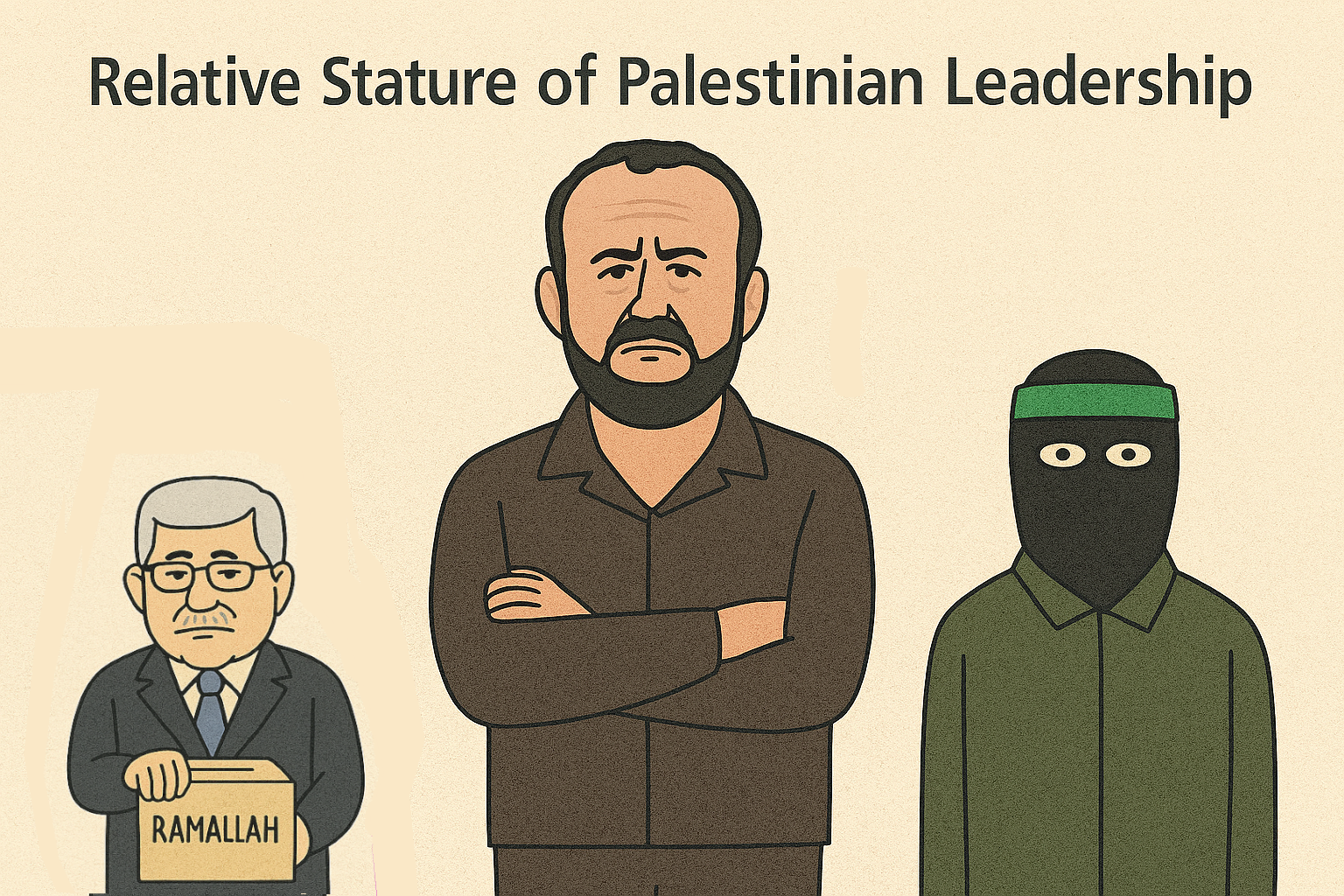
Cartoon by author and Copilot AI
As the Trump peace architecture enters its decisive phase—with Israeli security concerns at its core—one name continues to surface with growing resonance: Marwan Barghouti. Imprisoned since 2002 for orchestrating attacks during the Second Intifada, Barghouti remains the most widely supported figure in Palestinian politics. His symbolic weight—rooted in resistance credentials and political durability—positions him uniquely to bridge a fractured Palestinian landscape that no current leader can unify.
President Trump confirmed last month that he is “considering Barghouti’s release,” telling TIME that a decision “will be made soon.” Barghouti’s wife and son have met with US envoys and members of Trump’s foreign policy circle, framing his release as a potential restart of Palestinian political consolidation. The Elders—a network of former world leaders—issued a statement urging his release to “unlock Palestinian unity and credible negotiation.”
Polling from the Palestinian Center for Policy and Survey Research (October 2025) shows Barghouti commanding 49% support in a three-way presidential race, compared to 36% for Hamas’s Khalid Mishal and just 13% for Mahmoud Abbas. In a two-way contest, Barghouti defeats Mishal 58% to 42%. Abbas received less than a third of Mishal’s support and a quarter of Barghouti’s. His diminished stature is reflected not only in numbers, but in public imagination. Among younger Palestinians, Barghouti’s appeal rests on perceived authenticity, resistance legacy, and political maturity.
That same popularity, however, is what makes Barghouti a source of deep concern in Israel. His record in the Second Intifada is seared into national memory; his release could galvanize mass mobilization, reenergize militant networks, and shift the Palestinian political center of gravity away from more controllable actors. For many in the Israeli security establishment, Barghouti is not a bridge but a destabilizing force—one whose symbolic potency could disrupt the containment architecture now being built around Gaza.
And yet, the region is offering a precedent worth analytical attention—not as a model, but as a lens. Ahmed al-Sharaa, Syria’s interim president and former commander of Hay’at Tahrir al-Sham, was once designated a terrorist by both the US and Israel for his ties to al-Qaeda. Today, after years of internal fragmentation and regional pressure, he is being cautiously engaged by both governments—not because Syria has been demilitarized, but because his leadership now operates within a tightly contained, internationally monitored framework. Trump met with Sharaa in Riyadh earlier this year and will host him at the White House on November 10—the first visit by a Syrian leader in more than 80 years. Israeli officials have quietly opened limited coordination channels with Sharaa’s transitional government, recognizing that under strict oversight, even former militants can become stabilizing actors rather than perpetual spoilers.
Barghouti shares certain traits: mass legitimacy, symbolic authority, and the ability to bridge militant and technocratic constituencies. But his potential reemergence would have to be structured within a tightly sequenced, benchmarked framework. Verified Hamas disarmament would come first—complete, irreversible, and monitored. Barghouti would have to publicly accept and advocate for the Trump 20 Point Peace Plan. Only after such benchmarks are met could a phased political reintegration process be considered, backed by regional endorsement and grounded in Israeli security guarantees.
This would not be a reward for past violence, but a strategic pivot designed to consolidate a demilitarized Palestinian politics under a unifying figure. For Israel, the calculation is not about trust; it is about leverage—using one prisoner’s symbolic value to reshape the political battlefield that Hamas currently dominates. Whether that leverage is accepted or vetoed remains an open question.
The opportunity is real. So are the risks. Barghouti’s release could transform a stalled process into a credible framework—or reignite old fault lines under new banners. The question is not whether Israel should trust him, but whether it can design an architecture strong enough to contain him.
Related Topics