
Israel Paralympian Silver Medalist, Adaptive Sport Thought Leader
Battle of the classes
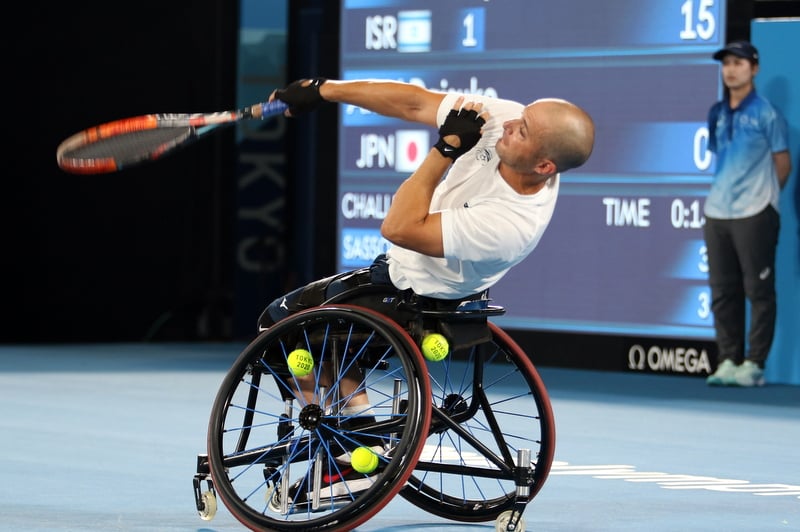
Guy Sasson, world number 3 in quad wheelchair tennis and Paralympic bronze medalist (Keren Isaacson)
Just the other day, in a heavily promoted event in Dubai (note to self – the rebranding of the United Arab Emirates as a world leader in hosting huge sporting events and its effect on the world of competitive sports is worth a separate blog post), the world number 1 female tennis player, the mighty Aryna Sabalenka, took on the retired former world number 13 male tennis player, Nick Kirgios, in front of a sold out arena full of celebrities and Arab sheikhs.
The purpose of the event was pure entertainment and a very unnecessary reconstruction of the famous 1973 version in which Billy Jean King defeated Bobby Riggs in what became a milestone in the development of modern women’s tennis.
The event, not a match, was (very partially) fun to watch, and made a lot of money for both players, but its underlying message is good old misogyny and distortion of the very idea of sports: competition in fair terms.
I am even somewhat disappointed with Sabalenka for agreeing to take part in this circus. I hope they paid her very well. It was a lose-lose situation for women’s tennis – if Sabalenka had won, they would say Kirgios is a retired and injured player currently ranked 671 in the world. Now that she has lost, they say – see, men’s tennis is better.
It is even more frustrating because women’s tennis today, with four different grand-slam winners in 2025, is a much better and more interesting and competitive product than men’s tennis.
It reminds me of a question many ask when they see a good wheelchair tennis player – will he or she be able to beat a standing player? My answer is always the same – he would, if the other guy is also sitting in a wheelchair.
Not saying Sabalenka is similar in any way to a disabled player, In fact I think that wheelchair tennis is the most beautiful and skillful version of the game, just making the point that sports wouldn’t exist without fair competition. I personally prefer watching Sabalenka play (when wheelchair tennis isn’t on) to any gentlemen’s match any day.
While not perfect, the Paralympic world’s core value is fair competition and the primary tool used to strive towards that fairness is the classification system. In the Dubai match they tried to level the playing field by using a smaller court and one serve, but that was just a gimmick. In Paralympics, the eternal pursuit of fair competition is reflected in decades-long debates and discussions on classification and constant changes to the classification system of each sport with the purpose of promoting a competition that’s fair.
Classification is an entire world and at the Israel Parasport Center, we treat classification as a crucial pillar of success, investing meticulous resources and world-renowned expertise into medical and functional evaluations that can take months to complete.
The goal of proper classification in Paralympic sports is not only to honor the spirit of fair competition, but also to give every person with a disability the sense that there is a world where the playing field is truly level – where they can pursue their dreams and reach their fullest potential, even on the international stage.
Did Kirgios win the game eventually? Yes he did.
Is Kirgios a better tennis player than Sabalenka? No, he is not. She is the world’s best female player, who has perfected her elegant and graceful tennis to a level of art, and he is the former world no. 13 male player, current no. 671, mostly infamous for being a trash talker. He is not even close. He was just playing in the wrong class.
Related Topics