


Israel Paralympian Silver Medalist, Adaptive Sport Thought Leader
Be Careful What You Wish For: Paralympic Sport at a Crossroads
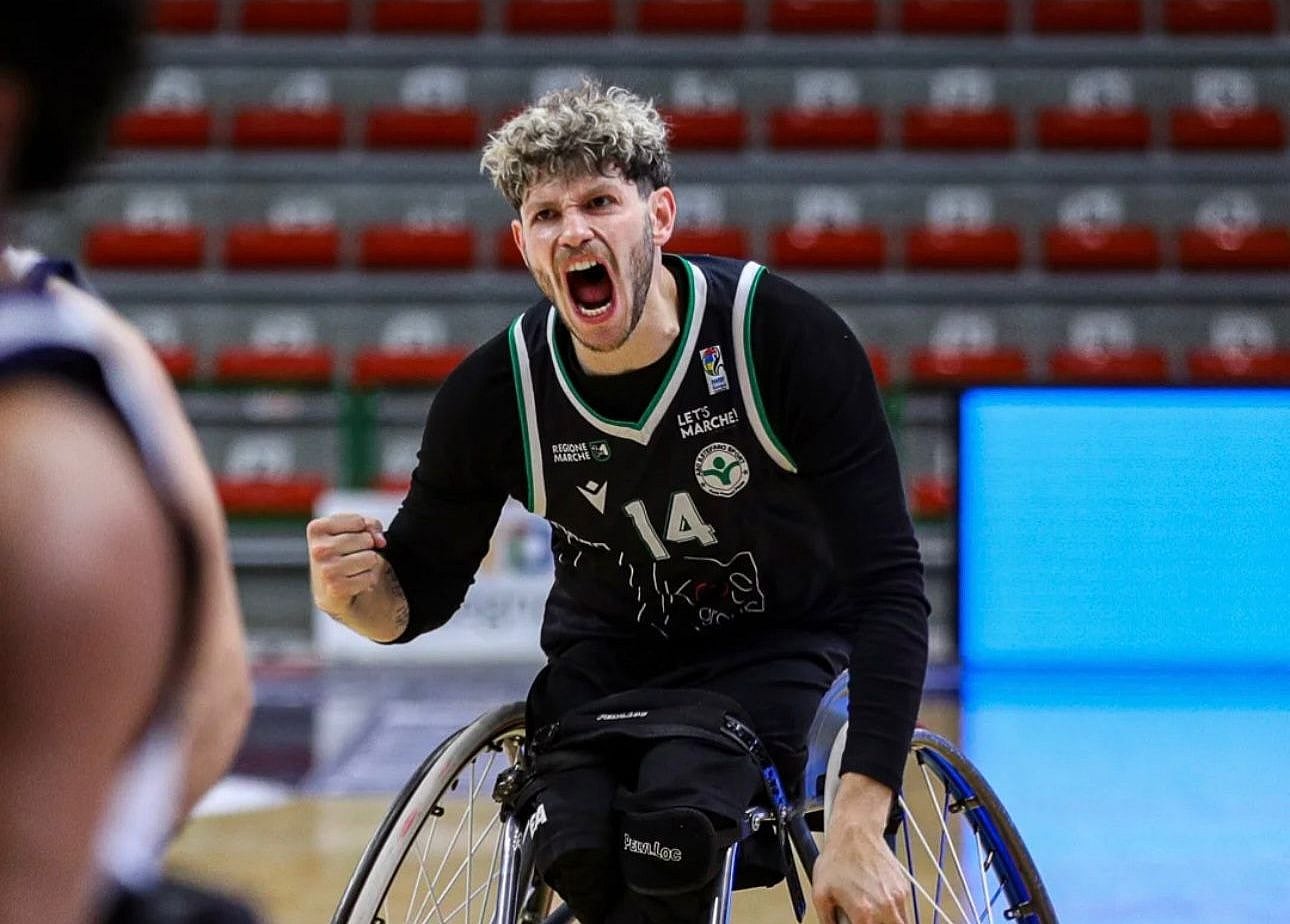
Israeli wheelchair basketball player Amit Vigoda playing in team Santo Stefano in Italy last year before moving on to play for Hannover United in Germany. From Amit Vigoda's personal collection.
When rehabilitation expert and the Jewish (what else would he be?) Sir Ludwig Guttmann initiated the first Stoke Mandeville Games (the precursor to the Paralympics) for British war veterans in the late 1940s, I don’t think he imagined that, two and a half decades into the 21st century, the Wimbledon Wheelchair Tennis Championships would offer a record £82,000 in prize money for the winner, while more than 12,000 paying spectators filled Court No. 1 at the All England Club to watch Japan’s Tokito Oda lift the trophy after defeating local star Alfie Hewett.
This is very different than when I played wheelchair tennis – and this is merely 10-15 years ago – when professionalism was only emerging. Prize money was modest, we usually used it to upgrade ourselves to single hotel rooms instead of sharing, and the very few spectators were usually in one way or another, forced to be there. In the good cases it was school kids. In the weird cases it was Chinese prisoners. It’s a long story I’ll have to tell another time.
I also doubt the legendary Dr. Guttmann could have pictured the brutal wheelchair basketball player market that takes place every summer between seasons. Across Europe, clubs scout players, make offers, negotiate contracts and compete with one another during an increasingly sophisticated and intensely competitive summer transfer window.
In a handful of countries, wheelchair basketball has effectively become a professional sport. Players make a living from playing. It isn’t LeBron James money, but it is real money and it is changing the game.
This is good news, right?
Finally, wheelchair athletes are receiving the recognition, compensation and attention they deserve. Paralympic sport is becoming more visible, more attractive and more commercially viable. Athletes are becoming professionals, events are attracting spectators, media are paying attention, fans are following teams and players. After decades of fighting for legitimacy, perhaps Paralympic sport is finally getting there.
But this slow and steady metamorphosis comes with a cost.
And it raises an important question that has been sitting at the heart of Paralympic sport since its beginning: What is the purpose of Paralympic sport? The competition? The participation? In Guttmann’s original vision, the answer was straightforward: both.
The innovative Stoke Mandeville Games were born out of rehabilitation, but they were never only about that. Guttmann understood the power of sport to provide people with disabilities with something much bigger: physical activity, recreation, social connection, achievement, competition and even more importantly, a different way of seeing themselves.
Over time, however, the competitive element has become increasingly dominant: As classification systems developed, competitions became more sophisticated, and international events became larger and more prestigious, parts of adaptive sport have gradually transformed into elite sport, and elite sport has its own set of rules.
It rewards talent, it rewards training, it rewards professional support, money, time, access to facilities, coaching, technology and sophisticated sports science.
While doing that, it also inevitably leaves people behind.
Just as in non-disabled sport, not everyone who wants to compete can become an elite athlete. But in Paralympic sport there is an additional complication: some of the people being left behind are precisely those whom the system was originally created to include.
An athlete with a more significant disability may struggle to compete even within the boundaries of the classification system. It is simply what happens when sport becomes sport. Elite sport is, by definition, exclusive.
And perhaps that is where the identity crisis begins.
In many ways, this is exactly what we have been fighting for. We wanted wheelchair tennis to be played on Wimbledon Centre Court; We wanted Paralympic athletes to be professionals; We wanted spectators to buy tickets, broadcasters to compete for rights, sponsors to invest and clubs to fight over the best players; We wanted the athletes to be seen first and foremost as athletes. Now, some of that is happening.
But the more successful we become at building elite Paralympic sport, the less space there may be for the people who were never going to become elite Paralympic athletes.
So maybe the future of Paralympic sport is not about choosing between participation and excellence. Maybe it is about building a system in which excellence sits at the top without swallowing everything underneath it.
A system where a Tokito Oda can play in front of a full house at Wimbledon and where someone with a much more significant disability can still find a place to compete; a system where professional wheelchair basketball can have transfer markets and salaries while wheelchair basketball remains accessible to the person who will never be good enough to earn a salary from it; a system where winning a Paralympic medal is the cherry on top, but not the definition of what Paralympic sport is.
And while celebrating the jaw-dropping performance of the elite Paralympic sports, we must make sure we never forget why it exists in the first place.