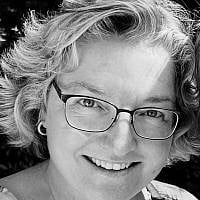
Beauty Queen Fighting Antisemitism With Joy and Pink Dresses
Picture this: Times Square. The usual chaos of Elmo demanding tips, tourists photographing billboards, street performers battling for attention. And then — a woman in a hot-pink dress with an oversized Star of David necklace, surrounded by children of all backgrounds, including Muslim kids, begging for photos like she’s stepped out of a Disney movie.
This isn’t a publicity stunt. This is Ayelet Raymond’s life.
You might know her as Kosher Barbie. Or Miss Israel 2025-2026. Or Miss World Influencer. But what matters most is what she’s doing in a moment when Jewish visibility in America increasingly feels like a risk: she’s making antisemitism lose its power through sheer, unapologetic joy.
A Particular Kind of Exhaustion
There is a particular exhaustion that settles into the Jewish soul when hatred becomes ambient noise. Since October 7, that exhaustion has deepened into something heavier: grief layered with vigilance. We explain ourselves carefully. We cite facts meticulously. And still, antisemitism keeps rising — on college campuses, in social media comment sections, on city streets that once felt safe.
The instinct for many has been to soften our edges, to clarify endlessly, to make ourselves smaller and less threatening.
Ayelet Raymond has chosen a different response. Not denial. Not silence. Not retreat.
Joy.
Not Here to Blend In
“I live in the US with a thick Israeli accent, and I’m not trying to hide it,” she tells me when we sit down to talk. “I’m not here to blend in — I’m here to represent.”
Read that sentence again. At a time when saying you’re Israeli can attract immediate hostility — when Jewish students are advised to hide their identity “for safety” — she leads with her Israeli identity.
And she’s under no illusions about what that means.
“When I say I’m Israeli or from Israel, the word Israel is already connected to politics. It attracts hate or criticism,” she says matter-of-factly. She knows the risk. She chooses visibility anyway.
“I feel the necessity for Israeli voices in the United States in the rise of antisemitism — rising up so much against Jews.”
When influencers with massive platforms spread misinformation about Israel, she doesn’t respond with rage or carefully crafted rebuttals. She responds with something far more powerful: authenticity.
“I advocate for Israel to bring smiles on people’s faces,” she says simply.
Not to win arguments. Not to shame critics. To bring smiles.
The Context That Makes This Matter
Ayelet understands something crucial about the current moment. “We see so much false information about Israel on the media — even from supermodels or influencers.” She pauses, then adds something that puts the challenge in perspective: “They have more followers than entire Jewish populations in the world.”
Jews are a minority. Israelis are a minority within a minority. And yet the expectations placed on them — to explain, justify, apologize — are limitless.
Ayelet’s response is not to argue harder, but to connect differently. To show up as fully herself.
From Ultra-Orthodox Jerusalem to Beauty Queen
Ayelet’s story refuses to fit any expected narrative. “I grew up in an ultra-Orthodox Hasidic family community in Jerusalem.”
For many, that would have defined the boundaries of their entire life. For her, it was just the beginning.
“And here I am as a beauty queen — not just for being a model or showing my body, but to show Israeli beauty.”
And by “Israeli beauty,” she doesn’t just mean physical appearance. She means the culture itself — the directness, the warmth, the emotional honesty.
“If I like somebody, I say I like you. If I don’t like, they will understand I don’t like,” she says with characteristic Israeli straightforwardness. “We’re very straightforward. We don’t play games. It’s not about being rude — but there are beautiful things about being Israeli.”
That authenticity — that refusal to perform for the comfort of others — is exactly what makes her advocacy cut through the noise. There’s no corporate polish, no carefully calibrated messaging designed to offend no one. Just presence. Just herself.
And a crown that makes a statement.
A Crown With Meaning
When Ayelet talks about her crown, her voice changes. “This crown is very dear to my heart.”
It should be. “It’s the first-ever beauty queen crown in the world to show Israel’s Star of David.”
Think about the timing. Jewish symbols are being torn down on college campuses. Jewish students are removing their mezuzahs from dorm room doors. Visibly Jewish people are being advised to hide their identity in certain neighborhoods.
And Ayelet Raymond is wearing a Star of David on her head. On the global pageant stage.
Not as defiance. As identity.
“It shows the community of the Jewish nation — Israelis caring for each other,” she explains.
Why the Kosher Barbie Persona Works
The Kosher Barbie aesthetic — pink dress, oversized jewelry, unapologetic Jewishness — could easily be dismissed as gimmicky. It could be written off as shallow.
Until you see what actually happens when she walks through Times Square.
“When I walk with the Kosher Barbie dress in Times Square, I have even Muslim kids running after me for pictures,” Ayelet says. “They look at me like I’m a Disney princess.”
Read that again.
In a moment when Jewish identity is constantly framed through the lens of conflict, tragedy, and tension, she’s reframing it as something else: human. Joyful. Accessible. Something children instinctively respond to.
“Barbie can feed everybody if you put a smile on people’s faces,” she says with a laugh, but the point is serious.
“I like to say it’s pro-Semitism — Jewish joy, resilience, being a proud Jew. Loud and proud.”
She’s not denying that hatred exists. She’s refusing to let hatred define the entire interaction. She’s refusing to let hatred set the terms of engagement.
Beauty Queen Meets Reality
Don’t mistake the pink dress for escapism. Ayelet is brutally honest about what she carries beneath the costume.
“People think beauty queen — I don’t dream about castles,” she says, leaning forward. “I wake up for urgency and emergency. Another call for the community.”
She volunteers with hostage families. She wakes up to news of terror attacks. She carries the horror stories from October 7. She lives the tension that every diaspora Jew knows right now — how to balance profound grief with the necessity of showing up, of continuing to represent joy even when your heart is breaking.
“It’s hard with all the horror stories about October 7. So much sadness. So many terror attacks and challenges,” she acknowledges. “I’m trying to put a smile on people’s faces, but also waking up and working and volunteering with hostage families.”
This is not performance activism conducted from a safe distance.
“This is real life,” she says quietly.
What Joy Can Do That Arguments Can’t
Here’s what Ayelet understands that much of the Jewish advocacy world has forgotten: how we show up matters as much as what we say.
At a time when Jewish advocacy often gets reduced to outrage cycles and defensive statements — press releases, carefully worded responses, fact-checking threads that few people read — Ayelet is offering something different. Not better arguments. Not louder protests. Not more data.
Joy.
“We don’t need a reason to smile,” she says, her voice softening. “Waking up in the morning and being able to open our eyes — that’s a blessing of life.”
It sounds almost too simple. But it’s actually revolutionary.
In a media landscape where influencers with audiences larger than the entire global Jewish population spread misinformation, Ayelet is changing the emotional temperature of the conversation. She’s reminding people — including Jews ourselves — that we are not just a headline. Not just a tragedy. Not just an intractable conflict.
We’re a people who carry resilience, creativity, warmth, and humanity wherever we go.
The Message America Needs
“America is about immigrants. It’s about multi-cultures,” Ayelet reminds me. “And that’s why Jewish voices are so important.”
She’s right. This country was built on the premise that you don’t have to choose between your heritage and your home. That your thick accent, your distinctive identity, your refusal to blend seamlessly into some imagined monoculture — these aren’t problems to be solved. They’re contributions to be celebrated.
Ayelet Raymond isn’t trying to win debates with antisemites. She’s not interested in converting people who are committed to hating Jews.
She’s doing something more subversive than that: she’s living joyfully, visibly, unapologetically Jewish in the most public spaces imaginable.
And in Times Square — the crossroads of the world, where every nation and culture passes through — kids of all backgrounds are running after her for photos.
They’re not running because they’ve been convinced by arguments. They’re running because she represents something they instinctively recognize: someone comfortable in their own skin, confident in their identity, radiating something positive they want to be near.
Ayelet Raymond is not trying to win debates. She’s changing the emotional temperature of the room. She’s reminding the world that Jews are not just a conflict or a cause — but a people who carry resilience, creativity, and humanity with them wherever they go.
And right now, that might be one of the most radical acts of all.