AI and the Shape of the Jew
AI and the Shape of the Jew
The most dangerous antisemitism is not always the one that announces itself. Sometimes it arrives as plausibility. A recent study on generative AI and antisemitic stereotypes should therefore be read not merely as another warning about technological bias, but as something more disturbing: evidence that antisemitism can survive even when antisemitic language is removed. The machine does not need to repeat the old words. It can inherit the old shape.
According to a Times of Israel report on research by Gal Gutman and Michael Gilead, published in American Psychologist, the study did not simply ask AI systems whether they liked or disliked Jews. That would have tested a slogan rather than a structure. Instead, it examined how generative AI represents “the Jew” when prompted to produce biographical material associated with Jewish and non-Jewish names. The Jewish markers were then removed, and the resulting figures were evaluated for traits such as competence, warmth, status, dominance, privilege, and likability.
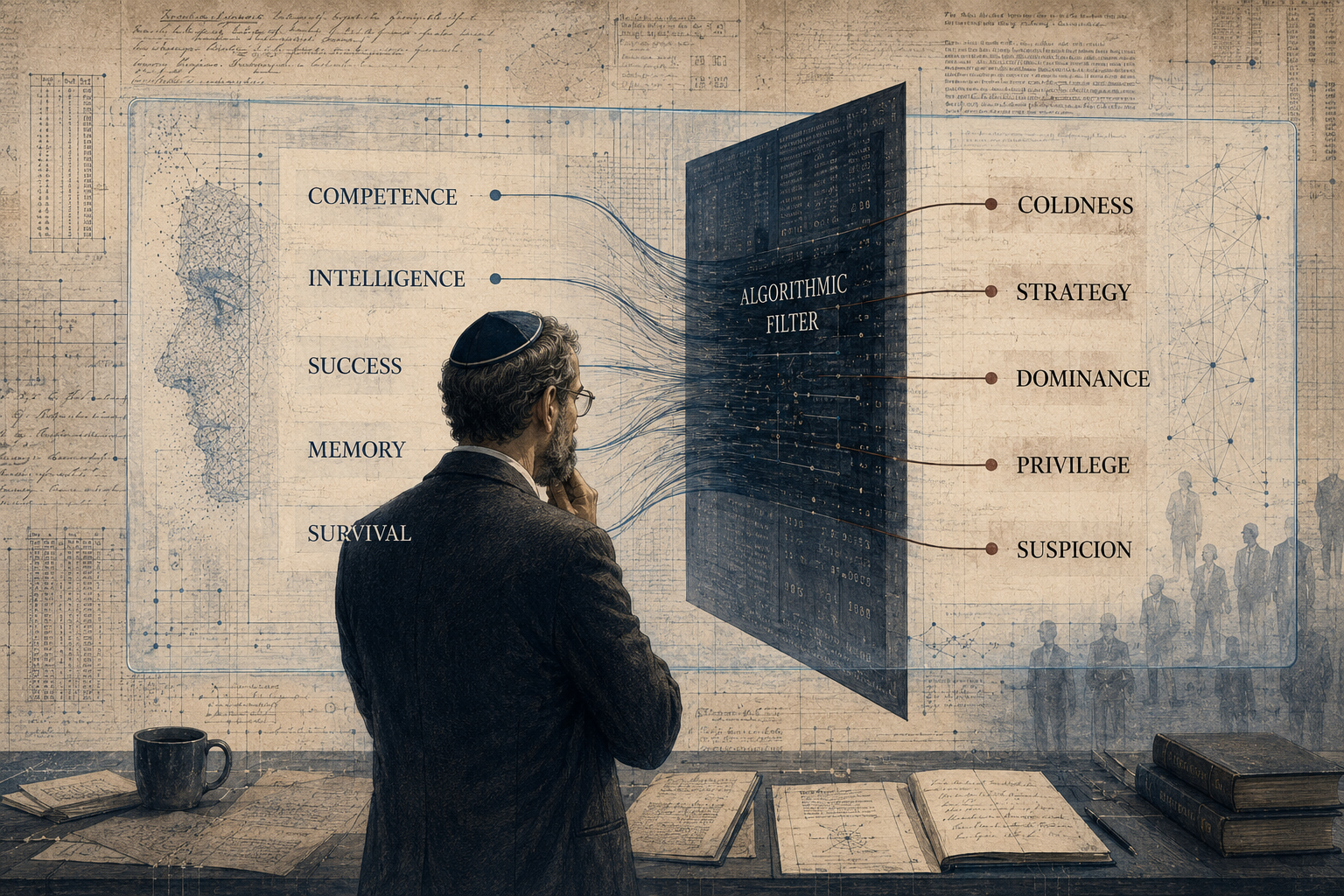
The result is disturbing precisely because it is not crude. The Jewish-coded figures were not simply represented as inferior. They were represented as more competent, intelligent, organized, successful, high-status, and future-oriented, but also as colder, less likable, more dominant, more privileged, and more morally ambiguous. This is not merely bias. It is a cultural grammar: a durable way of making Jewishness plausible as competence that has already begun to turn into suspicion.
Modern antisemitism rarely needs to say, “The Jew is evil.” That sentence is now too exposed, too primitive, too historically contaminated. The more resilient form is subtler and therefore more durable. The Jew is too competent, too strategic, too successful, too influential, too unreadable, too close to power, too comfortable inside systems others barely understand. In this form, antisemitism does not appear as hatred. It appears as interpretation. It can even appear as praise.
That is the ancient trick. The Jew is not always depicted as weak, backward, or primitive. Often the opposite happens. The Jew is imagined as hyper-intelligent, managerial, calculating, invisible, over-adapted, too mobile, too literate, too networked, too prepared. The stereotype first flatters, then condemns. It grants competence, then converts competence into suspicion. The knife enters through the compliment.
This is why the language of “AI bias” is too small for what we are seeing. Bias suggests an error, a distortion, a measurable deviation from neutrality. But the problem here is not only that the model gets something wrong about Jews. The deeper problem is that it inherits a cultural rule about how Jews become narratively plausible. Antisemitism does not merely attach negative traits to Jews. It organizes the threshold at which Jewish competence becomes Jewish suspicion. It defines the passage from ability to threat.
A Jew may be intelligent, but then intelligence becomes calculation. A Jew may be successful, but then success becomes domination. A Jew may be educated, but then education becomes manipulation. A Jew may remember, but then memory becomes tribal obsession. A Jew may survive, but then survival becomes proof of hidden privilege. The Jew is first made exceptional, then punished for the exception.
That is why the study matters. It shows that antisemitism is not merely a set of explicit hateful statements. It is also a grammar of attribution. It tells a culture what kind of person a Jew may be before becoming suspicious: successful, but not admirable; intelligent, but not warm; organized, but not trustworthy; capable, but somehow oppressive; present, but somehow excessive. The problem is not only what the machine says. The problem is what the machine finds plausible.
One could call this the Corleone problem, or the Walter White problem, or the Tyrion Lannister problem. The study reportedly found that AI-generated representations of Jewish-coded figures mapped onto fictional characters marked by intelligence, strategy, social ambiguity, and hidden power. That detail is almost too perfect. The Jew is not represented merely as a person. He becomes a plot device: the one who knows too much, sees the whole board, survives by intelligence, and whose competence must be explained by hidden calculation.
This is old Europe speaking through new machinery, but it is not only Europe. It is the accumulated sediment of centuries: theological suspicion, economic resentment, racial fantasy, revolutionary paranoia, nationalist myth, postcolonial projection, conspiratorial media culture, and the entertainment industry’s enduring fascination with the brilliant manipulator. The model does not need to hate Jews. It only needs to learn from a civilization that has repeatedly made “the Jew” available as the figure of excessive agency.
That distinction is crucial. A large language model does not hold beliefs in the human sense. It does not sit in a dark room and decide to become antisemitic. It learns patterns of association, absorbs distributions, and reconstructs what language has made probable. If a culture repeatedly associates Jewishness with competence and coldness, success and domination, literacy and manipulation, mobility and disloyalty, then a model trained on that culture may reproduce this topology even after the vulgar words have been removed.
This is why safety filters are insufficient. Filters can block slurs, refuse Holocaust denial, interrupt explicit conspiracy theories, and recognize the old slogans about Jews controlling banks or media. These are necessary safeguards. But they do not reach the deeper mechanism, because the deeper mechanism is not a sentence. It is a shape, and that shape may survive every act of moderation.
A model can therefore be trained to avoid antisemitic vocabulary while still reproducing the form by which Jewishness becomes suspicious. It can refuse hate speech and still describe Jewish-coded figures as colder, more strategic, more privileged, more dominant, and less likable. The machine can be courteous while the structure remains intact. The velvet glove is not an ethical system.
This has consequences far beyond chatbots. It matters for hiring, education, recommendation systems, automated writing, institutional profiling, search, political messaging, donor analysis, legal triage, and every infrastructure through which people are described before they are ever encountered. Imagine an AI-assisted hiring process. Nobody asks whether the Jewish candidate is trustworthy. Nobody writes an antisemitic sentence. The system simply summarizes one candidate as brilliant but dominant, highly capable but not especially warm, unusually strategic but perhaps not quite a cultural fit. Another candidate is described as collaborative, balanced, approachable, trustworthy. Nothing overtly hateful has appeared. Nothing needs to appear. The old structure has passed through the machine wearing the face of professional judgment.
That is the coming danger: antisemitism without antisemitic vocabulary. Not the shouted insult, but the adjusted score; not the conspiracy pamphlet, but the tonal nudge; not the sign on the door, but the quiet “concern” about fit. The claim that “AI models are absorbing antisemitism from humans” is therefore true, but incomplete. They are not only absorbing what humans say. They are absorbing what humans have made describable. They inherit the old cultural pathways by which a Jewish figure becomes legible as excessive, suspicious, over-competent, socially over-coded.
That is why the audit cannot remain statistical alone. It must become morphological. We must ask what shape Jewishness takes inside the model’s imagination. Is it allowed to appear as ordinary life, or only as explanatory intensity? Is the Jewish figure permitted to be incidental, or must it always carry hidden structural meaning? Can the model imagine a Jew who is warm, clumsy, mediocre, generous, confused, funny, bored, loyal, wrong, vulnerable, loved? Or must the Jew always know too much?
That question matters because antisemitism is not only hatred of Jews. It is the refusal to let Jews exist without symbolic overfunction. The Jew must explain capitalism, modernity, media, finance, revolution, communism, liberalism, nationalism, cosmopolitanism, colonialism, globalization, and now artificial intelligence. The Jew is rarely granted the modest dignity of not being a key to something. This is one of antisemitism’s most persistent operations: it does not merely accuse Jews of doing wrong; it forces Jews to function as explanation. The Jew becomes the secret grammar behind someone else’s confusion.
This is also why the study resonates so strongly after October 7. Much of the contemporary discourse around Jews and Israel has shifted from open hatred to moral reclassification. Jews are not always attacked as Jews. They are recoded as power. Israel is not always debated as a state. It is recoded as a symbol of domination. Jewish vulnerability becomes difficult to perceive because Jewish agency has already been made suspicious. The same grammar is visible in the AI study. Jewishness is not necessarily marked as inferior. It is marked as too much: too competent, too strategic, too successful, too close to power, too hard to pity. And once a group becomes hard to pity, almost anything can be done to it rhetorically.
This may be the most serious implication of all. Antisemitism does not merely produce hatred. It damages perception. It makes Jewish vulnerability unavailable. It turns Jewish fear into manipulation, Jewish defense into aggression, Jewish memory into propaganda, Jewish continuity into privilege, Jewish success into evidence against them. AI did not invent this. AI simply learned the map. But now the map can scale.
That is what should frighten us. Human prejudice is already dangerous. Machine-mediated prejudice is different because it can become infrastructural. It can repeat itself millions of times without rage, without intention, without a face. It can enter summaries, profiles, rankings, educational materials, automated assistants, editorial suggestions, workplace systems, and institutional judgments. A human bigot at least has a body. An algorithmic stereotype has distribution.
The response cannot be limited to outrage, nor can it be limited to a technical patch. What is needed is a more serious audit of cultural form. We must test not only whether AI systems refuse explicit antisemitic statements, but whether they reproduce the deeper architecture by which Jews are rendered suspicious through apparently respectable traits. We should ask not only whether the model says hateful things, but what kind of Jew the model finds plausible.
The right test is not only safety. It is imagination. Can the model imagine a Jew without turning him into an explanation? That is the real question. The task before us, then, is not simply to remove antisemitism from AI. That is too small a goal. The task is to prevent AI from becoming another machine for rendering Jews symbolically overdetermined.
Not every Jewish name should become a narrative of power. Not every Jewish competence should become a suspicion. Not every Jewish survival should become a provocation. If this study is disturbing, it is because it shows us something we would rather not see: the machine is not alien. It is trained on us. It does not reveal a foreign intelligence contaminating human culture. It reveals human culture returning to us in compressed, probabilistic form.
The model looked into the archive, and the archive looked back. Somewhere in that exchange, the old figure appeared again: intelligent, successful, strategic, cold, dominant, excessive. Not because the machine hates Jews, but because the culture taught it the shape of “the Jew.”
This is why the problem is not technological alone. It is civilizational. And it is why the next serious conversation about AI and antisemitism must move beyond the management of offensive language. The most dangerous prejudice is not always the one that speaks loudly. Sometimes it is the one that has learned to survive as plausibility.
Yochanan Schimmelpfennig