
Becoming a great-grandparent
Our oldest grandchild and her husband just had their first baby, a little girl. By arriving, the baby made her mother and father parents, their parents grandparents, and my wife and me great-grandparents. A cascade of kinship. Good work, little girl!
Life stages bring challenges but no handbooks.
When you become a parent, you get a baby (or more), but no manual. You go by what you think you recall about your own upbringing, memory that may be partial and distorted. You commit to avoid what you think were parenting missteps, even as you make others that you don’t notice. Your children may later point them out.
Of course you get a lot of advice: from elders, friends, and assorted experts, who offer their views with the firm confidence experts always project.
Periodically, you realize that you haven’t got a clue. But you forge ahead because, well, you have to. Slowly, you gain confidence in your own judgment. Time may tell whether your confidence was justified.
The wisdom of the ages
Once upon a time, child-rearing wisdom was expected to be dispensed by elders, who had experience. By female elders, at any rate. The Gemara, discussing why men’s market value depreciates more in old age than women’s, quotes a Babylonian folk saying: “An old man in the house is an obstacle, a broken piece of heavy furniture. An old woman in the house is a treasure.” She can help out with kids, once she sidesteps the old man.
In the modern world, traditional wisdom, about child-rearing in particular, is less valued. My wife and I have met others in our cohort who found, to our surprise and dismay, that many things we thought were right about child rearing were now wrong. Wrong! What we were told to do had been displaced by vivid new insights that were in turn supplanted with alarming speed by newer insights that blazed even brighter, for a few shining moments. We were born too soon to seek wisdom from internet influencers.
When our own children were young, I was training to be a pediatrician. They taught me to advise mothers about what foods to introduce to infants, at what age and in what order. Yet the mothers I met with showed me that food introduction and timing differ wildly from one culture to another. Somehow, most kids grow up anyway. They get toilet-trained too, often much faster than our own kids did.
Back then, I read a book on the history of child-rearing as endorsed by authorities, of whom there is never a lack. Expert guidance varied markedly over time, even though the human species does not: from telling parents to be permissive to being rigid, cuddly to distant, hair-trigger responsive to cool and “scientific.”
One phase of expertise that I recall, long-outmoded by the time our kids were born, came in the 1930’s, when Behaviorists ruled and ordered limited cuddling and strict schedules. Kohelet says lakol z’man, to everything there is a time, and the Behaviorists knew just when it was.

Of course, the pendulum kept swinging. Doctor Spock had his vogue. Later, his perceived permissiveness was blamed for wayward children and other social ills.
And so time passed, nervous parents (is there another kind?) did the best they could, as we did, and for the most part kids grew up. In many cases, they did so in healthy and attractive ways. (Though you sometimes had to wait a bit to appreciate this.)
Grandparenting
When we became grandparents, we learned the value of looking amiable and keeping still, enduring virtues with wide application. We’d had our turn, and now we watched.
The popular view of grandfathers veers from sentimental to condescending: the wise sage conveying wisdom to the muddled gent doddering in the backyard.
My wife and her whole generation grew up without grandparents. Hers had lived in Europe and had not been allowed to live long enough to meet their grandchildren. Born to American parents, I was fortunate to spend much time with my mother’s parents, but I was too young to truly know them. The gap of two generations, along with their displacement from a vanished and foreign world, was in some ways too great for me to bridge as a child and youth.
Grandparenting has advantages: For one, you are not responsible for hard decisions. Also, if you are lucky enough to merit longevity, and proximity, you can see your grandchildren develop from cute little tykes into actual people, even charming and interesting ones. You might get lucky enough to have access to them without their parents, grandparental heaven.
Great-Grandparenting: The Final Frontier
Friends who already have great-grandchildren have taught us that being a great-grandparent is mainly a ceremonial position. Any moxie you still have, any insight you might offer, is bound to interfere with the child’s parents and grandparents, who are all busy interfering with each other. Once again, the best approach is to stand aside, look cordial, and be quiet.
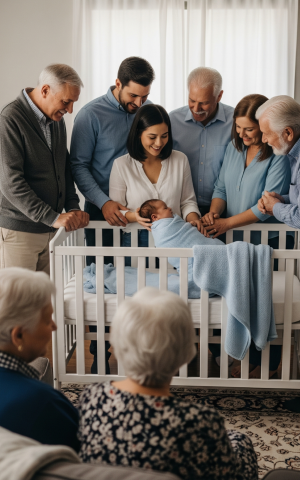
That turns out to be a very pleasant perspective: not once- but twice-removed from direct responsibility. You have lived to see a pair of generations—through, or despite, your best efforts–grow up to be solid and responsible adults, many with splendid human qualities and impressive talents that you never would have allowed yourself to imagine, and for which you have been around the block far too many times to claim any credit.
To paraphrase Tehillim: Look: Your children and their children are like olive trees and saplings around their own tables!
Better yet, not only can you glimpse the promised land of the future, with all its shimmering though blurry potential, but you’ve been given the chance to live there yourself for a time—and with a non-speaking part! Granting that, who would want to offer anything less than a Shehecheyanu from the very bottom of the heart.
In the Gemara, Abaye says le’olam lishatef inash nafsheh behadei tzibura, one should always associate private prayers with those of the community. In that spirit, and in the spirit of this specific moment for Israel and Jews around the world, I will add more from Tehillim, begging indulgence for a small adjustment:
יברכך ה’ מציון וראה בטוב ירושלים
וראה בנים ובני בנים לבניך
שלום על ישראל!