
London based entrepreneur, cybersecurity analyst doing a PhD in AI
Before Religion, There Was Conscience
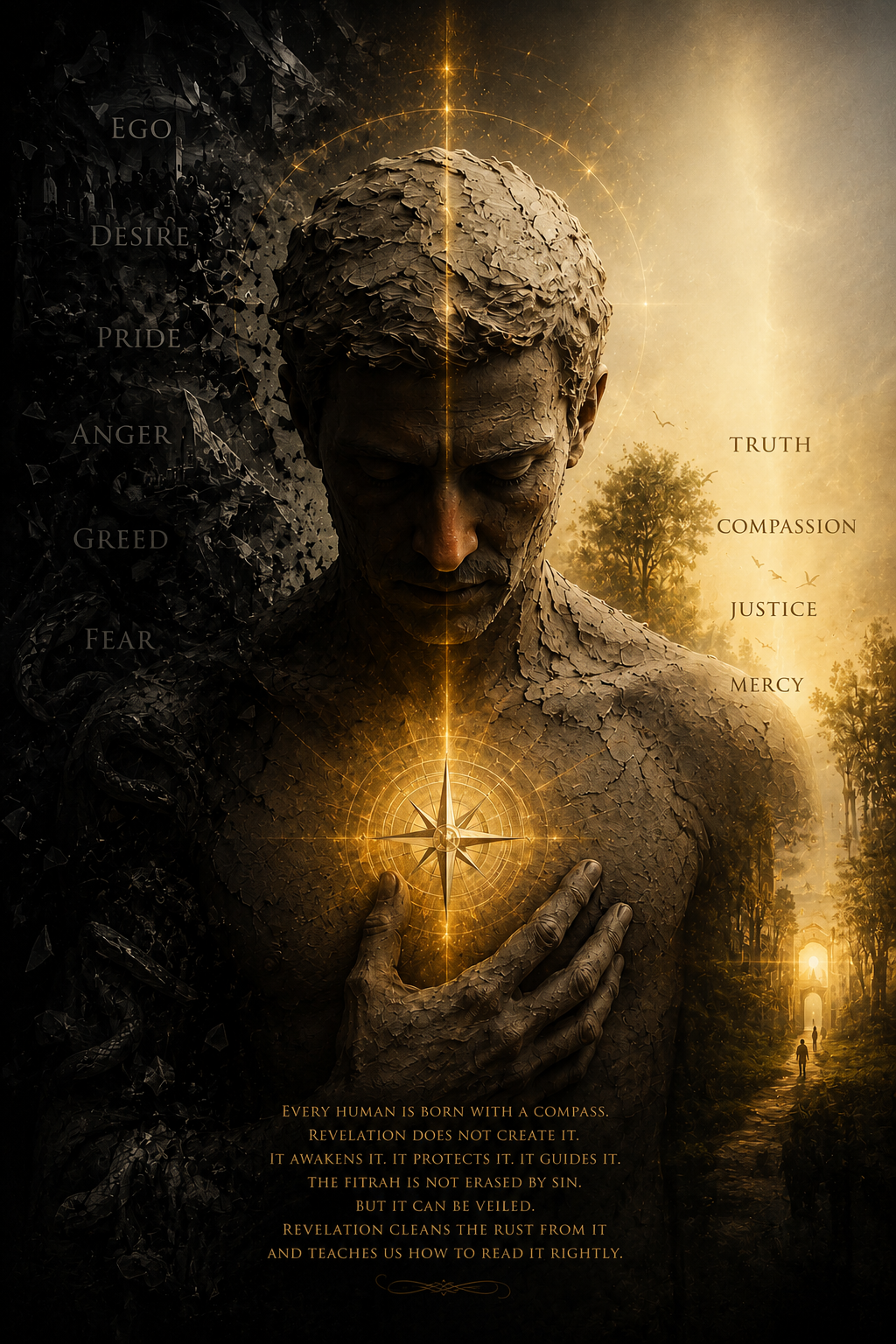
Every civilisation eventually asks the same question.
Where does morality come from?
Is it imposed by law?
Learned from parents?
Inherited through culture?
Or is it religion?
But religion is usually “interpreted” – which usually goes back to culture.
Or is there something deeper—something already present before the first commandment is ever heard?
The Hebrew Bible and the Qur’an begin in remarkably similar places.
Both tell us that before there were nations, before there were tribes, before there were institutions or laws, there was a human being fashioned by God.
The Qur’an speaks of what it calls the fitrah:
“So direct your face towards the religion, inclining to truth—the fitrah of Allah upon which He created mankind. There is no changing the creation of Allah.”
Qur’an 30:30
The verse is often read as a call to religion.
It is also a profound statement about human nature.
Something essential precedes culture.
Something within us precedes ideology.
Before we become members of a nation, a religion or a political movement, we are human beings endowed by God with an intrinsic moral capacity.
We know, somewhere within us, that compassion feels different from cruelty.
That honesty feels different from deception.
That mercy feels different from vengeance.
This inner compass is easily ignored.
It is far more difficult to extinguish.
Religion, does not overwrite that compass.
It is the language of that compass. Sharia literally means “path to water” in Arabic, and Halacha means “walking” or “the way one walks”.
The meaning being, in a desert, water is life. This life is similarly a desert without spirituality.
It provides an external structure, a moral exoskeleton, that preserves what God has already placed within the human heart.
The fitrah is not created by religion.
It is remembered through it.
And thus the following Hadith, truly reflects the essence of religion –
Wabisah ibn Ma’bad reported: The Messenger of Allah, peace and blessings be upon him, said to me, “Have you come to ask about righteousness and sin?” I said yes. The Prophet clenched his fist and struck his chest, saying, “Consult your soul, consult your heart, O Wabisah. Righteousness is what reassures your soul and your heart, and sin is what wavers in your soul and puts tension in your chest, even if people approve it in their judgments again and again.”
Source: Sunan al-Dārimī 2533
Grade: Hasan (fair) according to Ibn Hajar
The Hebrew Bible tells us :-
“If you meet your enemy’s ox or donkey going astray, you shall surely return it to him.” [Exodus 23:4]
The Quran speaks similarly :-
“Do not let the hatred of a people cause you to depart from justice. Be just; that is nearer to righteousness.” [Qur’an 5:8]
Notice the use of the word enemy in the Hebrew Bible and the use of the word Hatred in the Quran. Not your friend, not your community member, your enemy.
Why does both the Hebrew Bible and the Quran emphasise this?
That may explain one of the oldest experiences known to humanity.
When we wrong another person, the deepest wound is often not the one we inflict.
It is the one we carry.
Long before anyone else sees our actions, conscience has already begun its quiet work.
It asks uncomfortable questions.
It resists convenient justifications.
It remembers what rhetoric tries to forget.
Psychology has given this phenomenon many names.
Cognitive dissonance.
Moral injury.
The burden of unresolved guilt.
Whatever vocabulary we choose, the experience is familiar.
Literature recognised it long before psychology did.
In Crime and Punishment, Dostoevsky’s Raskolnikov convinces himself that murder can be justified by reason. He constructs an elegant philosophy to excuse an act he believes serves a greater purpose.
Yet it is not the police who first condemn him.
It is his own conscience.
The crime is committed in a single moment.
The punishment unfolds within his own mind for a lifetime.
The cost is often unseen, because we don’t dare verbalise it so people judge us.
So we suffer inside.
In Raskolnikov’s case, His intellect attempts to silence his moral intuition.
His humanity refuses to cooperate.
Dostoevsky’s insight is strikingly consistent with the Qur’anic vision of the fitrah: human beings can suppress the moral law within themselves, but they struggle to erase it entirely.
This often takes the form of taking drugs and substance abuse or mental health disorders such as bulimia.
Human beings possess a remarkable ability to explain almost anything to others.
We are far less successful at explaining it to ourselves.
That is why societies can become trapped in dangerous cycles.
When enough people suppress their moral discomfort, they often begin constructing narratives that justify it.
The external story grows louder because the internal voice has become more difficult to silence.
Every new justification requires another.
Every compromise demands the next.
Eventually, what began as an exception becomes an identity.
Society becomes a delirium unable to speak the truth to themselves or each other.
History shows how fragile that process can be.
The collapse of a civilisation rarely begins with the failure of its buildings.
It begins with the erosion of its conscience.
Institutions can survive disagreement.
They struggle to survive when moral self-examination disappears.
The Hebrew prophet Micah distilled ethical life into extraordinary simplicity:
“He has told you, O man, what is good: to do justice, to love mercy, and to walk humbly with your God.”
Micah 6:8
Notice that humility accompanies justice.
Not certainty.
Not triumph.
Humility.
Because humility leaves room for conscience to speak.
That is what both the Hebrew Bible and the Qur’an are ultimately protecting.
Not merely obedience.
But the fragile moral faculty through which human beings recognise truth before they have fully articulated it.
Civilisations do not endure because they never make mistakes.
They endure because they retain the courage to hear the quiet voice that tells them when they have.
The greatest danger to any society is therefore not disagreement.
Nor criticism.
Nor honest self-examination.
It is the gradual numbing of the conscience that God placed within every human being.
For once that inner compass is silenced, no amount of external strength can prevent internal decline.
Before there was religion, there was conscience.
Religion does not replace that conscience.
It reinforces it.
It protects it.
It disciplines it.
Like the exoskeleton of a seed protecting the life already contained within, revelation surrounds the moral nature that God has placed within every human being.
The purpose of religion is therefore not to manufacture morality.
It is to preserve, cultivate and continually awaken the conscience we were created with.
A society which cultivates that is ultimately successful, a society which destroys it is ultimately doomed.
I will leave with these two Hadith which capture the essence of Fitrah. The mere act of ritualistic worship does not embody the essence of religion, but our ability to live in line with the eternal moral compass already inside of us.
Abu Huraira reported: The Prophet, peace and blessings be upon him, said, “A woman entered the Hellfire because of a cat or kitten she had imprisoned. She did not let it eat, nor release it to eat the vermin of the earth, until it died emaciated.”
Source: Ṣaḥīḥ Muslim 2619
Grade: Sahih (authentic) according to Muslim
Abu Huraira reported: The Prophet, peace and blessings be upon him, said, “A prostitute had once been forgiven. She passed by a dog panting near a well. Thirst had nearly killed him, so she took off her sock, tied it to her veil, and drew up some water. Allah forgave her for that.”
Source: Ṣaḥīḥ al-Bukhārī 3321, Ṣaḥīḥ Muslim 2245
Grade: Muttafaqun Alayhi (authenticity agreed upon) according to Al-Bukhari and Muslim
Related Topics
Related Posts