
Bridging faith. Defending truth. Confronting hate
Before the Mourning Began
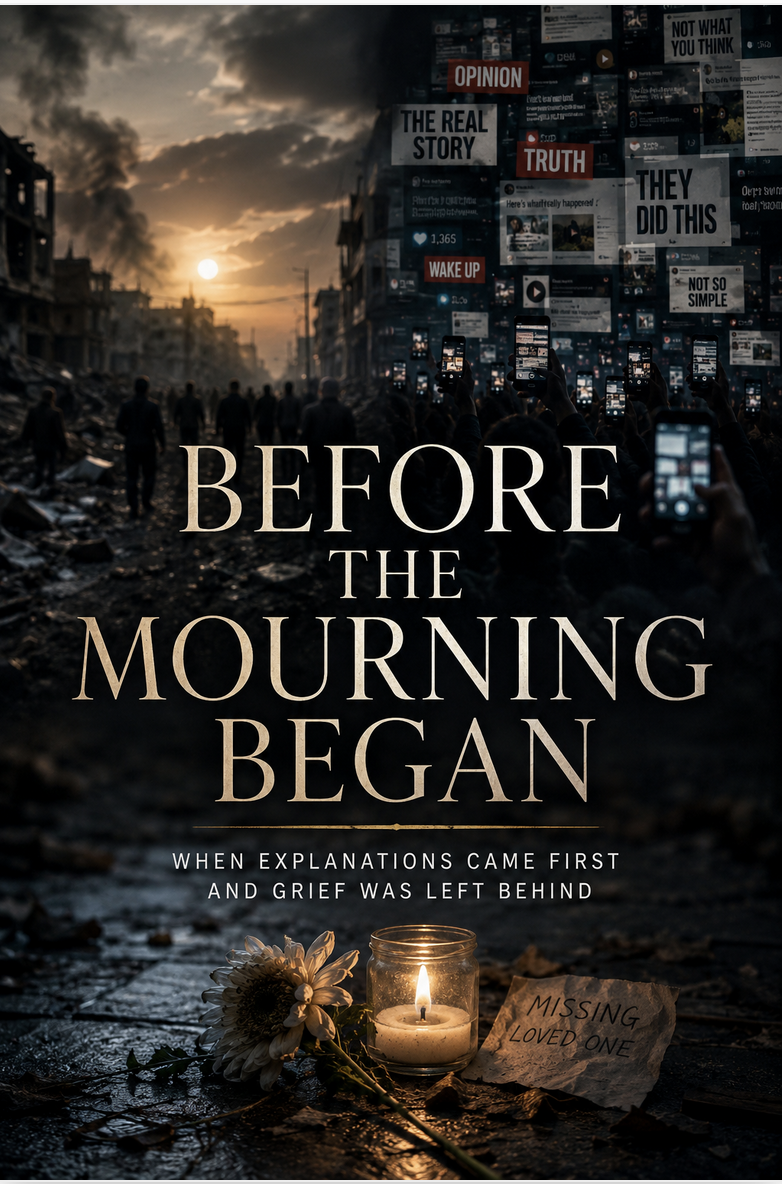
Image created from ChatGPT by Tim Orr
The morning after October 7 was troubling in a way that I still have trouble putting into words. Even before many Israelis could find their missing loved ones, before the full death toll was known, and before anyone could really grasp what had taken place, explanations had already flooded the world.
People started protesting in big cities all over the West, not in a few weeks or months after the troubling event took place, but right away. And if you went online, especially on social media, you couldn’t avoid people’s takes. Pretty much no one knew what the actual facts were yet. I was in London at the time and found myself endlessly scrolling through responses to what had happened. I was disturbed, not just by the tone everyone was using when shouting at each other, but also at the speed at which everyone had seemed to decide what the event “meant.” I noticed something else, too: how often those “meanings” almost immediately placed Jews as the moral problem.
No one had even counted the bodies yet or begun telling the stories of the dead. People had barely been given time to mourn, yet the victims already seemed to be turning into chess pieces inside other people’s moral and political narratives. It felt as though many had already decided what the killings “meant” before we had even fully absorbed that the killings had happened at all.
I’m not saying that antisemitism began on that day nor that violence against Jews began then. History is replete with examples of enough massacres and expulsions and ideological fanaticism and political cruelty to never make that claim. What struck me was not the chronology of antisemitism itself, but the speed with which Jewish suffering was absorbed into interpretive frameworks that already seemed prepared to explain it away before the mourning had even begun. In many cases, the massacre itself seemed almost incidental to the interpretations ready to greet it. This stuck with me because it demanded from me a reconsideration of what antisemitism comprises, and how antisemitism does fit into the modern moral universe.
The thing that really bothered me was not just seeing everyone argue about what had happened. After something huge goes down, it is natural for there to be a bit of back and forth. But it was how quickly everyone seemed to move on from what actually happened and launched straight into trying to explain it all. It seemed like people knew exactly what to think about it and what it all meant, way too soon. There just was not much tolerance for admitting we do not get it, or asking questions, or even leaving room for people to just be sad. Even when families were still out there searching for missing relatives, and we did not even know exactly how many people had been hurt or killed, the conversation around blame and justice, or about the politics of it all, were already way out in front. The explanations everyone fired off seemed really common, almost like they had just been waiting since before October 7 for something new like this to come up so people could dust them off and start using them.
What I was seeing raised a deeper “why” question that I could not easily answer.
Different civilizations persecuted Jews in different ways and for different reasons, and I am not trying to reduce all of history to a single explanatory formula. But the more I reflected on it, the harder it became to ignore certain recurring patterns. Again and again, societies that otherwise shared very little in common seemed to assign Jews a remarkably similar role whenever confidence in the system itself started to crack.
The question could no longer be avoided: Christianity, Islam, revolutionary movements, racial ideologies, nationalist projects, contemporary moral visions, they all disagree about everything. They have different holy books, different readings of shared history, opposite moral priorities, and mutually exclusive plans for the future. But when they run up against frustration or contradiction, they all imagine Jews in the same symbolic way. Why should ideologies so different come together on this point?
That is part of what makes antisemitism different from ordinary prejudice. Most forms of hatred eventually weaken when conditions change, when populations disappear, or when institutions evolve. Antisemitism has shown an unusual ability to survive across radically different civilizations, ideologies, religions, and political systems. It survives theological revolutions, nationalist revolutions, scientific revolutions, secularization, globalization, and even the destruction of the societies that once sustained it. Christians, Muslims, racial nationalists, revolutionary movements, postcolonial activists, and progressive humanitarian systems often share almost nothing else intellectually. And yet, across very different periods of history, the accusations somehow keep circling back to the same basic themes. Jews are blamed for corruption, accused of hidden influence, treated as disloyal outsiders, or made to symbolize what is supposedly broken inside the culture itself. To be sure, the vocabulary changes from age to age, but the pattern is hard to miss once you start noticing it.
An equally important question follows from this observation. Why Jews? Human history contains many persecuted peoples. Armenians endured genocide. Assyrians survived centuries of displacement. Roma communities suffered exclusion across Europe. Coptic Christians lived as vulnerable minorities for generations. Yet none of these groups occupy the same recurring role in the imagination of civilizations. Something about the Jews repeatedly draws them into the center of larger stories societies tell about themselves. Understanding why became one of the central questions that drove this book.
When societies promise justice, liberation, equality, redemption, or historical progress and those promises fail to materialize, pressure builds to explain why. One option is to honestly confront its own failures and limitations. The other option is to push the contradiction somewhere else. Antisemitism often functions in the second way, which allows the system to preserve its moral self-confidence even when reality exposes its weaknesses. In these moments, “the Jew” stops functioning primarily as an actual person or community and instead becomes an explanation.
What increasingly occurred to me was that many of these systems had the same aspiration. Each, in its way, thought that history could be finished; through salvation, revolution, national renewal, liberation, moral progress, and so on. Yet history kept not finishing. Suffering simply continued. Injustice remained. People disappointed each other. And the Jew kept appearing as a reminder that the great reconciliation was not yet here.
My upcoming book published toward the end of the year, ultimately became about the moral psychology of civilizations unable to confront their own shortcomings honestly. Antisemitism matters not only because of what it does to Jews, but because of what it reveals about the civilizations that produce it. Again and again, civilizations seem unable to metabolize contradiction internally. They seek explanations that do not compromise their self-concept, and often locate blame elsewhere. In many cases, antisemitism is not so much a failure of morality as a perversion of it. Antisemitism allows highly moralized societies to maintain their sense of innocence while externalizing their guilt.
This book is neither a conventional history of antisemitism nor a simple study of prejudice. It is an attempt to understand why Jews repeatedly occupy the same symbolic place in radically different societies. To answer that question, we will move through theology, politics, intellectual history, and moral philosophy. Antisemitism persists because it adapts itself to the language and ideals of each age.
The specifics of a situation matter. My argument is not that all cases are equivalent, but rather that they tend to recur: different systems of explanation and justification seem always to put Jews in the same place during moments when the system loses traction. Nor, obviously, am I arguing that all criticism of Israel is antisemitic. States make decisions and should be criticized. Political disagreement is normal. The distinction to insist upon is the distinction between criticism and blame. Criticism focuses on policy, leadership, institutions, and outcomes. Blame transforms Jewish existence itself into a civilizational problem. The book is primarily concerned with the latter. Without preserving that distinction, serious analysis becomes almost impossible because everything collapses into ideological reflex.
After extensive contemplation, I concluded that the question posed by the persistence of antisemitism is more profound than can be elucidated by hatred. Hatred explains hostility, but it does not explain recurrence. It does not explain why radically different societies find themselves time and again returning to the Jews, when their own hopes of redemption are frustrated. That is the starting point for this book. It represents an attempt to understand why the Jew so often becomes an embodiment of the contradiction and tension societies perceive in themselves. In the end, I have come to think that antisemitism reveals something, not about Jews in particular, but about the inability to accept that history is always incomplete.
Related Topics
Related Posts