
Bridging faith. Defending truth. Confronting hate
Before the Nakba: Khomeini’s Kashf al-Asrār and Iran’s Antisemitic Roots
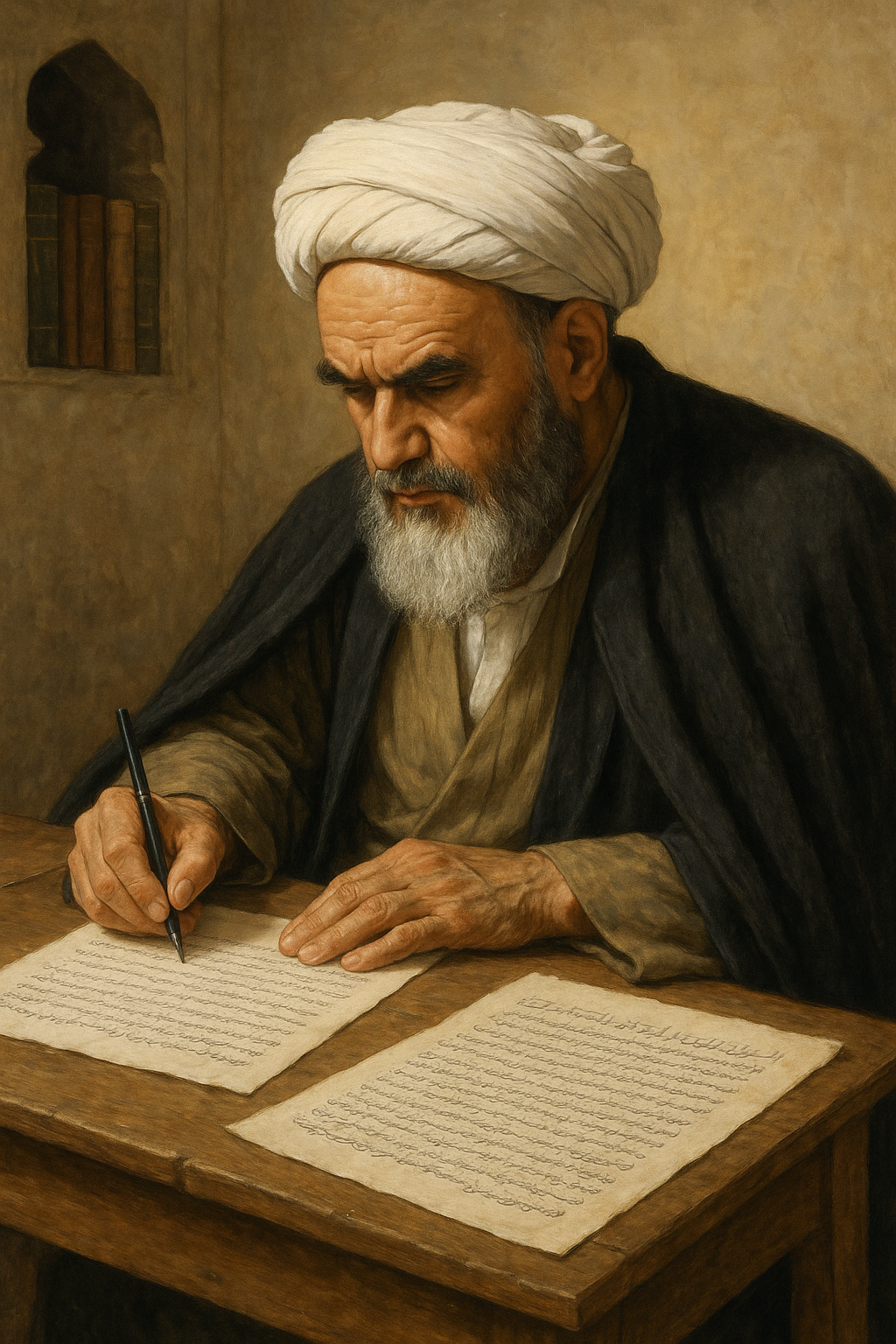
An artistic imagining of the moment Kashf al-Asrar (‘Uncovering of Secrets’) was being written — capturing the intensity, conviction, and theological depth behind one of the most influential ideological works of the modern Middle East.
Most people are familiar with the Islamic Republic of Iran and its architect, Ayatollah Ruhollah Khomeini. His worldview was laid bare during the 1979 Iranian Revolution, and nearly everything we know about his political theology is shaped by what he said and did after the 1948 Nakba. Yet this raises an important and often overlooked question: was the ideological force behind his revolution something that developed gradually in the decades leading up to 1979, or is there evidence that it had already taken shape much earlier? What did Khomeini believe, and what ideas did he articulate, before 1948 transformed the political landscape of the Middle East?
This question becomes especially significant when we consider one of his earliest works, Kashf al-Asrār (“The Unveiling of Secrets”), published in 1942. Unlike his later writings, such as Hukumat-e Islami (The Guardianship of the Jurist) and The Little Green Book, both of which have been translated into English, Kashf al-Asrār has never been made available to an English-speaking audience. Scholars have suggested that this omission is due in part to the book’s deeply problematic and inflammatory content. More importantly, its absence obscures the fact that it directly challenges the popular “Nakba thesis,” which claims that Iran’s hostility toward Israel emerged only as a reaction to the 1948 displacement of Palestinians.
Because Kashf al-Asrār predates the Nakba by six years, it provides a crucial benchmark for understanding how Khomeini’s rhetoric, and Shiʿi Islamist discourse more broadly, evolved after the creation of Israel. It allows scholars to distinguish between the endogenous components of his ideology, rooted in Islamic jurisprudence, Shiʿi theology, and anti-secular sentiment, and the reactive components shaped by later geopolitical events such as 1948, the Suez Crisis, or the Six Day War. One of the most revealing aspects of this early work is how Khomeini discusses Jews and “Zionist” influence before 1948 — before the establishment of Israel reshaped global political discourse.
The Iran of 1942: Political Upheaval and Clerical Anxiety
To fully grasp the ideological significance of Kashf al-Asrār, it must be situated in the tumultuous Iran of the early 1940s. The book was written at a moment of profound transformation and crisis. Reza Shah Pahlavi had spent the previous two decades pursuing a rapid program of Western-style modernization and secularization, weakening the traditional influence of the clergy and sharply curtailing their role in education, law, and politics. In 1941, under Allied pressure, Reza Shah abdicated in favor of his son, Mohammad Reza, amid a British-Soviet occupation of Iran. The resulting vacuum of authority, combined with deepening political instability, created an atmosphere of intense ideological competition over the country’s future.
For the Shi‘i clergy, this was an existential moment. State reforms, secular intellectuals, and foreign influence had all weakened their power. In this time of upheaval and perceived shame, antisemitism, both theologically based and brought over from European discourse, provided a strong explanation. It allowed clerics like Khomeini to personify abstract forces such as imperialism, secularism, and modernization in the figure of the “Jew,” who could be blamed for social corruption, political decline, and the erosion of Islamic values. Kashf al-Asrār should therefore be read not simply as a polemic against the Pahlavi regime, but as part of a larger clerical attempt to reclaim ideological dominance in a rapidly changing society.
Antisemitism as a Theological and Political Worldview
Far from being a peripheral theme, antisemitism lies at the heart of Kashf al-Asrār and is woven into Khomeini’s broader conception of the Islamic state. The book portrays Jews as agents of foreign domination, corrupters of society, and existential enemies of Islam. As scholars such as Said Amir Arjomand and Ervand Abrahamian have shown, Khomeini accused Jews and their collaborators of manipulating the press and cultural institutions to corrupt the minds of youth, spread doubt about religious truth, and erode the moral foundations of society. He also depicted Jewish influence as reaching into the highest levels of power, where they whispered in the ears of rulers, shaped political decisions to their advantage, and conspired with imperialist powers to weaken the Muslim world. These portrayals reveal that antisemitic tropes, including the image of Jews as conspirators, corrupters, and agents of foreign domination, were central to Khomeini’s worldview long before he reframed them in the language of anti-Zionism.
Crucially, this worldview was not merely bigotry disguised as politics. It was embedded in Khomeini’s understanding of Islamic history and theology. Shi‘i thought sees history as a cosmic fight between truth (haqq) and falsehood (batil), between the righteous followers of the Imams and those who have always fought against them. In this way, Jews were frequently portrayed as quintessential adversaries of divine guidance, exemplified by their repudiation of the Prophet Muhammad and their treachery towards Imam ʿAli. Khomeini drew on this tradition to portray Jews not just as political adversaries but as metaphysical opponents of God’s order, a theological framing that intensified their perceived threat and justified their exclusion from the moral and political community of Islam.
This theological underpinning also intersected with Khomeini’s emerging vision of velayat-e faqih (the guardianship of the jurist), which he would fully articulate decades later. In Kashf al-Asrār, we see the embryonic version of this idea: a belief that Islamic society must be ruled by righteous jurists who safeguard the faith from external and internal corruption. Jews, in this schema, function as the ultimate corruptors, whose influence justifies the need for a clerically guided state. Antisemitism thus becomes not an incidental prejudice but a structural component of his political theory.
Old Polemics, New Conspiracies
The antisemitism of Kashf al-Asrār was not created in a vacuum. Shi‘i polemics had long portrayed Jews and other minorities as corrupters of the faith, and by the early twentieth century, these narratives had merged with European conspiracy literature circulating in Iran. Persian translations of The Protocols of the Elders of Zion appeared by the 1930s, and myths about Jewish media control and political manipulation became common among both clerics and nationalists (Matthias Küntzel, Jihad and Jew-Hatred, 2007). This synthesis of traditional Islamic polemic and European antisemitic fantasy intensified the perceived scope of the Jewish threat, transforming Jews from mere theological adversaries into the embodiment of global imperial power.
Khomeini’s language of manipulation, infiltration, and secret control mirrors both Islamic and European sources. It casts Jews not as a minority but as an omnipotent network capable of corrupting society from within. At times, he even deploys biological metaphors, accusing Jews of “infecting” youth and “polluting” society with irreligion, rhetorical strategies that shift them from ideological rivals to existential threats.
From Prejudice to Policy
Khomeini’s antisemitism extended beyond mere animosity towards a religious community. It became a way for him to bring together his opposition to many things, including imperialism, secularism, monarchy, and even modernization. Khomeini said that imperialists “used the Jews as their tools” to attack Islam’s faith, morals, and independence, as Abrahamian points out. Vanessa Martin observes that he portrayed secular reformers as fronts for a Jewish plot to uproot Islam. By linking Jews to every ideological adversary, Khomeini transformed antisemitism into a comprehensive worldview that explained Iran’s subjugation and justified his revolutionary project.
This worldview did not remain confined to the pages of Kashf al-Asrār. In the 1960s and 1970s, Khomeini replaced the word “Jews” with “Zionists,” recasting the same conspiratorial narratives in explicitly political terms. Zionism, he argued, was responsible for imperialism, capitalism, secularism, and cultural degradation (Meir Litvak, Constructing Nationalism in Iran, 2017). After 1979, these ideas were institutionalized as state doctrine. Textbooks portrayed Zionism as a global conspiracy against Islam, hostility toward Israel was elevated to a religious duty, and antisemitic propaganda became a staple of official discourse.
The ideological continuity is unmistakable. The conspiracies first articulated in Kashf al-Asrār became the bedrock of Iran’s revolutionary identity and foreign policy. Khomeini’s depiction of Jews is similar to the rhetoric used by European antisemitic fascists, especially Nazis. They saw Jews as corruptors of society and power manipulators. Whereas the fascists depended on racial pseudoscience, Khomeini based his animosity on a religious cosmology, depicting Jews as perpetual adversaries of God, ideas reflected in the Quran. His ideas also resonate with Sunni Islamist thinkers such as Hassan al-Banna and Sayyid Qutb, though his Shiʿi context adds a distinct dimension, casting Jews as historical betrayers of the Imamate and perennial corrupters of the ummah.
Conclusion: Ideology That Outlived Its Origins
Kashf al-Asrār is not a historical curiosity. It is a foundational text of a political ideology. In its pages, antisemitism is not an incidental prejudice but a structural principle that binds together anti-imperialism, anti-secularism, and anti-modernism. It offers a simplified, conspiratorial explanation for Iran’s historical challenges and provides a justification for revolutionary ambition.
Khomeini’s view of the Jews as conspirators and corruptors has influenced Iran’s political culture for over eight years. It is important that to understand the Islamic Republic’s ideology and its ongoing hostility toward Israel, it is necessary to revisit this 1942 polemic and recognize the antisemitic foundations upon which it was built.
—
References
Abrahamian, E. (1993). Khomeinism: Essays on the Islamic Republic. Berkeley, CA: University of California Press.
Arjomand, S. A. (1988). The Turban for the Crown: The Islamic Revolution in Iran. New York, NY: Oxford University Press.
Küntzel, M. (2007). Jihad and Jew-hatred: Islamism, Nazism and the Roots of 9/11. New York, NY: Telos Press Publishing.
Litvak, M. (2017). Constructing Nationalism in Iran: Religion, Empire, and Revolution. New York, NY: Routledge.
Martin, V. (2000). Creating an Islamic State: Khomeini and the Making of a New Iran. London, UK: I.B. Tauris.
Qutb, S. (1951). Ma‘rakatuna ma‘a al-Yahud [Our Struggle with the Jews]. Cairo, Egypt: Dar al-Shuruq.
Related Topics