Looking forward
Before the next war
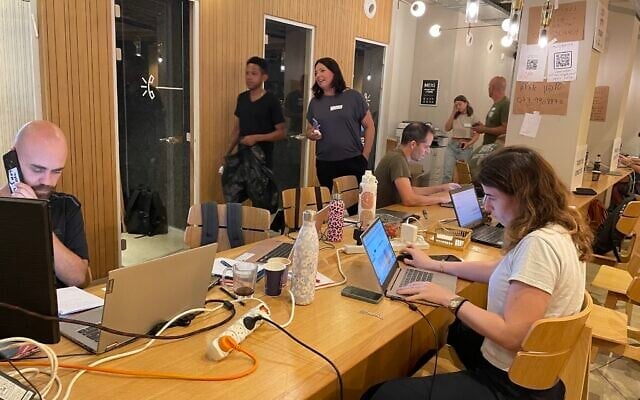
In shifts, volunteers deal with requests from the public (Or is on the left), at the Civilian Operations Hub, Expo Tel Aviv, October 19, 2023. (Sue Surkes/Times of Israel)
Hamas, Hezbollah, and Iran are rearming, requiring us to find new ways to prepare for what comes next.
Here we are: Hamas is reimposing control over Gaza and gathering advanced weapons in staging points abroad; Hezbollah is challenging the Lebanese State and openly speaking about the next war with Israel; Iran is threatening to send ten times more rockets than the last time around, two thousand in a single wave of attack; and in the major cities of the West where Jews had previously felt safe, antizionist forces have captured key positions of power across both the Left and the Right, translating media wins during the Gaza War into political leverage. Our people feel hounded, friendless, and frightened.
We’ve sacrificed so much, faced down so much, marshaled so much and we now find ourselves in what seems to be a more difficult strategic circumstance: increasingly isolated, embattled, and exhausted.
The good news is that we’ve been in similar circumstances before and prevailed. In 1948 we faced worse odds, declaring independence in the face of a global arms embargo and widespread Western support for the Arab armies due to the world’s post-war reliance on petroleum to rebuild Europe. We also shouldn’t forget that Israelis felt on the brink of extinction before the Six Day War. In 1973, Jews worldwide thought Yom Kippur could mark the end of the Jewish State.
Today we have a state, one of the strongest militaries in the world, and a vibrant economy. What we are lacking – the reason so many of us once again feel existential dread – is worthy leadership. Our current government is more adept at tearing us apart than bringing us together, more focused on litigating its past failures than preparing for future challenges.
In the aftermath of October 7 it was Israel’s civil society, not the Israeli government, which rose to the challenge of first response in the towns and villages on the periphery, taking in refugees, caring for the wounded, feeding the hungry. Outfitting our troops. Jews around the world reprioritized their giving to focus on where it was needed most, based on a deep partnership with Israeli society and an understanding that if they do not help, no help would come. The government played catch-up.
Now, as global forces realign to launch their next campaign against Israel and the Jews, I believe civil society needs to move on the offensive, to set the pace for the government’s eventual response. Were I to advise the leaders of our major civil institutions – business leaders, global nonprofits, funds and philanthropic foundations – I’d recommend organizing our approach along three overlapping phases: first, we need to gather our resources. Second, we need to fortify our positions. Last, we need to take initiative.
Gathering our resources requires us to apply a cold, hard logic to our communal expenditures: will our investments improve our prospects in the long term? This applies to for-profit investments in infrastructure and economic development as well as charitable giving to strengthen institutions. There are a number of fields in which we are wasting resources due to precedent, and we can’t afford to do so any longer: our efforts to fight antisemitism have been marginally successful at best, our efforts to build allyship seem to have failed. Our cultural investments have at times backfired, our support for Holocaust education has been turned against us. And so on.
We need to audit our communal infrastructure and make tough decisions as to where to cut and where to double down. For example, the realization that the information space and social media algorithms have been weaponized against the Jewish People and the State of Israel needs to be matched by an analysis as to which resources were effective in holding back or even countering campaigns. Underperforming investments should be culled. New investments need to be made in cyber, reputation management, and messaging.
Second, we need to use those freed-up resources to fortify our positions to ensure we can survive the next wave of attacks. This will require us to identify where we were lucky enough in this past war to avoid catastrophe through no strength of our own. For example, local to Israel: prior to the Iran attack, government agencies warned that rockets could damage Israel’s centralized electric grid, leaving millions without electricity or water for extended periods of time. We need to mitigate this risk. We should be building bond mechanisms and spinning up other financial tools to encourage municipalities to invest in creating the infrastructure of micro-grids that can independently generate electricity and water during crises. The technology and knowhow exist globally; there’s no reason Israel shouldn’t apply it in this and other areas where resilience is required.
Lastly, we need to take initiative. Our current Prime Minister, for years, had been saying that Iran was the enemy that should be addressed. I agree the State should focus its vast resources on countering its kinetic threat. But as civil society, I believe we should prioritize our efforts on Qatar and their sponsored proxies.
I once met a man who paid tens of millions a year to public relations agencies whose entire purpose was to keep him and his family out of the media. Similarly, from reports, Qatar and its ruling al-Thani family operate in the shadows. They must be hounded. Their money, branded. Reporters, politicians, publishers, and media personalities who interact with them should be outed for their complicity.
We must take the offensive against Qatar and the al-Thani not out of vengeance, but because of the strategic necessity to curtail their influence. To raise the price of their continued support of Hamas and other antizionist efforts, to convince them they’d be better off betting their billions elsewhere. Let us not forget that Qatar is a slave-driving state made rich by selling a substance heating the planet past the point of mass extinction, a cabal of multibillionaires corrupting our democracies and decimating the Open Societies we fought so hard to build. They should know no quiet until they choose to change their ways.
Just as we of civil society couldn’t leave the fate of Israelis in the hands of the failed government that presided over October 7, we cannot afford to leave our country’s fate in the hands of the current crop of politicians. Our civil society has proven itself to be a shining light, a global success story. Despite the desire to take a breath now that the fire in Gaza has ceased, I believe we cannot afford to rest: another war is coming, and unless we in civil society act now to prepare for victory, we will find ourselves mired in defeat.
Related Topics
Related Posts