Before We Can Change Reality, Must We Change Minds?
Conversations with Eliyho
By Guy Hochman and Eliyho Metz
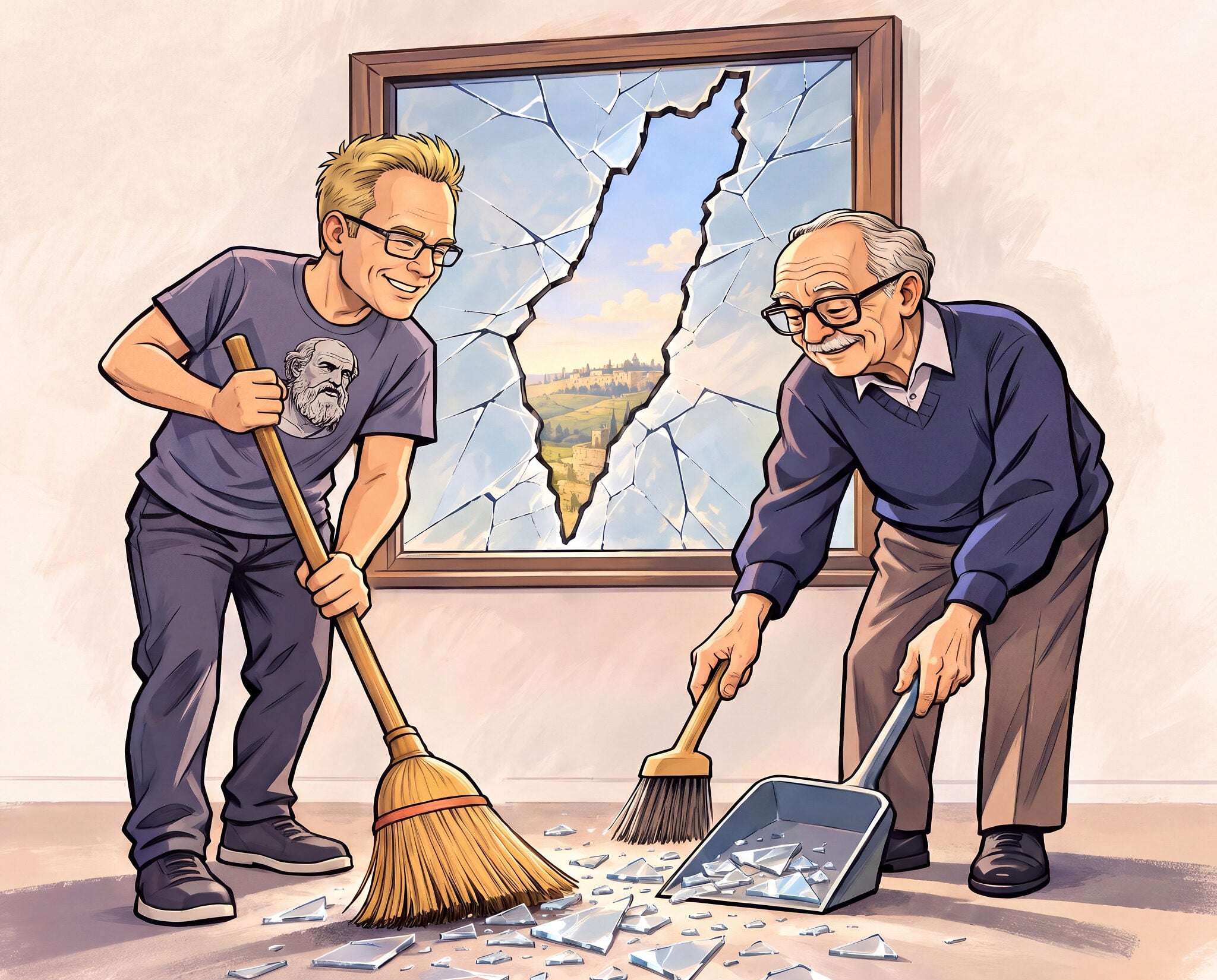
Eliyho, a historian living in Massachusetts, believes thick glass can be broken with stones, not cotton balls.
We have been corresponding for some time. Eliyho has spent much of his life studying history, governments, intelligence, and political thought. Many years ago, he worked with Hillel Kook, whose unconventional political activism challenged the Roosevelt administration over the rescue of European Jews during the Holocaust. Eliyho’s extensive historical research and conversations with Kook convinced him that challenging an entrenched political establishment requires more than persuasion. That conviction shapes his approach to the Israeli-Palestinian conflict today.
I have spent much of my life studying judgment and decision-making, and the psychological mechanisms shaping our understanding of reality.
We agree on many things, though I suspect he disagrees.
Eliyho thinks that I haven’t fully understood the problem. I have. I simply believe understanding a problem, finding a good solution, and implementing it are three different things.
Behind our disagreement lies a larger question: Should we develop great solutions, however revolutionary, or first consider what it would take for people to accept them? Israel is a good test case.
An unconventional foreign minister
Eliyho argues that Ra’am leader Mansour Abbas should be appointed foreign minister.
Imagine the reaction. Most Israelis are unlikely to judge the proposal by Abbas’s diplomatic skills, his understanding of regional politics, or Israel’s strategic objectives. After October 7, the very idea of an Arab politician representing the Jewish state can be seen as betrayal. The identity that might make him credible abroad is the one that makes him suspect at home.
For Eliyho, the appointment could improve Jewish-Arab relations within Israel and change how the world, especially the Arab world, sees the country, by signaling that Arab citizens can be trusted to advance Israel’s interests. It might also challenge the assumption that Palestinian interests, Arab identity, and Israeli interests must necessarily conflict.
Social identities shape how we interpret information and whom we trust. Yet people belong to multiple groups, and the roles they occupy can shift which identity they protect.
An Arab foreign minister could therefore help. But not necessarily. When evidence contradicts our beliefs, we sometimes reinterpret the evidence to preserve them. Jewish Israelis may dismiss Abbas as the exception that proves the rule; the Arab world may dismiss him as a collaborator. A good appointment cannot guarantee it will achieve its goals.
A city that does not yet exist
Eliyho’s more ambitious proposal is a joint Israeli-Palestinian city-state along the Israel-Gaza border, called Trump City. And he keeps telling me he doesn’t understand human psychology.
The idea deserves serious attention. Eliyho rejects the premise that resolving the conflict requires separating Israelis and Palestinians. He prefers creating circumstances that make living and prospering together attractive.
Picture a city built around opportunities for both peoples, where development, education, and jobs give them a common stake. It may sound unrealistic, but cooperation towards shared goals can reduce hostility when one group’s success depends on the other’s.
But proximity alone does not reduce hostility. Sustainable cooperation requires credible institutions and confidence that goodwill will not be exploited. And people are not perfectly rational economic agents. When researchers sweetened Israeli-Palestinian peace deals with material incentives, people who considered the disputed issues sacred responded with more outrage, not less. A prosperous city could give both sides something worth protecting, but only if it does not look like a bribe.
The Pakistani doctor
Eliyho told me about Ali, the Pakistani doctor who treated his wife for cancer. Ali sat with him for an hour explaining the disease and the treatment, and promised to save her. He did.
A Jewish man and a doctor from a country that does not recognize Israel did not need to resolve the conflict between their peoples before recognizing each other’s humanity. Why does that capacity disappear when discussing Israel’s future?
Perhaps because doctors don’t require patients to prove they’re worthy of their professional commitment. Perhaps because nationality is not the most important part of that relationship. Or perhaps because they shared an objective. Whatever the reason, the question is not whether Israelis and Palestinians can see each other as human beings, but what circumstances would allow them to.
The problem with good solutions
Eliyho knows that leaders can sit down to develop political solutions grounded in history, philosophy, and rational analysis. Unfortunately, research suggests that even when people discuss problems, they often spend more time assigning blame or justifying their actions than trying to solve them.
People tend to decide whether a proposal fits their beliefs before searching for reasons to accept or reject it. Hence our tendency to support a policy proposed by someone we identify with, yet oppose it when proposed by someone we dislike. Israeli Jews rated an actual Israeli peace plan less favorably when told it came from the Palestinians.
Eliyho fears we have grown so accustomed to the existing political framework that we cannot imagine alternatives. So bold ideas are required to break the deadlock. I fear the psychological mechanisms that prevent us from imagining a new reality may also prevent us from implementing one, especially when someone else has imagined it for us.
People bring loyalties, prejudices, and anxieties that can lead them to reject a solution or undermine its implementation. Getting support is not a nuisance to address after the intellectual work is done. It is a problem a good solution must solve.
Granted, radicalism may be necessary. Many great changes were once dismissed as unrealistic, unacceptable, or dangerous. Had their advocates waited for universal approval, we might still be waiting.
Back to the window
At least Eliyho and I agree that cotton balls will not break thick glass. But if we want to show people a different reality, shattering the window may backfire. Rather than welcome the view, they may install thicker glass.
Sometimes, when people refuse to open the window, we must break it. What happens afterward matters. If they rush to board it up, the break will not achieve much.
Brilliant ideas won’t fix things on their own. Neither will dismissing them as the fantasies of a “madman” from Massachusetts. But we’ll learn something if we consider them.
The question is when we’ve changed people’s minds enough to start breaking the glass. I keep trying to convince Eliyho to wait until a few more people are willing to help pick up the pieces. With his age and my disability, we can use all the help we can get.