
Bending, Rising: Italy’s Jewish Story
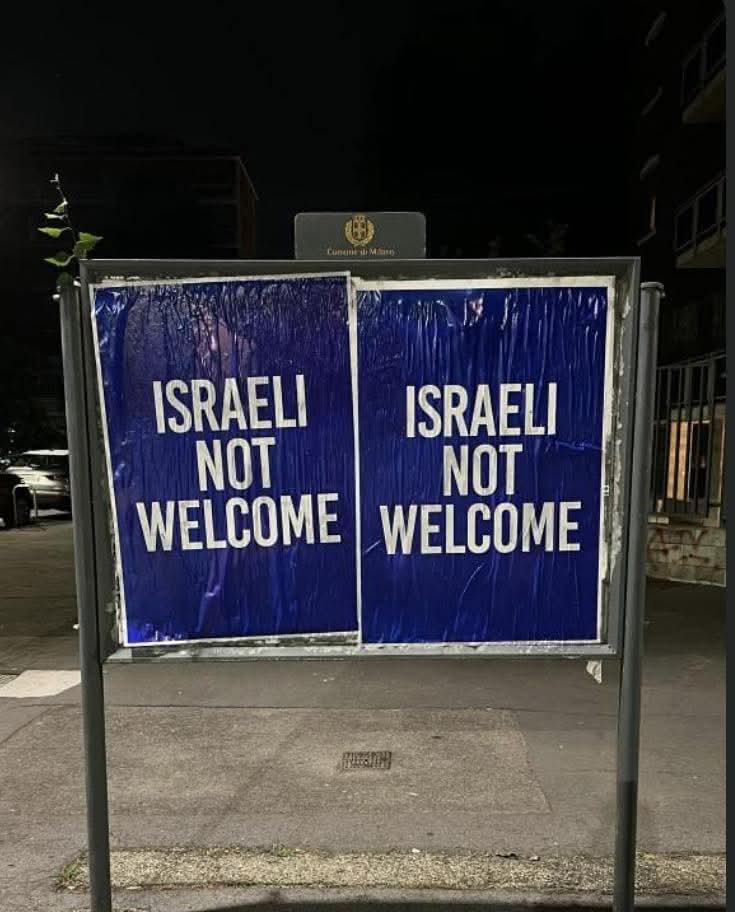
A few days ago, in Milan, our community woke up to posters reading “Israeli Not Welcome” plastered near spaces of everyday Jewish life. Daniele Nahum, a Jewish member of Milan’s City Council, called it what it is: “posting discriminatory signs against any nationality is an operation worthy of the fascists of the 1930s.”
It is easy to dismiss these incidents as marginal, but nothing is marginal when you are Jewish in Europe, and certainly not in Italy. We are a small, visible minority. We live with soldiers stationed outside our synagogues, schools, and community centers. This was true before October 7. It was true before Hamas. It has been true for decades.
Let us start with a fact that should never go unnoticed: Italian Jewry has a history spanning over two thousand years. It is a history of stubborn presence, constant adaptation, silences and returns, and deep roots in a land that has always been only half a homeland. It is not merely about surviving; it is about inhabiting an identity. For us, being a minority is not a temporary condition but a way of seeing the world, of moving through fractures without breaking.
Among the images our tradition offers, the encounter of Yaakov with Esav, after years of distance and fear, is perhaps the most eloquent. Yaakov does not flee, dominate, or impose himself. He bows, yet remains firm in his identity. This is how many Italian Jews have learned to navigate society, culture, and politics: as interpreters, avoiding sterile rigidity while preserving identity precisely through the ability to bend without breaking.
Today, this way of existing is being tested. No Italian political party can be a full home for a Jew, yet nearly every party in Italy has intersected with Jewish history. Now, attention inevitably focuses on Fratelli d’Italia. Not out of ideology, but out of reality: it is the country’s leading party, holding the Prime Minister’s office, setting the agenda. It is a party co-founded by Ignazio La Russa, now President of the Senate, who condemned the “Israeli Not Welcome” posters for what they were: a disgrace that must be opposed. Yet much of the foreign and domestic press hastily labels Fratelli d’Italia among the “European right,” without distinction or understanding.
Fratelli d’Italia emerged from Alleanza Nazionale, which inherited the symbolic and contradictory legacy of the Italian Social Movement (MSI) after the Fiuggi turn in 1995. Born after the war as a refuge for veterans and fascist nostalgics, MSI was internally divided over relations with Israel and the Middle East. One faction saw Israel as a Western outpost against Soviet-backed Arab expansion; others, including some far-right extraparlamentary militants, sympathized with the Arab cause, openly voicing hostility toward Israel.
These ambivalences reappeared over time in symbolic, often contradictory gestures. In 1967, some far-right extraparlamentary militants sought to join the Egyptian army to fight Israel, while others, like Giulio Caradonna, offered protection to Rome’s Jewish institutions against far-left violence. During the Yom Kippur War, Il Secolo d’Italia (the MSI newspaper) criticized Aldo Moro’s “equidistance” as anti-Israel. Such contradictions persisted from MSI to Alleanza Nazionale and remain in Fratelli d’Italia today.
I have often written that Fratelli d’Italia will always host conflicting souls, and it is up to us to build bridges with those who sincerely prove themselves close to Am Israel and the State of Israel. Some bridges have been built, but alongside these openings, unresolved nostalgias persist.
In 2014, Giorgia Meloni, now a pro-Western leader, tweeted: “Another massacre of children in #Gaza. No cause is just when it spills the blood of innocents. #Israel and #Palestine #twopeoplestwostates,” echoing narratives emerging from Gaza and Hamas. In 2018, she credited Hezbollah for preserving Christian traditions in Syria, and after October 7, 2023, despite her initial solidarity with Israel, she later criticized Israel’s response as taking on “unacceptable forms.” This oscillation reveals her party’s unstable positioning.
Worryingly, signals from below persist. Gioventù Nazionale, Fratelli d’Italia’s youth movement, has shown post-fascist, anti-Israel, and anti-Western leanings, from praising Hezbollah to banners honoring Soleimani after his targeted killing by the US. In 2018, GN Rome posted praise for Hezbollah and Assad’s Syria, while GN Siena wrote about “the sacred war of blood against gold.” GN Milan militants displayed banners honoring Soleimani. In 2017, Paola Frassinetti, now Undersecretary for Education, publicly questioned the timing of Israeli airstrikes against Iranian targets in Syria, calling them “strange coincidences” just as Assad’s forces were fighting ISIS, while also arguing that Iran (whose policies are dictated by the Islamic regime) was fighting terrorism rather than funding it.
Yet it would be unfair not to acknowledge that Fratelli d’Italia also includes figures who have taken firm stances against the Islamic regime in Iran and in support of freedom in the Middle East. MEPs Nicola Procaccini and Carlo Fidanza have supported sanctions against the regime; Giovanni Donzelli has defended those resisting Iranian repression. But here lies the need to read between the lines: the same party also saw Procaccini caught on video making a “legionary” forearm salute with a militant, and Fidanza joking “heil Hitler” while saying, “you always need the Jewish friend to defend you.”
Thus, within Fratelli d’Italia coexist parliamentary support for Israel and the defense of the West, alongside symbols, language, and gestures rooted in a post-fascist imagination that is hard to eradicate. It is in this oscillation that our responsibility is tested: to build bridges when necessary, to denounce clearly when needed, and never to stop reading between the lines.
Under the current government, Italy has been among the few countries defending Israel’s legitimacy over East Jerusalem at the UN, and Giorgia Meloni’s remarks before Chanukkah in 2022 genuinely recognized Jewish resilience and identity.
In June 2024, new images surfaced of young militants praising fascism, making Roman salutes, and mocking Senator Ester Mieli, granddaughter of a Shoah survivor. Internal reactions followed: Donzelli announced measures, Defense Minister Crosetto apologized, and Ignazio La Russa expressed sincere solidarity. Yet La Russa, who keeps a bust of Mussolini at home, has shown himself more of a friend to Israel and the Jewish people than many in Italy’s progressive circles.
An Italian Jew recognizes this immediately: there is a distance between symbolism and substance, between the shadows of memory and living relationships. This is where clarity is needed: to build bridges where possible, to refuse silence when it is time to speak. Italy and its Jewish community cannot afford superficiality in these contradictions: clarity, patience, and courage are required.
Recently, at a Yom HaAtzmaut celebration in Rome, I saw Giovanni Donzelli in an official role, displaying authentic closeness to Israel and Jewish identity. Fratelli d’Italia also includes figures like Senator Lucio Malan, president of the Italy-Israel parliamentary friendship group.
Faced with a centrist and leftist Italy that lightly uses words like “genocide,” calls for sanctions against Israel, and often hesitates to support Jerusalem as it defends itself, we must be willing to engage with any political side that honestly recognizes Israel and the Jewish people’s right to self-defense—even if it means confronting a right that carries unresolved legacies but does not fear challenging dominant narratives.
Yet the real question is how long this can be endured. This is a country where, even before the rise in radical anti-Israel sentiment, antisemitism required our children to walk past soldiers outside their schools, our elderly to see armed guards at the doors of nursing homes, and our families to see soldiers outside every synagogue. Now, with the growing Arab presence in cities like Milan, wearing a kippah openly can become an act of risk, not of freedom. The Italian state, which claims to protect multireligious pluralism in public spaces, has failed to preserve the equal dignity of those spaces. In reality, our Jewish identity—which has existed in Italy for two thousand years—is being pushed back to make room for others, as public spaces are occupied by those who do not wish to share them.
This context is complex. Perhaps I will explore it further in future writings. For now, it must be said: we are not here to ask for favors. We are Yaakov before Esav: we present ourselves, we explain ourselves, but we do not deny our name. We do not seek approval, but we demand respect. Let no one use our name for convenience, nor trample it to please a narrative that often does not know the history we have lived, that we continue to live, and that, despite everything, we will continue to bear witness to.