


Geopolitical Analyst: Bridging Somaliland & Israel to the world
Berbera Offers a Way Out of the Horn and Red Sea Confrontation
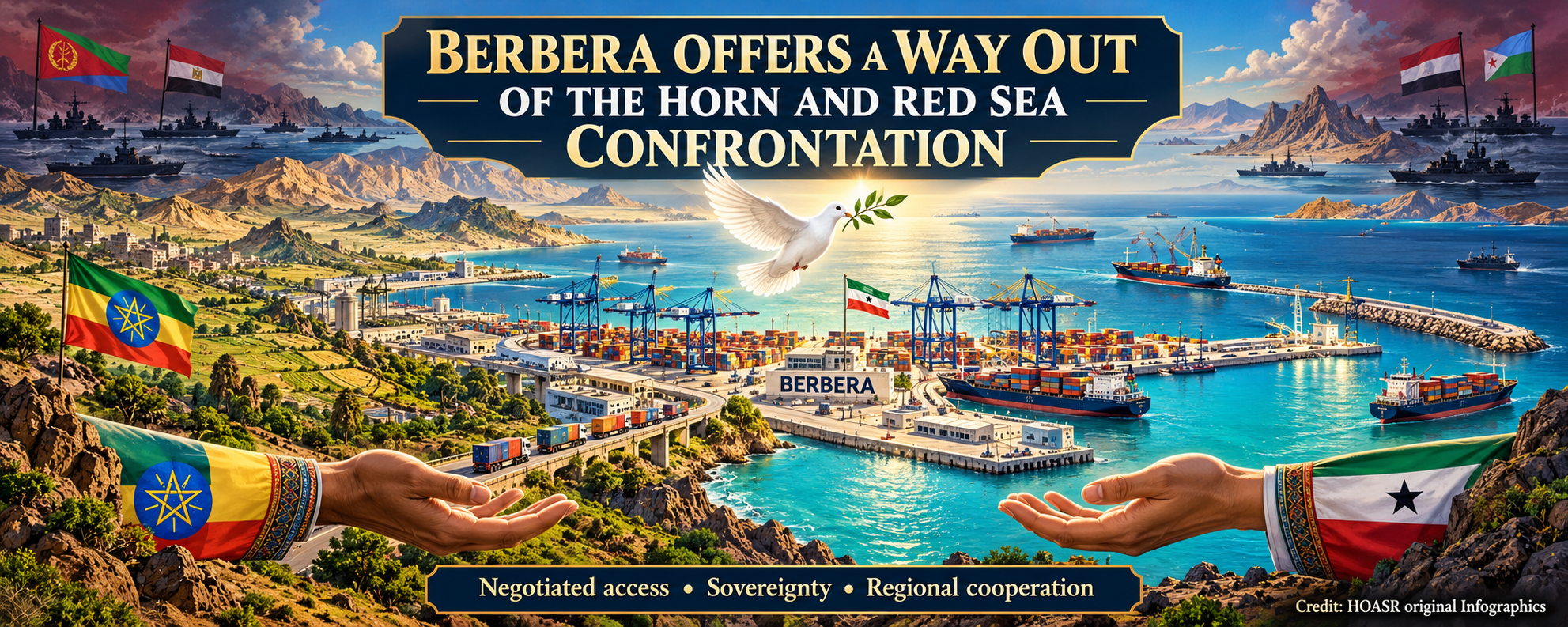
An infographic artwork placing Berbera at the center of a peaceful strategic response to maritime rivalry. The harbor, commercial shipping, open hands and olive-branch dove illustrate negotiated access, respect and cooperation across the Horn and Red Sea region. Credit: original HOASR infographic
A negotiated Ethiopian maritime outlet through Somaliland could reduce the danger of a wider regional war and turn Berbera into a foundation for cooperation and reciprocal recognition
Berbera offers the Horn of Africa a practical way to reduce the danger of a regional confrontation spreading into the Red Sea. Ethiopia’s search for maritime access has become entangled with disputes over the Nile, neighboring states’ sovereignty and the recognition of Somaliland.
A negotiated outlet through Berbera would give Addis Ababa a route to the sea without requiring pressure on Eritrea’s coastline. Its wider value lies in reducing one of the pressures that is drawing separate regional disputes into the same dangerous confrontation.
The Alamein declaration of 4 October made the overlap clear. Egypt, Eritrea, Sudan and Somalia brought Red Sea governance, downstream Nile interests and opposition to Somaliland recognition into a common diplomatic framework.
Each government approaches Ethiopia from a different position, but their concerns now reinforce one another. That convergence increases the danger that a dispute over a dam or a maritime outlet will acquire the weight of a much broader regional power struggle.
Ethiopia’s Nile and maritime ambitions have deep roots. Addis Ababa regards greater use of the Nile as essential to development and sees dependence on foreign ports as a strategic constraint following Eritrea’s independence in 1993.
The Grand Ethiopian Renaissance Dam (GERD) changed the balance of influence upstream, while the search for a maritime outlet challenged arrangements along the coast. Together, these ambitions explain why Ethiopian policy unsettles several neighbors at once. They also explain why an acceptable maritime settlement could have consequences well beyond the port selected.
The danger is especially visible in Ethiopia’s relationship with Eritrea. Reuters reporting on 9 October recorded Ethiopia’s accusation of an Eritrean invasion and Eritrea’s counterclaim that Addis Ababa was pursuing aggression for sea access. These competing accounts show how coastal ambitions have entered the justification option for military confrontation.
A credible alternative outlet would give Ethiopia a means of meeting its maritime needs while reducing the fear that Eritrean territory is the intended solution. That is the regional opening Berbera provides.
The Berbera calculus begins with an overlap of economic interests. Ethiopia needs dependable routes for imports and exports, while Somaliland seeks investment and a larger place in regional trade. Berbera, on the Gulf of Aden, offers a port linked by a land corridor to the Ethiopian interior.
Ethiopia can diversify access through negotiated commercial arrangements while Somaliland retains authority over its coast. An outlet developed on those terms gives both governments a reason to maintain cooperation instead of allowing maritime access to become another source of coercion.
The physical foundations already exist. DP World and Ethiopia’s transport ministry signed a corridor memorandum in 2021 to develop the Ethiopian side of the Berbera route, and DP World subsequently opened the Berbera Economic Zone with Somaliland’s government.
These projects provide infrastructure around which a broader political agreement can be built. What matters now is reliable operation, sufficient cargo movement and commitments that survive diplomatic pressure. Berbera’s contribution to regional stability would grow from a functioning partnership that governments and businesses have an interest in protecting.
Somaliland has also expressed political willingness to negotiate. According to Kaab TV’s report, its foreign ministry reaffirmed on 3 October support for Ethiopian maritime access based on mutual benefit and rejected outside interference in Somaliland’s agreements.
Hargeisa is indeed offering a route through consent at a moment when the coastal question is becoming more confrontational elsewhere. A clear Ethiopian response could demonstrate that maritime access can be secured through a willing partner. The resulting agreement would have significance for every government concerned about how Addis Ababa intends to reach the sea.
The benefit for Eritrea would be a reduction in pressure on its coastline. A settled Ethiopian outlet through Somaliland would make arguments for coercive access to Assab harder to sustain and give regional diplomacy a concrete alternative to confrontation.
This depends on Ethiopia accepting access through an agreement as a sufficient objective, rather than continuing to demand sovereign coastal territory. The law of the sea provides a framework for negotiated transit while protecting the legitimate interests of transit states. Berbera offers a practical setting in which that discrepancy can be sustained.
Egypt would retain its concerns over the Nile, and Sudan would retain its own water and security interests. A Berbera agreement would nevertheless reduce the scope for the maritime dispute to intensify those disagreements. Cairo could pursue negotiations over the GERD without the added danger of an Ethiopian–Eritrean coastal confrontation expanding across the region.
The value lies in narrowing the crisis: disagreements over water would still require negotiation, but they would have less reason to become part of a struggle over several countries’ territorial security. Maritime de-escalation would create more room for the separate diplomacy the Nile requires.
Djibouti’s interests also deserve a place in this arrangement. Ethiopian diversification would affect competition among ports, but an additional route need not become a campaign to weaken Djibouti’s sovereignty or exclude it from regional trade.
Predictable agreements would allow Ethiopia to use several gateways according to commercial requirements and reliability. Djibouti would face port competition within an agreed regional system rather than demands backed by strategic pressure. Berbera could therefore offer diversification without making every existing maritime relationship an adversarial one.
Somalia and Türkiye present a different diplomatic challenge. The Ankara Declaration of December 2024 proposed Ethiopian commercial access under Somalia’s sovereign authority, but it did not name Berbera. An arrangement involving a port administered by Mogadishu is different from one involving Somaliland’s coast.
Somalia’s opposition to Somaliland’s separate international standing remains a political obstacle, and Hargeisa’s control of Berbera remains essential to implementation. A durable settlement requires diplomacy to address both realities instead of leaving Ethiopia’s outlet dependent on unresolved claims about who controls Berbera and can deliver it.
For Somaliland, the regional purpose strengthens the case for reciprocity. My earlier maritime doctrine analysis argued that Ethiopia must treat Hargeisa as a strategic partner with interests of its own.
If Somaliland is being asked to assume the risks of a long-term coastal or naval arrangement, the promised political and economic returns need an explicit diplomatic commitment, including recognition where it forms part of the bargain.
However, ordinary commercial trade can expand independently, but strategic privileges require clear limits and settled jurisdiction. Recognition and respect for Somaliland’s authority would help establish who is responsible for fulfilling the agreement.
The original January 2024 memorandum connected proposed coastal access with Somaliland’s expectation of Ethiopian recognition, according to the public accounts discussed in those earlier analyses. The next agreement needs to make its obligations clear and publicly defensible.
Ethiopia requires dependable access; Somaliland requires enforceable benefits and continued authority over its territory and security decisions. Commercial facilities and any military component must be defined separately, with appropriate national oversight.
Such clarification would give the wider region stroger grounds to assess the arrangement than ambiguous promises or competing interpretations of an unpublished new MoU.
Berbera’s significance also reaches beyond Ethiopia. In an earlier recognition analysis piece, I examined an analysis in the Ethiopian Foreign Affairs (IFA) publication describing operational recognition, in which practical international engagement deepens through infrastructure, trade, diplomacy and security cooperation.
The concept helps explain why reliable coastal authorities acquire greater importance during maritime insecurity. The IFA publication represents a contributor’s analysis rather than an Ethiopian government commitment.
Its wider insight is useful here: a functioning relationship at Berbera can shape regional behavior before every formal diplomatic disagreement has been settled.
The Scoop
For the Red Sea region, the benefit would come from a more predictable relationship on its African approaches. Ports and corridors work best when their governing agreements encourage cooperation and allow investment to continue.
A stable Berbera partnership would give external commercial actors a stronger interest in preserving that order and provide a dependable logistical gateway near the wider Red Sea trading system.
And that would reduce one source of political confrontation without claiming to resolve every threat to navigation through Bab el-Mandeb. That is a meaningful contribution in a region where disputes increasingly spread across borders and maritime routes.
The benefit proposed here is regional de-escalation. Ethiopia’s domestic conflicts would still require their own political settlements, and a maritime agreement would leave the Nile dispute to separate negotiations.
What Berbera can change is the relationship among those pressures by providing a credible outlet before the coastal question adds further momentum to regional confrontation.
Governments would have less reason to treat every Ethiopian dispute as part of a single struggle over the future balance of power. A working corridor would also create economic interests that favor stability instead of prolonged escalation.
Berbera offers a solution to both: a major escalation of the current conflict and an increased confrontation in the Horn and Red Sea. Ethiopia can secure a maritime outlet through negotiation with Somaliland, and a reciprocal agreement can give Hargeisa a durable return for the role it is being asked to play.
Regional diplomacy would gain a practical means of reducing coastal tensions while other disputes are negotiated on their own terms.
As the danger of a wider conflict grows, the strategic choice is whether governments will use the available Berbera option to reduce that danger.
A port agreement built on consent and clear obligations could achieve more for regional stability than another round of competing claims over the coast.
Related Topics
Related Posts