


Geopolitical Analyst: Bridging Somaliland & Israel to the world
From Peace Prize to Proxy War: How Ethiopia’s Old Enemies Changed Sides
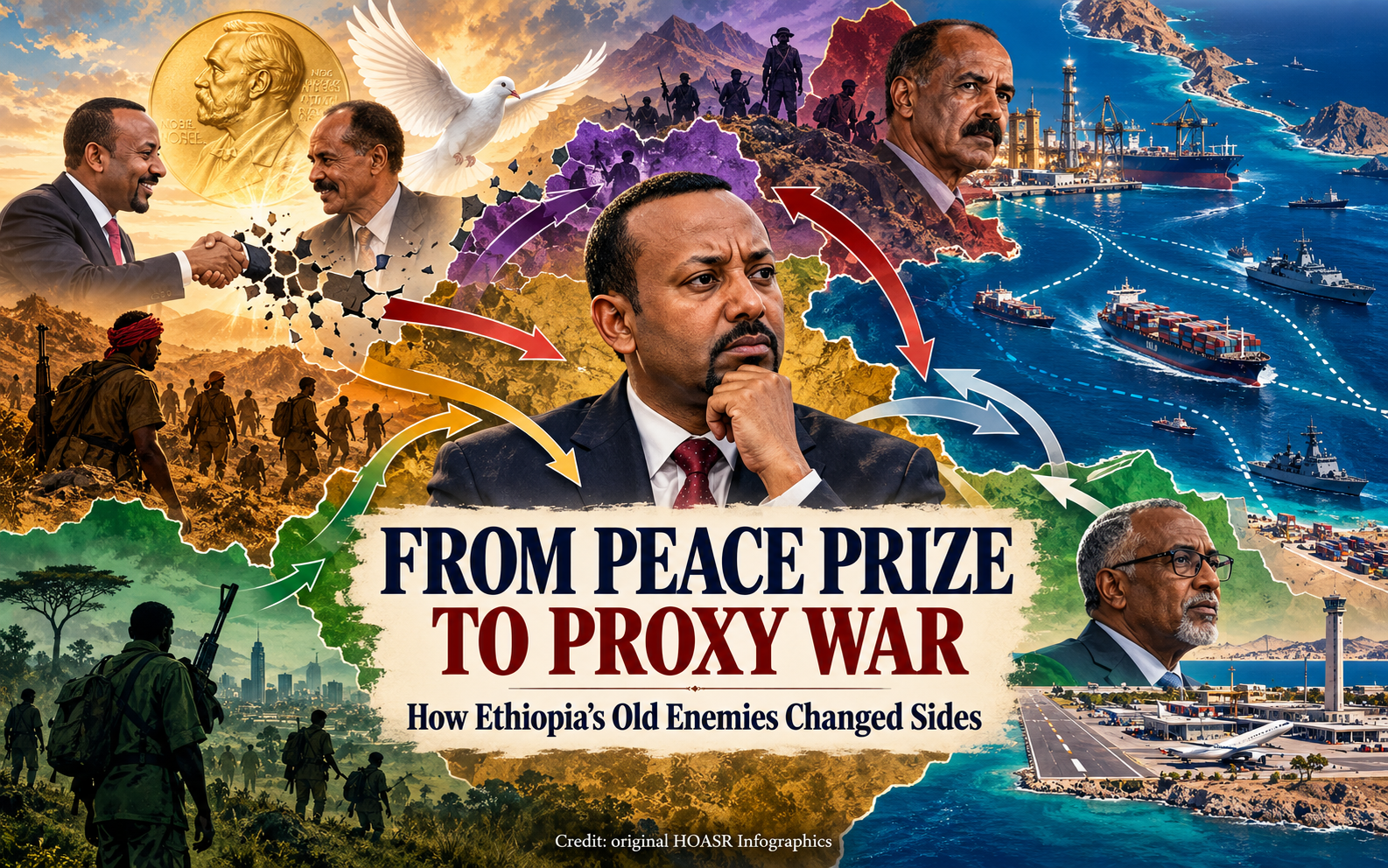
A geopolitical infographic illustrating Ethiopia’s changing alliances, the aftermath of the Tigray War, Eritrea’s renewed role and the strategic importance of Assab, Berbera and Somaliland. Credit: Original HOASR Infographics
The political map of the Horn of Africa has not changed. The alliances on that map have.
In 2020, Ethiopian Prime Minister Abiy Ahmed, Eritrean President Isaias Afwerki and Amhara forces fought together against the Tigray People’s Liberation Front. Today, Eritrea is accused of helping its former enemy. Fano forces that helped Abiy enter Tigray now attack federal supply routes. Tigrayan and Amhara movements that dispute territory have announced an alliance against Addis Ababa.
This is not simply a similar second Tigray war. It is the collision of three unfinished settlements: Eritrea’s separation from Ethiopia, the fragile Tigray peace and Ethiopia’s renewed search for direct Red Sea access. Mekelle is only one front. The deeper contest stretches from the Tigrayan highlands to Assab, Berbera, the Sudanese border and the wider Red Sea.
Eritrea’s road from federation to independence
Eritrea was an Italian colony until Italy’s defeat in the Second World War. Britain then administered it while the Allied powers and United Nations debated its future.
In 1952, the UN placed Eritrea in a federation with Ethiopia. Eritrea was to retain its assembly, constitution and domestic authority; Ethiopia controlled defence and foreign relations. Ethiopia’s need for sea access was already central. UN records
Emperor Haile Selassie dismantled Eritrean autonomy and absorbed the territory in 1962. An independence struggle had begun the previous year. Historical record
The Eritrean Liberation Front initially led the rebellion, later overtaken by Isaias Afwerki’s Eritrean People’s Liberation Front, or EPLF. The EPLF cooperated with the Tigray People’s Liberation Front against Mengistu Haile Mariam’s military government, the Derg.
Their cooperation was decisive. The EPLF captured Asmara in 1991 while the TPLF-led Ethiopian People’s Revolutionary Democratic Front entered Addis Ababa. Mengistu’s government collapsed, Eritrea became independent in practice and Ethiopia accepted that a referendum would determine its formal status.
In April 1993, Eritreans voted overwhelmingly for independence in a UN-observed referendum. Formal independence followed on 24 May. The peaceful process was a major African diplomatic achievement, but left Ethiopia without a coastline. UN referendum
Relations were initially close. The movements had shared weapons, territory and enemies. Ethiopia continued using Eritrean ports; trade and border movement remained relatively open.
Disputes over money, trade, borders and power eroded that friendship. Badme clashes escalated into war in 1998, killing tens of thousands before the 2000 Algiers Agreement. A boundary commission awarded Badme to Eritrea, but Ethiopia resisted full implementation. Boundary ruling
Nearly two decades of no war, no peace followed. Frontier troops remained, trade stopped and Eritrea became one of Africa’s most militarised states.
The peace that earned Abiy a Nobel Prize
Abiy became prime minister in April 2018, accepted the boundary ruling and travelled to Asmara in July to sign a Joint Declaration with Isaias.
Flights resumed, embassies reopened and separated families reunited. Images of Abiy and Isaias embracing created a powerful sense that one of Africa’s most bitter rivalries had ended.
The Norwegian Nobel Committee awarded Abiy the 2019 Peace Prize for his initiative. It acknowledged that peace depended on Isaias accepting the offer, although the prize went to Abiy alone. Nobel Committee
Yet the settlement was narrower than it appeared. It established a close relationship between leaders, without strong institutions to manage borders, trade, ports or future security disputes. It also had an unstated political target: the TPLF.
For Isaias, the TPLF had fought Eritrea and dominated a hostile Ethiopian government for nearly twenty years. For Abiy, it resisted centralisation and his replacement of the EPRDF coalition with the Prosperity Party. Both leaders had found a common enemy.
The Tigray war
The political dispute intensified after Abiy came to power. The TPLF lost its dominant role in the federal government, withdrew into Tigray and refused to join the Prosperity Party.
When national elections were postponed during COVID-19, Tigray held a regional vote in September 2020. Addis Ababa declared it unlawful; Tigrayan leaders accused the government of extending its mandate without constitutional authority.
War began in November 2020 after Tigrayan forces seized facilities belonging to the Ethiopian army’s Northern Command. Addis Ababa called it unprovoked; TPLF leaders claimed a pre-emptive move against preparations by federal and Eritrean forces. Who fired first remains politically contested, but both sides had prepared for confrontation. The first war produced a clear alignment.
Federal forces fought alongside Eritrean troops, Amhara regional units and Fano militias. Eritrea sought to destroy the TPLF threat; Amhara forces sought western and southern Tigrayan territory they regarded as historically Amhara.
The TPLF and Tigray Defence Forces united regional forces, military defectors, militias and volunteers. Reuters documented Eritrea’s assistance to Abiy and score-settling with the TPLF. Reuters investigation
Federal and Eritrean forces captured Mekelle, but the Tigrayan leadership withdrew into the mountains, reorganised and returned to guerrilla warfare. The TDF recaptured Mekelle in June 2021 and advanced towards Addis Ababa.
The Oromo Liberation Army coordinated with Tigrayan forces, sharing an immediate enemy rather than a political programme.
A federal counteroffensive, strengthened by foreign-supplied drones, pushed the TDF back. By late 2022, exhaustion, displacement, economic collapse and humanitarian disaster had made continued war ruinous.
Pretoria stopped the war but did not settle the conflict
The federal government and TPLF signed the Pretoria Agreement on 2 November 2022.
It ended large-scale fighting, provided for Tigrayan disarmament, restoration of federal authority and humanitarian access. It saved lives and created space for political negotiation, but its structural weakness was that only the government and TPLF signed.
Eritrea, Amhara forces and the OLA were absent. Western Tigray, outside forces’ withdrawal and displaced communities’ return remained disputed. Armed actors capable of restarting the war remained unsatisfied.
Fano felt Amhara interests had been sacrificed. When Addis Ababa later tried to integrate regional special forces into national institutions, Fano turned its weapons against the federal government in 2023.
Tigray also fractured. Getachew Reda’s camp worked with Addis Ababa through the interim administration. Debretsion Gebremichael’s faction resisted and restored the TPLF’s prewar leadership structure.
The federally backed Tigray Peace Force emerged from the anti-TPLF camp and fights alongside the Ethiopian National Defense Force. The peace had not united Tigray. It had produced rival Tigrayan armies.
Seven movements but not one army
On 20 September 2026, seven armed and political movements announced the Ethiopian People’s Forces Alliance for Survival, seeking Abiy’s removal. Reuters report
They are the TPLF, Amhara Fano National Movement, Oromo Liberation Army, Ogaden National Liberation Front, Afar Revolutionary Democratic Unity Front, Benishangul People’s Liberation Movement and Gambella People’s Democratic Movement. Group profiles
Their histories, territorial aims and military capacities differ. Some were recently enemies; the alliance is not a single national army.
The TPLF and TDF remain the strongest organised force in northern Ethiopia. They are fighting to preserve Tigray’s political autonomy, restore their authority inside the region and reverse federal and rival control of contested territory.
Fano seeks Amhara security, influence and territorial claims, opposing federal disarmament or absorption. Its cooperation with the TPLF is tactical; western and southern Tigray remain disputed.
The OLA fights over Oromo self-rule, exclusion and state violence. It coordinated with the TPLF in 2021 and joined politically, but strong public evidence of integrated northern operations remains absent.
The ONLF historically sought self-determination and resource control in the Somali Region, signing peace in 2018. Its reported alliance membership is internally disputed; a spokesperson described support as political, not military.
The Afar Revolutionary Democratic Unity Front, or Ugugumo, has fought alongside Tigrayan forces in northern Afar, briefly capturing Abala and Erebti before federal counterattacks.
The Benishangul People’s Liberation Movement and Gambella People’s Democratic Movement reflect long-running western borderland grievances over local control, political representation, ethnic security and competition over land. They broaden the alliance geographically, but verified evidence of major coordinated northern operations is limited.
This is a coalition of pressure points. Each attacks the federal state where it knows best. Weakening Abiy is the shared objective; what follows remains unanswered.
The battlefield does not tell the whole story
Federal forces and the Tigray Peace Force entered Mekelle on 3 October after the TDF withdrew. The advance was real, but not necessarily decisive.
The TPLF previously abandoned cities, preserved mountain forces, stretched supply lines and counterattacked. The 8 October Critical Threats assessment suggests the TDF is preparing asymmetric defence rather than accepting defeat.
The federal army must sustain long supply routes through hostile or unstable territory. Fano has attacked roads and towns along the A2 and B30 corridors connecting Amhara to Tigray. These operations serve its interests while complicating the federal campaign farther north.
Federal units, the Tigray Peace Force and aligned Amhara militias have competing southern Tigray claims. Clashes between allies show the coalition’s fragility. Capturing Mekelle differs from holding Tigray, securing roads and building legitimate government.
Eritrea: The wild card
The most striking reversal concerns Eritrea.
Addis Ababa now accuses Eritrea of supplying its former TPLF enemy and deploying troops. This suggests Isaias sees Abiy as the immediate danger, not that he trusts the TPLF.
Relations deteriorated after Eritrea’s exclusion from Pretoria and Abiy’s presentation of direct sea access as essential. References to Assab sounded in Asmara like territorial revision rather than requests for commercial access.
The 2024 Somaliland memorandum offered another route, without removing Eritrean fears. Abiy continued asserting Ethiopia’s right to participate in Red Sea affairs. An army advancing through northern Tigray could eventually threaten Assab.
Tigray therefore offers a buffer. Eritrean support apparently reflects an effort to prevent strategic encirclement.
On 9 October, Ethiopia told the Security Council that Eritrea had launched an all-out invasion, advancing 60 kilometres. Eritrea denied it, accusing Addis Ababa of using Tigray to justify attacking Assab. Reuters update
Witnesses and monitors reported troop movements and Ethiopian strikes on suspected Eritrean positions. Deployment size, mission and duration remain contested. Critical Threats assesses it was probably limited, reinforcing a Tigrayan buffer rather than starting full occupation.
Sudan turns the conflict into a regional proxy struggle
Sudan’s civil war complicates the equation.
The Sudanese Armed Forces are close to Egypt and have strengthened relations with Eritrea. The Rapid Support Forces have been widely accused of receiving UAE support, which Abu Dhabi denies.
The UAE also partners with Abiy. Ethiopia and the UAE deny helping establish an RSF facility in western Ethiopia.
Reuters reported Sudan hosted meetings contributing to the rebel alliance and that Tigrayan fighters had served alongside Sudan’s army. This shows connections, without establishing a regional command. Reuters analysis
For the TPLF and western Ethiopian groups, Sudan can provide political contacts, depth and access to supply networks. For Egypt and Eritrea, cooperation with its army strengthens a wider effort to limit Ethiopia’s power.
Addis Ababa sees potential encirclement: Eritrea north, Sudanese networks west, Egyptian Nile pressure and Somali opposition to the Somaliland agreement east.
But this is not a disciplined alliance. Egypt, Eritrea, Sudan and Somalia have overlapping concerns about Ethiopia, yet they do not have identical goals. Their cooperation is strongest when Abiy gives them a shared reason to coordinate.
The Red Sea is now inside Ethiopia’s conflict
Ethiopia legally accepted losing its coastline in 1993, but never fully absorbed it psychologically. A country of more than 100 million people depends heavily on Djibouti for maritime trade. Every Ethiopian government has sought alternatives.
Diversified port access is reasonable. Presenting access as territorial entitlement instead of commercial negotiation creates danger.
The Somaliland memorandum offered negotiated access and possible recognition for long-term maritime rights, alarming Somalia and Eritrea. Ethiopia Twin Obsessions
Somaliland’s recognition case should not become an instrument against Eritrea. Berbera’s strongest offer is stable, lawful, negotiated access, not a platform for territorial threats. Berbera
On 4 October, Egypt hosted Eritrea, Somalia and Sudan’s leaders at El Alamein. Their declaration defended Somalia’s claimed territorial integrity, opposed Somaliland recognition and reserved Red Sea governance for littoral states. Critical Threats viewed it as containment of Ethiopia’s Nile and maritime ambitions. El Alamein
Berbera is therefore more than an economic port or recognition asset. It enters the contest over access, security and influence on the Red Sea’s African shore.
Abiy’s central problem: Its weakness is political over-extension
Abiy controls the federal state, a larger military, drones and valuable external relationships.
Yet the government confronts Tigrayan forces in the north, Fano across Amhara and the OLA in Oromia. It faces chronic western instability, growing Eritrean tensions, strained Egyptian and Somali relations, and new frontier threats from Sudan’s war.
Town-level victories cannot resolve these conflicts. Each campaign may create another local force to arm, manage or disarm.
Centralization produces a common fear among otherwise distrustful groups: federal control over regional power, security and territorial decisions. That fear holds the alliance together more than ideology.
What comes next
A rapid rebel march on Addis Ababa is unlikely. Distance, leadership, ethnicity and territorial claims divide the movements, giving the government openings.
But the government faces a serious danger if it mistakes fragmentation for weakness. The alliance does not need to function as one army to exhaust the state. It only needs to keep several fronts active, disrupt transport routes and prevent the federal military from concentrating its strength.
Eritrean intervention would intensify pressure. Direct interstate war would bring regular armies, drones and long-range strikes into an already crowded conflict.
A durable settlement requires Pretoria implementation, territorial agreements, displaced communities’ return, resolution of Fano’s federal relationship and talks in Oromia and the Somali Region. Ethiopia’s legitimate port needs must be separated from implied claims over Eritrean territory.
The Scoop:
Abiy’s 2018 peace deserved recognition, but personal relations and common hostility towards the TPLF sustained it. Once the shared enemy ceased to dominate, the partnership broke apart.
Pretoria stopped war while excluding Eritrea, Amhara actors and several other armed movements. They reorganised, changed sides and returned to cooperate on the battlefield. TPLF and Fano have not resolved their territorial dispute. Eritrea has not forgiven the TPLF for the border war. The OLA does not share Fano’s vision of Ethiopia. Western and eastern movements have different local agendas.
They now see Abiy as the greater immediate threat. Military advances cannot settle these questions. The alliance is not powerful, but unresolved disputes make its tactical cooperation dangerous.
The most dangerous mistake would be to read the present conflict only through the capture of Mekelle. The real struggle concerns the balance of power between Ethiopia’s center and its regions, Eritrean border security, the future of Assab and Berbera, and the political order surrounding the Red Sea.
The central argument is clear: The 2018 peace concealed Ethiopia and Eritrea’s strategic rivalry without resolving it, while the 2022 Pretoria agreement stopped the Tigray war without settling the disputes that caused it. Those failures have now reversed old alliances and drawn Ethiopia’s internal conflicts into a wider regional struggle.
Abiy’s peace prize marked the end of one strategic order. The unfinished Tigray peace and pressure for Red Sea access are creating another. The coast has not changed hands. But the fear that it might have already changed the war.
Related Topics
Related Posts