
Somewhere between Texas and Jerusalem
Beside the Brays: Houstonian Antisemitism and the Friction of Fortification
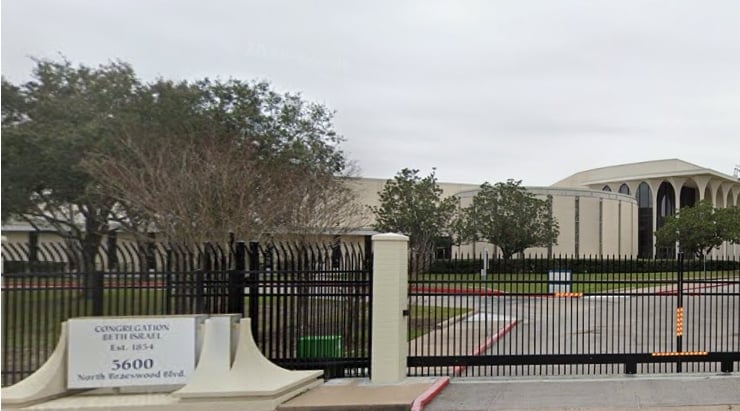
The exterior perimeter of Houston’s Congregation Beth Israel campus, which houses The Shlenker School. Synagogues and Jewish day schools nationwide have reinforced their street-facing entryways to enhance community safety. (Photo: Google Earth via Street View screenshot)
The Houston humidity smothers. In late April, the Texas air already carries a heavy, wet weight that settles into your clothes. Spring here doesn’t blow in; it seeps out of the bayou, a damp, heavy mist that slows your breath and makes the short walk from the car feel like wading through deep water.
Along Brays Bayou, the concrete channels snake through the flat expanse of the city, concrete baked gray by a relentless southern sun. The areas bordering the bayou—such as Meyerland, Braeswood, and Willow Meadows—traditionally serve as the historic heart of Houston’s Jewish community, hosting major institutions like the Evelyn Rubenstein Jewish Community Center and multiple historic congregations.
If you stand on the asphalt outside Congregation Beth Israel on Braeswood Boulevard, the city feels deceptively open, sprawling, and indifferent. But the geography of a modern diaspora is measured by its perimeters.
The Braeswood Spatial Contrast
Nestled on Congregation Beth Israel’s campus is The Shlenker School. To cross the threshold of the campus is to navigate an architectural fortifying process common to modern Jewish day schools. Visitors are met not by an open corridor, but by a guarded checkpoint and structural setbacks specifically engineered to absorb impact: the silent, hardened answer to a world where a car can be weaponized into an engine of hate. High-definition cameras track movement along the property line, while structural barriers and perimeter fencing turn a house of early childhood education into a secure compound.
A close look at the wrought-iron security gates sealing the perimeter is perhaps a grave contrast to the neighboring Brays Oaks community.
To understand the neighborhood’s bones, you have to look at the municipal record. The City of Houston’s historical profile of the area describes a classic boom-and-bust trajectory: “Brays Oaks was originally part of oil tycoon Walter Fondren’s ranch. Developers turned the undeveloped land into a new attractive location for young professionals. The area became one of Houston’s most accessible and popular communities….”
Essentially, on any given afternoon, the quiet tension of the campus perimeter bleeds straight into a sprawling, multicultural neighborhood where local food trucks line the streets, neighbors walk past mid-century ranch homes. There, traffic moves uninterrupted toward the Medical Center, delivery trucks are double-parking and commuters are taking advantage of any number of stops from which they can purchase and safely sip decadent iced coffee in open-air plazas. Here, behind reinforced blast walls, preschool-aged children are forced to navigate the exact same perimeter targeted by a foiled terroristic ploy.
A Siege Under the Houston Sun
On Wednesday morning, April 22, 2026, the campus of The Shlenker School fell completely silent. On a day when the space should have hummed with the bright, chaotic noise of primary school children arriving for classes, the doors were locked. The emergency closure followed direct, urgent guidance from the Houston Police Department, which had spent the preceding 24 hours working alongside the FBI to intercept an imminent, targeted vehicle-ramming plot.
The asymmetric terrorist scheme unraveled when a fast-moving, multi-state task force swarmed and arrested 18-year-old Angelina Han Hicks in Lexington, North Carolina. The localized threat right in the city’s backyard was neutralized when law enforcement arrested a 16-year-old juvenile in Harris County who was helping coordinate the logistics.
According to state prosecutors, Hicks was leading an encrypted online conspiracy “to kill as many Jews as possible” by weaponizing a vehicle directly into the Houston congregation. Working alongside two digital co-conspirators known only as “Angel” and “Teegan,” the cell had actively devised a mass casualty event scheduled to strike the campus.
The impending onslaught was narrowly averted by the rapid intervention of federal agents and local officers, triggering a sudden, protective lockdown of the shared campus. In a joint statement obtained by the Jewish Herald-Voice, Head of School Dr. Michelle Barton and president Arturo Karakowsky reflected the community’s sudden upending: “We acted quickly and out of an abundance of caution to ensure that no one was placed at risk.”
The sheer severity of the close call was echoed by the Jewish Federation of Greater Houston, which confirmed that after “significant discussions with both the FBI and HPD,” the Houston Police Department immediately flooded the zone, forcing “local law enforcement agencies [to increase] patrols around Houston-area Jewish institutions” to secure the city against any remaining ripple threats.
Classes have long been back in session, but the school’s fortified defenses serve as a constant reminder of the strict vigilance required to keep this community safe. Meanwhile, nearly immediately outside these security walls, the everyday rhythm of the surrounding Brays Oaks neighborhood carries on, largely unaffected.
The contrast is surreal against Houston’s otherwise effortless, multi-ethnic hustle amid a heavy denseness in the air which only serves as a thick reminder that, under the same Houstonian sun, some lives are lived in the open. Others, under siege.
The Deep Roots of Houston Hate
The threat on Braeswood Boulevard did not emerge from a vacuum. To understand how an eighteen-year-old could be drawn into a plot against a Houston synagogue, one must look at the historical soil of southeast Texas.
In the early 20th century, the Greater Houston area was a stronghold for the Ku Klux Klan, establishing a pattern of systemic exclusion that barred Jewish residents from elite neighborhoods, social clubs, and academic institutions. Over the decades, that localized animus shifted shape but never truly dissolved. Southeast Texas has long served as a quiet epicenter for violent extremist cells, from the historic footprint of the white supremacist Atomwaffen Division to the regional headquarters of deeply antisemitic black nationalist organizations.
2025 was the most violent year for American Jews since 1994
Today, that localized undercurrent mirrors a highly volatile national landscape. According to the Anti-Defamation League’s latest annual Audit of Antisemitic Incidents, overall reported incidents in the United States dropped by 33% in 2025 to 6,274 occurrences, driven primarily by a steep 66% decline on college campuses following strict institutional crackdowns. Yet, the raw numbers mask a far deadlier reality.
The same ADL data reveals that 2025 was the most violent year for American Jews since 1994, charting a historic high in targeted physical assaults and deadly weapon attacks.
Texas remains one of the worst states in the nation for these offenses.
In Houston alone, the ADL tracked 67 discrete incidents of antisemitic assault, harassment, and vandalism within the year, including local synagogue staff receiving direct threats stating that “Hamas ordered us to kill every Jew in America.”
Faced with this rising physical danger, the response from Texas leadership has been sharply divided between loud legislative action and noticeable silence. On the state level, Governor Greg Abbott has taken highly visible steps, issuing executive orders to combat antisemitism on college campuses, deploying over $4 million in state security grant funding directly to Jewish nonprofits, and tightening law enforcement coordination.
Conversely, local political analysts note that municipal and state leaders have often stayed mum on the structural drivers of the crisis. Lawmakers routinely avoid addressing how extreme gerrymandering in Texas has institutionalized political polarization, empowering radical fringe candidates on both sides of the aisle who openly flirt with antisemitic rhetoric.
While state officials are quick to sign checks for concrete barriers and armed guards, they remain largely silent on the regulatory vacuums that allow radicalization to flourish in the digital pipelines—leaving institutions like Shlenker to build bigger walls, and Jewish voters feeling increasingly isolated from the mainstream political apparatus. This silence extends to direct inquiries regarding the April plot; neither Texas State Representative Ann Johnson, the local lawmaker whose state house district directly encompasses The Shlenker School and Congregation Beth Israel campus, nor Mary Benton, Chief of Communications and spokesperson for Houston Mayor John Whitmire, responded to request for comment prior to publication.
Memory as a Shield of Hope
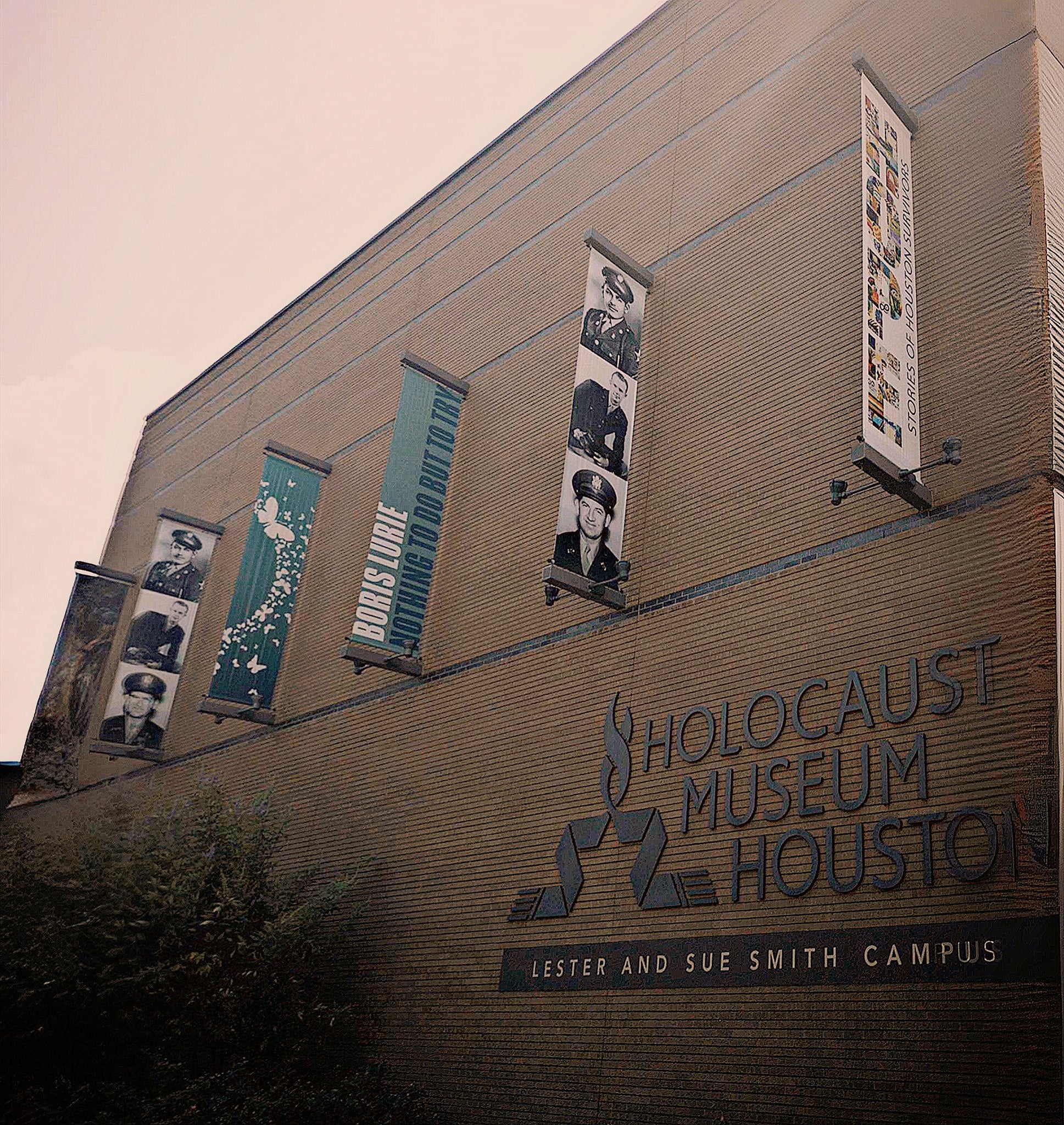
While municipal leaders remain silent on the systemic drivers of hate, the community’s defense has shifted from absent policies to concrete realities. The physical walls at Braeswood Boulevard are only one layer of the city’s defense; there is a psychological architecture at work here, too.
A twenty-minute drive northeast from Shlenker leads away from the concrete channels of the bayou and into the heart of the Museum District. There, Holocaust Museum Houston stands as a massive, deliberate structure of dark pocketed brick and stark angles, serving as an intentional monument to the perils of unchecked hatred.
Spending a morning inside the museum reveals how its role has transitioned from a repository of historical remembrance into an active moral command center. Leading this charge is CEO Gary Weisserman. A Michigan native and the son-in-law of a Holocaust survivor, Weisserman brought over 32 years of hard-nosed experience in K-12 and higher academic administration when he assumed the helm. Having previously run prominent institutions like Los Angeles’ Milken Community Schools and Chicago’s Bernard Zell Anshe Emet Day School, Weisserman is deeply familiar with the exact brand of campus anxieties keeping Shlenker parents awake at night. His leadership—recently recognized by the Houston Business Journal in their Most Admired CEOs index—treats the museum less like a vault for static relics and more like an active engine for civic defense.
Under his direction, the institution has radically expanded its mandate. Rather than simply teaching mid-century European history, the museum uses its specialized human rights galleries and educational toolkits to build “upstanders.” The museum’s grassroots, educational initiatives are filling in the gap to arm students, law enforcement, and regional educators with the explicit tools needed to detect and disrupt localized radicalization.
For Weisserman, the fight against the toxic normalization of online hate speech is urgent, with his goal being to use the museum as a beacon of uncompromising moral clarity. Addressing a largely non-Jewish audience—97% of guests, according to Weisserman—the institution proactively dispatches specialized educators who are directly asked to bring these vital lessons into classrooms and community spaces.
This proactive educational approach and community outreach, rather than a list of talking points, serves to fight hatred and apathy directly, as discussed in the context of the museum’s broader mission.
The Underground Calendar
There is a profound, structural irony in a city that prides itself on its effortless, multi-ethnic sprawl. On any given evening, candlelit patios fill with diners along Montrose, and traffic flows smoothly down Westheimer. Yet a few miles away, young children at The Shlenker School must play behind fortified boundaries, protected by armed deputies just to learn their alphabet safely.
You cannot build a perimeter thick enough to out-fortify a disease of the human heart. As the upcoming week begins, the local municipal machinery will predictably try to reset the clock, treating the dismantled April plot as an isolated, bad memory. But the digital asymmetric architecture that built the Harris County pipeline does not operate on a standard school calendar.
While the physical security gates at Congregation Beth Israel swing open for routine morning drop-offs, the uncaptured digital ghosts known only as “Teegan” and “Angel” remain active. Their encrypted chat rooms perhaps preparing for the forthcoming days. Hardening the concrete walls of our institutions buys time, but it hides a terrifying structural question. When the next high school bell rings across Houston this week, who is actually sitting at the desks—and who is quietly watching from the screen?
This is the first installment of a three-part investigative series.
Until then,
Heather Cathleen Cox
Author’s Note: Special thanks to CEO Gary Weisserman and Rachel Evans at Holocaust Museum Houston for providing access and critical insight into the community’s ongoing educational efforts.
Related Topics
Related Posts