Courtyards and Characters: Wandering Through Jerusalem’s Living Stories
Better Late Than Never?
Israel finally recognizes the Armenian Genocide. I wanted to hear what one grandson of a survivor thought.
One of the most haunting quotations ever attributed to Adolf Hitler had nothing, at least on its face, to do with the Jews.
As Nazi Germany prepared to invade Poland in 1939, some of Hitler’s generals reportedly expressed concern that the world would not tolerate the planned extermination of Europe’s Jews. Hitler dismissed those fears with a straightforward question: “Who, after all, speaks today of the annihilation of the Armenians?”
The Armenian Genocide had already begun fading from the world’s collective memory barely two decades after it occurred. If one of history’s first indisputable genocides could disappear from the world’s consciousness so quickly, Hitler believed, why should anyone expect history to remember another?
The message is all too clear. Recognizing genocide cannot change history, erase the trauma, or bring the victims back to life. What it can do is tell future generations that entire peoples cannot simply be erased from history and then forgotten.
That was the first thought that crossed my mind when I saw this headline last week:
ISRAEL RECOGNIZES ARMENIAN GENOCIDE AMID FROSTY TIES WITH TURKEY
My next thought was shame. How could it be that we were only doing this now?
As Jews, we understand better than anyone what it means to ask the world to remember. We have spent generations insisting that the Holocaust be documented, studied, acknowledged, and, most of all, never denied. It always seemed natural to me that the Jewish state would be among the first to recognize another nation’s historic tragedy.
I wasn’t quite sure how to process the news. Rather than reading some analysis or listening to yet another podcast discussing it, I decided to go somewhere far more interesting.
A few hours later I was walking through Jaffa Gate toward Elia Photo Shop, where I knew I would find the person who could help me make sense of it all.
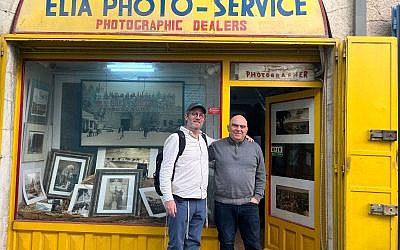
Many of you have met my friend Elia through these pages before. His family’s photography gallery is one of my favorite places in the Old City, its walls covered with extraordinary images of Jerusalem stretching back more than a century. Every visit begins with a cup of espresso rather than Turkish coffee, breaking from local custom here. I never asked why, but I have my suspicions. Ordering Turkish coffee in an Armenian shop feels a bit like asking a Jew to drive a German car.
The espresso and small talk inevitably give way to a history lesson as Elia pulls another remarkable photograph from a drawer and somehow makes the Jerusalem of a hundred years ago come vividly back to life.
Long before his family became known for preserving Jerusalem’s history, however, they became part of history themselves.
Elia’s grandfather survived the Armenian Genocide.
A Century Earlier
Beginning in 1915, during the final years of the Ottoman Empire, the empire’s Armenian population was systematically uprooted from its ancestral homeland. Armenian men were often separated from their families and executed. Women, children, and the elderly were driven from their homes and forced on death marches across the Syrian desert with little food or water. Entire villages disappeared. By the time the killings and deportations ended, historians estimate that between 800,000 and 1.5 million Armenians had died through massacre, starvation, disease, and exposure.
For Armenians, this is not ancient history. Nearly every Armenian family in Jerusalem carries a personal story that begins in 1915. Like Jewish families whose identities were forever shaped by the Holocaust, Armenian families understand their own history through the lens of the genocide.
Among historians, there is little serious debate about what happened. The overwhelming scholarly consensus has long recognized these events as genocide. The controversy surrounding recognition has rarely centered on the historical evidence. It has almost always been about politics.
That has certainly been true in for Israel.
The Long Road to Recognition
For decades, successive Israeli governments deliberately avoided formal recognition for strategic reasons. Turkey was, for many years, Israel’s closest Muslim ally. The two countries maintained military cooperation, shared intelligence, extensive trade, and tourism. Blaming them for a genocide was too risky at the time.
More recently, Azerbaijan, a seventy percent Shi’a Muslim country, became one of Israel’s most important regional partners. Israel supplies advanced defense technology to Azerbaijan, while they provide a significant portion of Israel’s oil imports.
And let’s remember, Azerbaijan has had long-running conflict with neighboring Armenia. Since the breakup of the Soviet Union more than three decades ago, the two countries have fought a series of wars over Nagorno-Karabakh, a disputed territory claimed by both sides. Israel’s close relationship with Azerbaijan has understandably made successive Israeli governments wary of taking steps that might be perceived as siding with Armenia.
One Israeli government after another concluded that recognizing the Armenian Genocide would unnecessarily jeopardize relationships considered vital to Israel’s security.
I understand those calculations, but I have never been entirely comfortable with them.
Governments do not have the luxury of conducting foreign policy based solely on moral principles. They are responsible for protecting their citizens, maintaining strategic alliances, and navigating an imperfect world.
Still, I have always found it difficult to reconcile Israel’s position with our own historical experience.
The Jewish people rightly insist that the Holocaust be remembered honestly and without qualification. We object when governments minimize it, distort it, or deny it altogether. If there is one nation that should instinctively understand why historical recognition matters, I have always believed it should be ours.
Coffee with Elia
Those thoughts were still running through my mind as I stepped into Elia’s gallery.
A group of tourists was browsing among the framed photographs, admiring them, but eventually leaving empty-handed. Without tourists in the city, business has been painfully slow for Elia.
Before we had even finished exchanging greetings, I launched straight into the question that had brought me there.
“So,” I said, “Israel finally recognized the Armenian Genocide?”
He smiled.
“Not exactly.”
He explained that the bill still needed to pass one more vote in the Knesset, a rather important detail that many news reports had conveniently omitted.
According to Elia, he has watched this same story unfold repeatedly over the years. Politicians make statements. Newspapers publish headlines. Expectations rise. Then the moment quietly disappears.
“This isn’t the first time,” he told me. “Israel always uses this as a political card.”
There was remarkably little anger in his voice. More than anything, I sensed resignation. After hearing similar promises for decades, skepticism had become second nature.
I asked him why he thought the issue had resurfaced now.
“Simple,” he replied. “Because Turkey is on the wrong side now.”
It was difficult to argue with his assessment.
Israel’s relationship with Turkey has deteriorated dramatically over the past several years. The strategic calculations that once discouraged recognition are no longer what they were twenty years ago. Whether that fully explains the timing, I cannot say, but it almost certainly explains part of it.
One final thought occurred to me.
“Could part of this be Israel trying to remind the world what a genuine genocide looks like?” I asked. “At a time when so many are accusing it of committing one in Gaza?”
Elia didn’t respond. He simply lifted his eyebrows with an intrigued look, leaving the question hanging.
Then I asked Elia what seemed to me the most important question.
“If this actually becomes official,” I asked, “how will Armenians feel?”
He paused for a moment.
“I guess it’s better late than never. But there won’t be any celebrations,” he said. “No one imagines that official recognition somehow heals a century-old wound.”
Recognition, he explained, simply acknowledges that history happened. It tells survivors and their descendants that the world is finally willing to call their suffering by its proper name.
“It would close a chapter for us,” Elia said, “but it cannot erase what came before.”
Then I asked him about his grandfather.
“What would he say if he were sitting here with us today?”
“He’d be pissed.”
We both laughed.
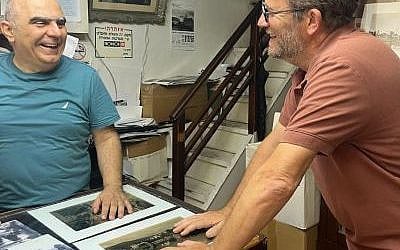 His grandfather, he said, had always expected Israel to recognize the Armenian Genocide from the very beginning.
“A people that had lived through the Holocaust should have understood instinctively why historical acknowledgment mattered,” he said.
The Photo I Couldn’t Resist
As our conversation drifted away from politics and back toward Jerusalem, I found myself like a child in a candy store. Surrounded by these extraordinary photographs, my eyes wandered from one image to the next. The remarkable thing about Elia’s gallery is that every photograph has a story, and Elia somehow seems to know almost every one of them.
He began pulling prints from drawers, each one opening another window into the city’s past. We looked at forgotten hotels, vanished storefronts, pilgrims entering the city, and streets filled with Bedouin, Ottoman officials, merchants, travelers, local Arabs, Jews, and Europeans, all sharing the same Jerusalem.
Then one photograph stopped me.
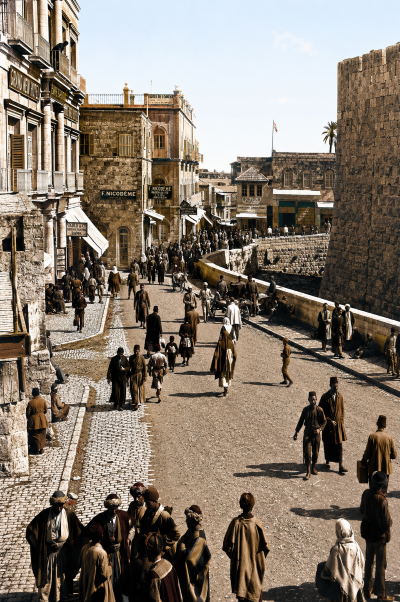
It was an extraordinary view of Jaffa Gate taken around 1900. I’ve walked through that gate hundreds of times, yet here was the same place bustling with life more than a century ago. The people were different. The buildings were different. The city somehow wasn’t.
“I’ll take this one,” I said, without even asking the price.
The truth is, I wanted an excuse to support Elia. It’s hard for me to imagine a Jerusalem without Elia’s shop. More than that, I wanted to take home a small piece of the afternoon we had just shared.
The photograph will soon hang in my office, and I know that every time I look at it I’ll remember our conversation that took place a few hundred yards away from that spot in the photo, over espresso, about memory, history, and the sad ways that politics can get in the way of truth.
Governments do what governments do. They weigh alliances, security interests, diplomatic consequences, and political realities. Sometimes those calculations lead them to ignore things that everyone knows to be true.
For Elia, however, this was never really about Turkey, Azerbaijan, or the latest political maneuvering in Jerusalem. It was about his grandfather. It was about whether the Jewish state that he proudly calls home was finally prepared to acknowledge the trauma his family has carried for more than a century.
Whether this latest announcement ultimately becomes official recognition or simply joins the long list of previous attempts remains to be seen. Elia has watched enough of these moments to remain skeptical.
I hope this time he is wrong.
If there is any nation that should understand the moral importance of recognizing another people’s greatest tragedy, it ought to be the nation whose own history has taught the world that forgetting is an evil in its own right.
And here is the photograph I brought home from Elia’s gallery, taken just inside Jaffa Gate around 1900.
Related Topics
Related Posts