
Looking forward
Featured Post
Between Athens and Jerusalem is Yom Kippur
Antisemites who think Jews seek world domination don't get the Jewish focus on self-determination in Zion. They need Yom Kippur's annual reminder of our imperfections and limits
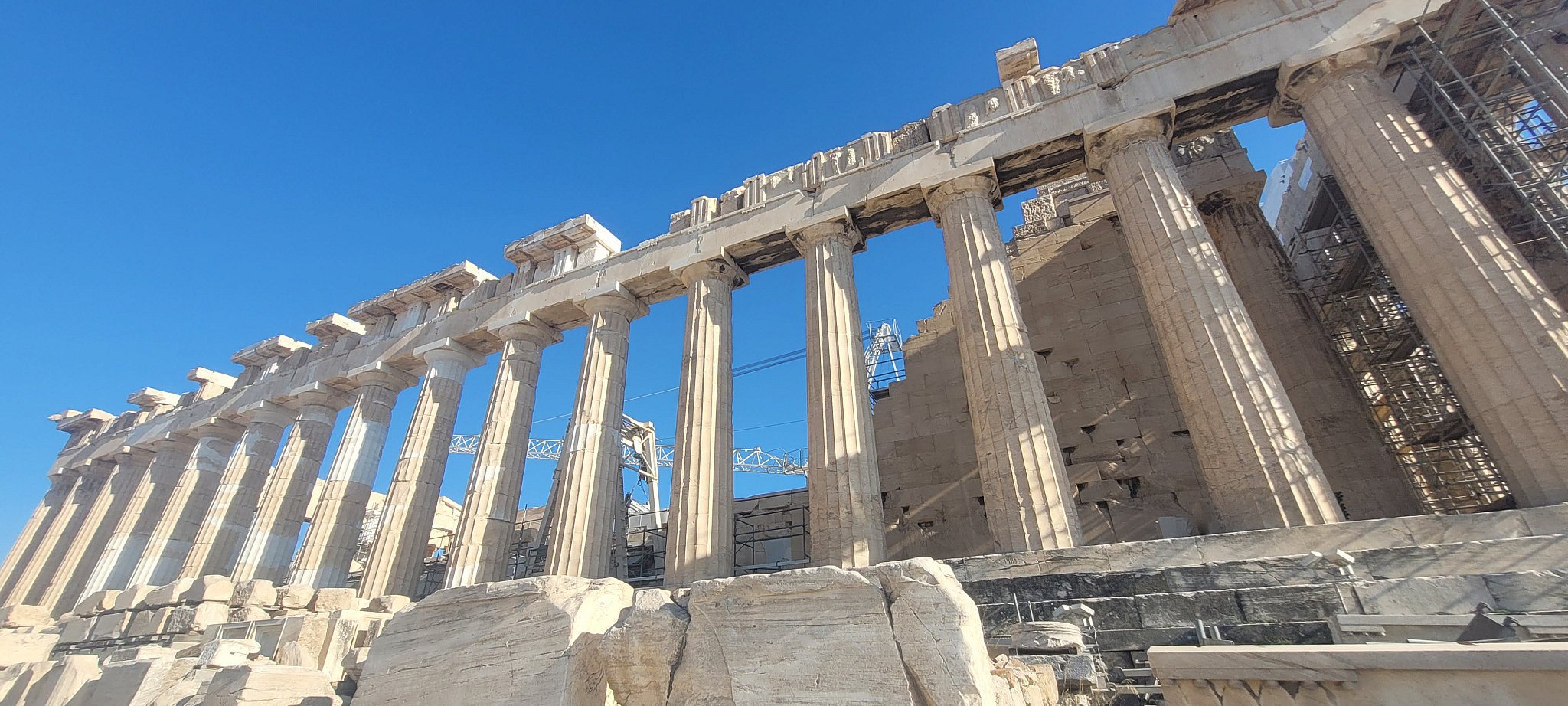
The ruins of the Parthanon (picture taken by author)
What the destruction and rebuilding of the Parthenon and the Temple can teach us about power, limits, and the Hebrew alternative to Western certainty
This summer, I visited the Acropolis Museum in Athens, Greece, where I noticed that the murals adorning one side of their temple (known as the Parthenon) portray scenes from a procession to sacrifice to their goddess, Athena: a bull being led to the altar, two sheep, water to wash the table where the work is done. Nearly identical to the description of the order of sacrifices in the Temple of Jerusalem I happened to be reading about at the time. And then I noticed the dates: the first version of the Athenian temple was destroyed in 480 BCE by the son of the Persian Emperor Darius who declared war on the Greeks, Darius being the same Persian emperor who provided the funds and experts to help the Jews rebuild our Temple in Jerusalem.
The Greeks eventually defeated Persia and rebuilt their temple with the spoils won in the war. Shortly thereafter, they went on to conquer the Mediterranean basin and beyond. Their self-confidence spawned an adaptable, flexible, universalizing culture. An imperial culture, one that absorbed others into their matrix, enabling each of the people they conquered to see themselves reflected in the universal so long as they accepted the rule of their betters.
I can’t stop thinking about the literal, historical co-incidence of these events. Little less than a century before the destruction of the first Parthenon, our own first Temple was destroyed in 586 BCE. Unlike the Greeks, we did not end up defeating the Babylonians and did not win any spoils. Unlike the Greeks, we had to beg and plead our case before the empire who defeated the Babylonians, Persia, and to attain the then-emperor Cyrus’s favor so that we may be permitted to return to our ancestral land. And unlike the Greeks, this means that when our Temple was rebuilt, we knew quite well that despite our belief in the oneness of the Most High and our covenant with the Eternal, our ability to live in our land was contingent upon the favor of temporal powers and their leaders.
Maybe that is why we Hebrews kept our ambitions local to the land between the river and the sea. We bristled and rebelled when we were told we could only celebrate our particularity within their universal framework, but remained satisfied when we were left to manage our own affairs. Even when we dispersed to lands ruled by the Persians, then the Greeks, and later the Romans, we stayed distinct, communally oriented, content to channel our tribute to Zion and limit our aspirations to self-determination.
This distinction has been reflected in our systems of thinking since, and has shaped our understanding of the other. The Greeks and their heirs in the West seek the universal, the scalable. Philosophy assumes to uncover the absolute truth, and derides any who do not accept it for being illogical. We Hebrews, on the other hand, may have had a broader vision for humanity at some point, but universalizing those ideas was never our ambition. Our greatest thinkers and teachers were content to focus on our own behavior as a collective, to shape our own way of life. Case in point: those with higher ambitions went elsewhere, such as Rome to found a church, to Mecca to found an umma, to London to found a revolutionary movement.
This distinction is imprinted in the stories each of our cultures tell: Greek myths celebrate power and its rights, recognizing the injustice in the world as a fact of life even as they aspire to a universal ideal. The Greeks invented the idea that there can be a singular retelling of events that harmonizes experiences of reality through a practice we’ve come to call “history,” and which is really an opportunity for the victorious to tell his story of what happened and why he won. The Hebrews, on the other hand, told moralistic tales, stories of our family, its travails, and the rules to live by that we agreed to in covenant. There is a reason the stories of our people are called Torah, translated as teaching, and meant to be wrestled with and refracted through commentary.
This paradigmatic difference, I believe, has real contemporary implications: it is hard, for example, for the Hellenicized West to accept that Jews, even in their most extreme, only want to be left alone in the land of our ancestors. It is nearly impossible for those raised on universalizing concepts to understand what it means to be fundamentally satisfied with a small piece of the pie, disputed though it may be. Attempts by Jews to protest against theories of their global ambition are seen as nefarious admissions of global conspiracy, of universal impulses not acknowledged. Antisemitism, and its contemporary expression of anti-Zionism, results from this cognitive dissonance: the inability for the West to understand why a people with such native talents limits itself to such small ambitions.
Wokeness, in this understanding, is quintessentially Hellenic, Western: a faith of universalistic proportions with the ambition to judge the world according to a single set of standards. An imperialistic righteousness applying ideas developed in one context – Black/White relations in America – to all others. Its fundamental problem with Zionism stems from the same fundamental cognitive dissonance that birthed antisemitism: how is it that we, as a collective, who are so very focused on our own morality, a people so fundamentally involved in human rights work and international law, cannot accept their universal truth? The conclusion they come to, the conclusion any universalistic faith always comes to, is that if we do not accept their ways we are sinners and must be saved, conquered so as to be forced out of the error of our ways.
Yom Kippur, in its post-Temple form, feels to me to be the antidote for such certainty. Encapsulated in the Ten Days of contemplation and teshuva (roughly translated as “an attempt to return to the right path”) before Yom Kippur is a Hebrew ethos forged in exile that I believe we may want to share with humanity more broadly: an annual reminder of our imperfection, of the fundamental fact of the limits of power. The acceptance of uncertainty.
I believe our own, Hellenized, leaders who aspire to turn Israel into super-Sparta could also benefit from the lesson taught by the Yom Kippur vidui, normally translated as confession but actually meaning a taking of responsibility: that we are responsible for the actions of those with whom we share community, individually responsible for the lives and livelihood of others. That we are dependent on others. That even those of us who believe we are righteous bear guilt, and that even those of us who think of ourselves as sinners have a chance to change our ways, and that often we are both and the same. That the world, that humanity, that truth, is too heavy for any one nation’s shoulders. That we can all benefit from seeing Temples broken, from accepting the limits of our expectations from the Lord of Hosts, from experiencing uncertainty. Understanding that all of us require to both request forgiveness and to forgive and to strive to fix and be fixed so that we may be inscribed in the Book of Life.
Related Topics
Related Posts