French-Israeli Visual Artist and Writer
Between Languages and Silences – Noah 5787
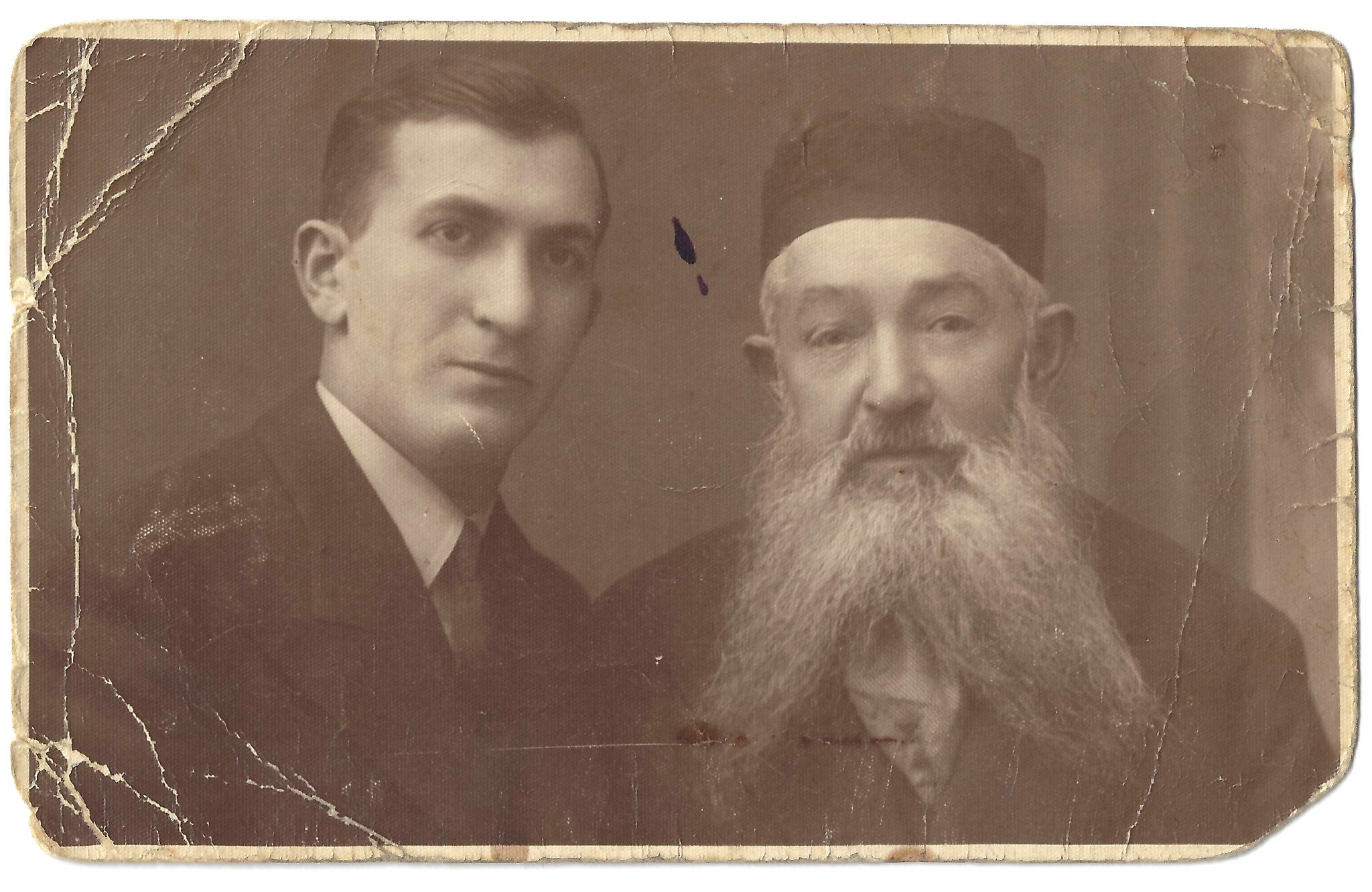
From left to right: Abraham Mandel and his father, Pessah Mandel. Kozienice, Poland, circa 1935. Family archive.
I approach the weekly Torah portion not as a religious scholar or someone seeking to offer an authoritative interpretation, but as a secular Jew for whom Jewish texts remain a source of curiosity, questioning, and spiritual reflection. My reading is shaped by commentaries, personal experience, and the circumstances of my life at the moment I encounter the text. As a visual artist and writer, I am particularly interested in what happens when these encounters become part of a creative process. This is an attempt to enter into conversation with the parasha, rather than to explain it.
Between Languages and Silences – Noah 5787
In Parashat Noah, the Torah traces the generations following the Flood, naming families and peoples, the lands in which they settle and the languages they speak.
Then, in the story of the Tower of Babel, we encounter a world in which everyone shares a single language.
The people understand one another and undertake an ambitious collective project: building a city and a tower reaching toward the heavens, hoping to make a name for themselves. But God intervenes, confuses their language and disperses them. Unable to understand one another, they abandon their project.
There are many ways to read this story, but what stayed with me this week was the relationship between language and communication: what becomes possible when people understand one another, and what happens when communication is interrupted.
When my grandmother died, I discovered family photographs I had never known existed while emptying her apartment. Given everything my family had lived through, I had assumed that little of that earlier world had survived.
Yet there they were: unfamiliar faces, people whose names I often didn’t know and whose lives I knew almost nothing about.
The photographs recently came into my possession, along with other family documents. This week, looking through them more closely, I found myself moving through generations in the opposite direction from the genealogies in Noah: tracing my ancestors backward, beginning with people I could not identify.
On the back of one photograph, I found a name and some information written in French.
Those few words gave me a starting point. Following names and family connections, I eventually discovered testimonies written in English by a descendant of the family, revealing parts of our history in Poland that I had never known.
It was an exciting discovery. Someone previously unknown to me was becoming a person with a history. A few handwritten words had opened a path toward memories preserved in someone else’s account.
Other photographs, however, had inscriptions handwritten in Yiddish, a language I know too little of to decipher the inscriptions.
Yiddish was my grandmother’s first language. She helped raise me, and we were deeply connected. When my sister and I wanted to learn Yiddish as children, she was excited by the possibility of sharing her language with us. My mother, whose relationship with Yiddish was shaped by painful family history, would not allow it.
But this week, looking at those photographs, I realized that the absence of Yiddish was only part of what I was confronting.
My grandmother also spoke French. Had I known she possessed these photographs, I would have asked her to sit with me, identify the people, translate the inscriptions and tell me whatever she remembered. I could have recorded their names and stories in French.
But I didn’t know they existed until after she was gone. She had never shown them to me.
I don’t know why, and I don’t want to presume to know. Perhaps the reasons belong to the very family history I am now trying to understand.
We had a language in common, but those conversations never happened.
Reading Babel made me think about communication beyond language itself. In the biblical story, people become unable to understand one another. With my grandmother, the possibility of communication existed, yet some things were never brought into our conversations.
Transmission, I realized, is shaped not only by what passes between generations, but also by what doesn’t. What remains unspoken may be as much a consequence of family history as what is deliberately shared. Those silences, too, become part of our inheritance.
The Yiddish inscriptions, however, are not necessarily inaccessible forever. Yiddish remains a living language, and I have people and resources that can help me decipher them. I may yet discover names, places or details that open further paths into my family’s history.
What I cannot recover is everything my grandmother might have told me about those people. Even a complete translation cannot replace her memories, her relationship with them or the conversations we could have had.
And yet, this week was also about the possibilities that remain.
I began sharing my discoveries with my children, my sister and relatives from my mother’s side of the family. New conversations followed. Some had information I didn’t know. Other memories emerged, bringing new questions and new directions for research.
What began as an individual search through old photographs became a shared exploration. We could no longer ask my grandmother, but we could ask one another.
There was something deeply fulfilling about discovering how much could still be learned, across generations and languages.
This curiosity also shapes my wider relationship with Jewish history, through research, writing and artistic creation. I seek out histories I did not necessarily inherit myself, making them accessible to others without deciding what those histories should mean to them.
Returning to Babel, I find myself thinking not only about the confusion of languages, but about what becomes impossible when communication breaks down. The people can no longer understand one another, and what they were building together comes to an end.
In my family, the interruptions were different. My grandmother and I shared a language, yet there are conversations we never had and can never have now. But this week, a name written in French led me to testimonies in English about our family in Poland, and from there to new conversations with people who may hold other pieces of that history.
The Yiddish inscriptions are still waiting to be deciphered, and I have ways to pursue their meaning. What my grandmother might have told me will remain beyond my reach. But there are still people to ask, stories to uncover, and conversations whose possibilities I cannot yet imagine.
Related Topics
Related Posts