Between Silence and Witness: A Gentile in a Jewish Room
A few days ago, I stood at the front of the community room next to the Beth Israel synagogue in California, looking out at rows of Jewish families waiting for a film to begin. The movie, Swedishkayt, is a very funny, very Jewish, very Swedish documentary. My task was simple on paper: say a few warm words, make people smile, set the tone. Instead, I stood there with a knot in my chest.
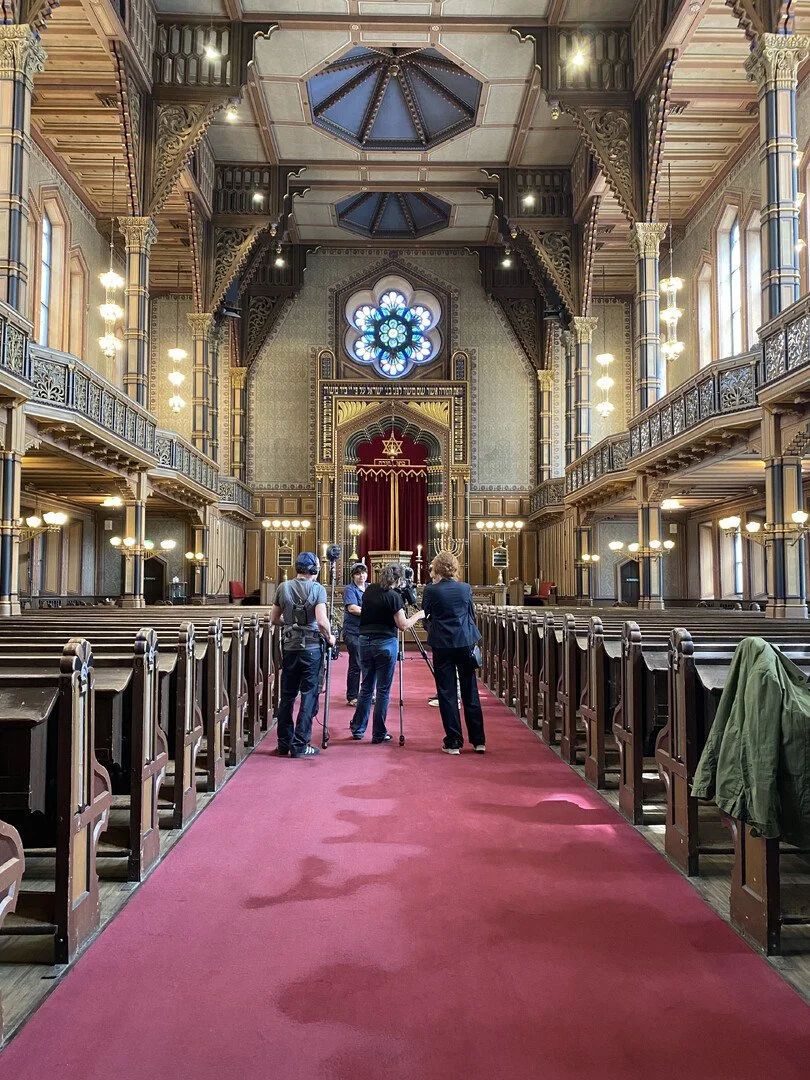
It wasn’t stage fright. I’ve spoken in public before. It was the question of whether I, a gentile from Sweden, had any right to speak in that room about Jewish pain, about Israel, about the way my own country has begun to lose its moral bearings. With my Jewish friends back home, I kept circling the same dilemma: if you don’t speak, does your silence become a kind of consent? If you do speak, do you risk fanning the flames?
The roots of that knot go back to early 2020, when I travelled to Israel—not as an activist or expert, but as a curious visitor who wanted to see beyond headlines. There I met two writers: Palestinian Raja Shehadeh and Israeli Yossi Klein Halevi. Listening to them, I realized something that has haunted me ever since: if we are not willing to hold two honest, conflicting truths in our hands at once, we end up holding neither.
From there, I went to the southern border. In Sderot, I saw playgrounds built as bomb shelters so children wouldn’t grow up fearing the concrete domes that might one day save their lives. In nearby Netiv HaAsara, looking directly into Gaza, I stood before the “Path to Peace” wall, covered in tiny ceramic tiles—hearts, doves, fragments of color, a fragile insistence that beauty and hope still belong there.
When October 7 came, those places reappeared in my life through a screen. The streets I had walked suddenly showed up in footage of slaughter and chaos. It took a moment to realize that this was not stock video, not another “Middle East conflict” montage, but the same roads, the same houses, now crime scenes.
In Sderot, a woman was found dead in the doorway of her home, shot at close range. Her little boy lay beside her, executed at her feet. The plastic grocery bag she’d been carrying had burst when she fell. Apples, a bottle of milk, some vegetables—ordinary items from an ordinary morning—were scattered over the front steps, soaked in her blood. It was not a battlefield. It was someone’s home. Someone’s child.
That scene became, for me, the symbol of October 7—not because it was the worst thing that happened that day, but because it stripped away every layer of rhetoric and crashed into the realm of the human. The first shock was the brutality itself. The second came almost immediately afterward, from people and places I thought I knew: young Americans and Europeans, some highly educated, doubting or downplaying what had happened, suggesting the reports were exaggerated or “understandable, given the history.” As if Jewish testimony must always be cross-examined, as if Jews are suspect narrators of their own suffering.
Then I turned my eyes homeward to Sweden—the Sweden that raised me with a sense of social responsibility and moral clarity—and something in me sagged. In the months after October 7, antisemitic hate-crime reports in Sweden didn’t just “tick up”; they exploded. A flood of threats, abuse and intimidation has been directed not at “Israelis on the news,” but at Jews in Swedish streets, schools and workplaces. Synagogues and community centers now operate behind heavy security. In schools, Jewish children are told not to wear a Star of David, not to mention that they have family in Israel, not to say out loud that they are Jewish at all.
Meanwhile, anyone who points out that a significant share of this new antisemitism comes from parts of the immigrant population from the Middle East is immediately met with the word islamofobi—Islamophobia—thrown like an invective, more to end the conversation than to deepen it. Instead of allowing us to name the fact that some newcomers arrived with decades of state-sponsored Jew-hatred in their political and religious baggage, we are told that even raising the issue is bigotry. Jews bear the brunt of this imported hatred, while many non-Jews who see it clearly retreat into a frightened politeness.
This reluctance to name what is happening is reflected in how our institutions speak about Jewish suffering. Major newspapers and public broadcasters hedge Jewish pain with quotation marks and caution. On streets and campuses, eliminationist slogans are chanted by people who insist they are targeting “only” a state, as if the Jews listening have no bodies or memories attached to that word. Places that once prided themselves on tolerance and solidarity have become arenas where Jews are pressured to choose between their safety and their visibility.
Standing inside that contradiction, I realized that what I felt was grief—a grief that seemed strangely personal for someone who is not Jewish. I also know, with the cold clarity of a European born in the 1950s, what silence can do. Whatever the mix of reasons, I found I could no longer stay comfortably quiet.
So when I was asked to introduce Swedishkayt, I arrived with all this inside me: the woman and child at the doorway, the Path to Peace wall, the Swedish headlines and chants, the conversations with my Jewish friends back home. I also arrived with a reluctance to center my own feelings in a room filled with people whose connection to this pain is far deeper and older than mine. I kept wondering whether this was my story to tell at all.
In the end, I decided that my responsibility, modest as it is, was to speak as honestly and carefully as I could—not as a representative of anyone, but as a witness. Not to speak for Jews, but to speak to my own people, to my own country, to the world I come from. I spoke about being Swedish and watching my country lose its moral orientation, about the trip to Israel, about Sderot and Netiv HaAsara—places that are now both real landscapes and inner landmarks for me. I spoke about the mother and the child and the groceries, because not speaking about them would have felt like betrayal. I spoke of my apprehension: of being a gentile in a Jewish room, afraid of trespassing on someone else’s sorrow, but more afraid still of becoming one more well-meaning bystander who chooses comfort over clarity.
Then I tried to connect that darkness to the light we were gathered for: to Swedishkayt itself, to Jewish humor, to the stubborn refusal of this people to let their identity be defined only by catastrophe. Humor, I realized, is not the opposite of grief. It is grief’s neighbor. Jewish jokes have lived for centuries alongside pogroms and expulsions and blood libels. Laughter, in this tradition, is not denial. It is defiance.
People later came up to me in the social hall. Some simply said “thank you.” Others shared their own stories of fear, of relatives in Israel, of children on American campuses. A few said what touched me most: that it mattered to them to hear a non-Jew speak clearly, without the familiar “yes, but…” that so often creeps in when Jewish suffering is acknowledged.
I’m writing this not to congratulate myself for showing up in one Jewish community room at Beth Israel, but to keep working through the question that tugs at me: What is the responsibility of the outsider when a minority community is being slandered, threatened, or slowly pushed out of the moral circle? I am more convinced than ever that total silence is not an option—not if we want to live with ourselves later.
To my fellow Swedes, and to others in comfortable majority cultures: if even one of us sees clearly what is happening and remains quiet, the silence grows louder. It becomes easier for others to retreat into the safety of not knowing, not asking, not noticing.
On that afternoon, sitting among Jews laughing at Swedish absurdities and Jewish neuroses, I was reminded of something basic and beautiful: Jewish life is not a tragedy. It is a living, breathing, laughing, arguing, stubbornly hopeful civilization. It deserves not only protection but companionship. Sometimes that companionship looks like joining the laughter. Sometimes, before the laughter, it looks like telling the truth, as best you can, even when your voice shakes.
I was apprehensive about telling my own story in that community room at Beth Israel. I still am, writing it down here. But the alternative—to leave the woman and child in Sderot, and the people of Netiv HaAsara, and my Jewish friends in Sweden, unmentioned—feels like a worse kind of intrusion. So this is my way of saying: I see you. Your grief reached me. Your humor did too. And as long as I have a voice, I will try, however imperfectly, not to leave you alone with either.
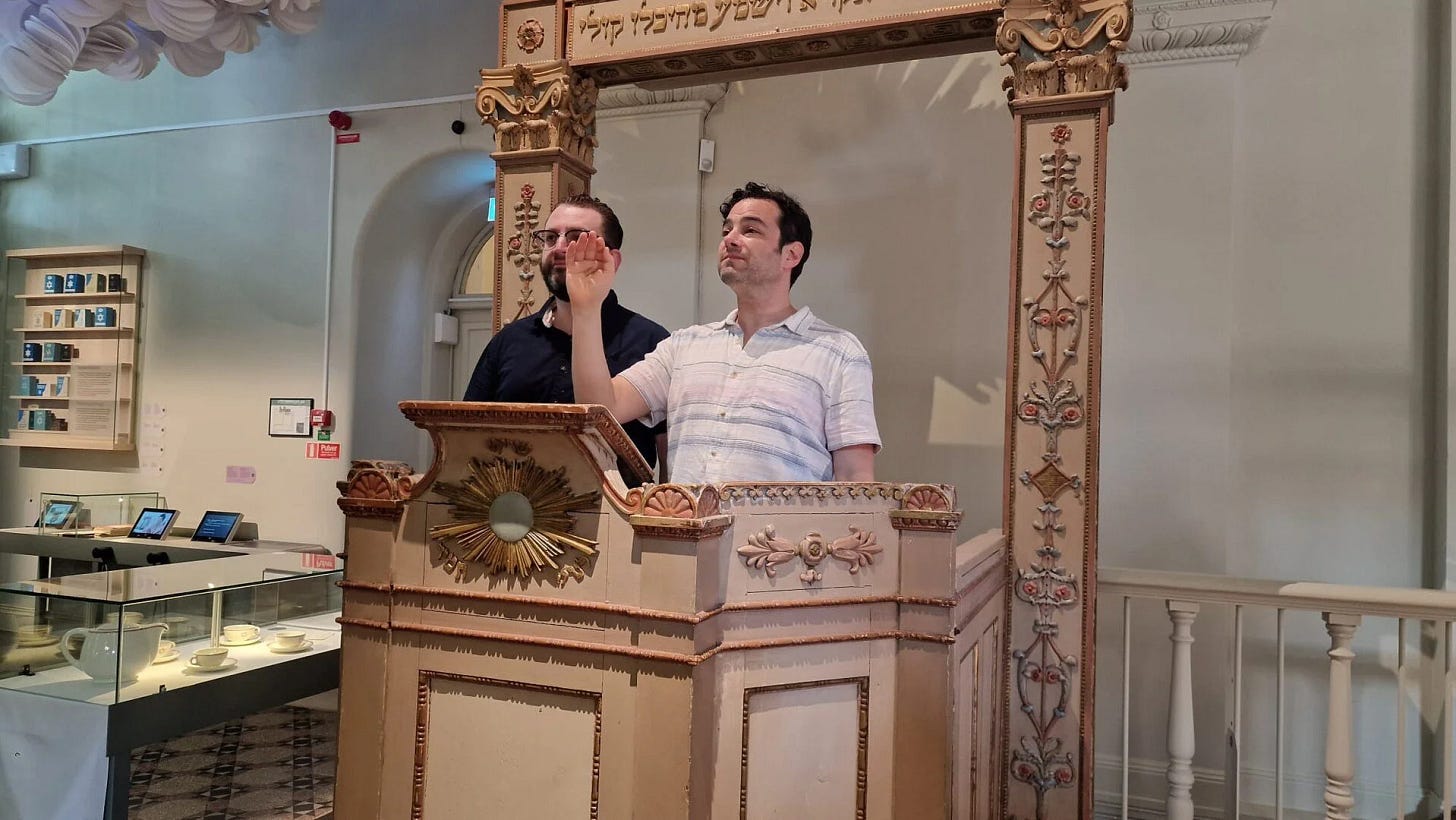 From the movie Swedishkayt.
—
Note: If, at any point, my language risks sounding as though I am speaking about “the Jews” as a single, unified block, that is a failure of words, not an intention of thought. I know perfectly well that Jews are not a monolith—religious and secular, left and right, Zionist and anti-Zionist, deeply observant and cheerfully atheist, and everything in between. I use “Jews” here only because that is how they are perceived and targeted by others: as a category onto which hatred, suspicion, or conditional acceptance is projected. When I speak about “Jews” in this essay, I am not erasing their internal arguments and differences; I am trying to describe the position they are placed in from the outside, regardless of what any individual Jew thinks, believes, or votes for.