
If You Have ‘F***-You Money’, Why Not Use It for Something Good?
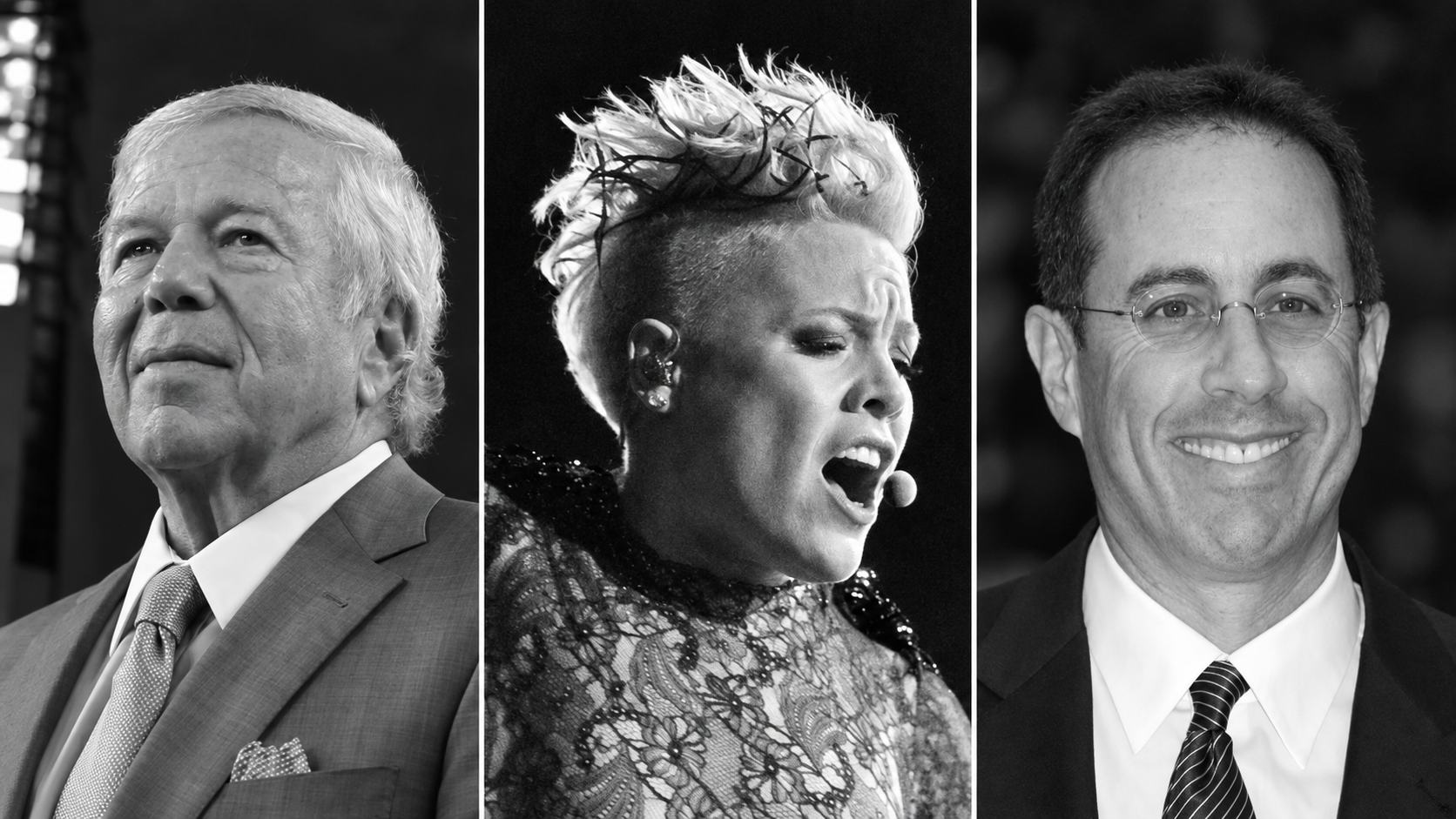
Kraft, Pink, Seinfeld and the courage to speak up for Jews—even when success can’t shield you from the backlash.
There’s a wonderfully inelegant expression for having enough money that you no longer have to worry about offending the people who sign your checks: fuck-you money.
I’ve been thinking about its companion: fuck-you fame. The kind of recognition that means losing an invitation, an endorsement, or the approval of several thousand strangers won’t end your career.
If you have both, what are you saving them for?
That question has been behind some of my frustration with prominent Jews who seemed reluctant to speak up. Back in January 2024, I asked where the Jews with platforms were. Maybe they were helping privately, I acknowledged. But we could use some help in public, too.
Lately, a few have given me reason to stop kvetching about it.
Robert Kraft. Pink. Jerry Seinfeld. Different people, different platforms, different ways of showing up. Three names don’t establish a movement. Still, if I’m going to devote ink to the silence, I ought to give some space to the voices.
And this week, a tip of the kippah seems in order.
For those who have managed to avoid the latest collision of entertainment, Israel, and social media outrage, congratulations. Here’s the short version. Macklemore’s performances opening for Ed Sheeran included Palestinian advocacy and his protest song “Hind’s Hall.” Kraft subsequently barred him from the upcoming Gillette Stadium dates, citing the recent performances and what Kraft described as a broader history of antisemitic rhetoric and imagery. Macklemore was dropped from the remaining tour dates amid venue objections. Reporting on Kraft’s decision.
The dispute involved more than the words “Free Palestine.” Macklemore’s set included war imagery and a political presentation that some Jewish concertgoers described as distressing. As the Commentary podcast emphasized, audience objections were part of the story before Kraft intervened. Those reactions deserve a hearing, too. An artist’s explanation of what he intended does not settle how his performance was experienced.
For Kraft, this is personal. He has devoted substantial resources to fighting antisemitism, and here were fellow Jews describing an experience that left them distressed. I admire his willingness to take their concerns seriously and act. Whether cancelling Macklemore was the most effective response is a separate question. It may have reassured some Jews that their concerns mattered while handing Macklemore a larger platform and an opportunity to portray himself as a martyr.
The dispute has also prompted donation announcements and challenges. If those produce more help for Palestinian civilians, good. But a competition over who writes the bigger check leaves a harder question unanswered: how do Palestinians build a future free of Hamas’s armed rule? Humanitarian generosity matters. So does confronting a movement that has brought catastrophe to Israelis and Palestinians alike. I’d welcome more influential voices willing to speak about both.
Pink’s response took a different form. After reposting a call for Macklemore to be dropped from the tour, she published a fuller explanation, saying she wasn’t asking for him to be fired or silenced. She affirmed Palestinian humanity and the protection of innocent life, while asking that her concerns as a Jewish mother be taken seriously.
She also described people using “Zionist” as an insult, assigning her beliefs before asking what she actually thought. That is a particularly isolating experience: speaking about your own community’s fear and finding yourself required to defend a position someone else has invented for you.
Then came the part that stayed with me:
I thought I knew how lonely that would be. And it’s lonelier than that. But I’m doing it anyway.
That was Pink describing the experience of standing up for her own community, after years of advocacy for others.
It made me reconsider the premise of my own question.
I had been thinking about what people with money and fame could afford to lose. Pink was talking about something that doesn’t appear on a balance sheet.
You can afford to lose the business and still feel the loss of belonging. You can have enough money for several lifetimes and still be hurt when people who once admired you suddenly assume the worst about you. Financial independence does not automatically produce emotional independence. Apparently, even a very successful career does not come with that particular upgrade.
Recently, writing about Boy George, I said that what moved me was his willingness to disappoint people who had long assumed he was on their side. Expressing a conviction carries a different weight when you know some of your own audience will resent hearing it.
Having the freedom to disappoint people doesn’t make their reaction painless. Just ask Jerry Seinfeld.
Seinfeld has enough money and fame to spend the rest of his life discussing breakfast cereal. Instead, he has made standing with Israel and fellow Jews a conspicuous part of his public life. He visited hostage families after October 7. He returned to Duke to help introduce former hostage Omer Shem Tov after facing a commencement walkout there the previous year. And the backlash has extended beyond hecklers: performers have withdrawn from a Lisbon festival where he is the headliner, with one publicly objecting to the views he defends.
Some of Seinfeld’s remarks have been harder to cheer. His comparison of the Free Palestine movement to the KKK was sweeping, and it risks obscuring the distinction between advocating for Palestinians and expressing hostility toward Jews.
Nor does admiring someone’s courage commit us to applauding every sentence they utter. If that were the admission requirement for Jewish solidarity, we would never achieve a quorum.
Standing with fellow Jews also leaves room for disagreement about Israel—and compassion for Palestinians. Anyone who reads the JNR knows that my attachment to Israel has survived considerable disgust with its government. Concern for Jewish safety and concern for Palestinian suffering can occupy the same human heart. We should welcome people willing to say so.
What money and fame provide is room to act. A person whose livelihood depends on the next booking or contract may face a very different calculation from someone whose financial future is secure. I’m reluctant to lecture the first person about bravery. I’m hopeful about what the second person can do with that freedom.
Speaking up can also mean helping someone else tell a story. Consider Fauda, whose latest season confronts October 7 and its aftermath. The Israeli series reached No. 1 on Netflix in Lebanon and the top ten in several other Arab countries. Those rankings don’t tell us what viewers took away. But they do tell us that an Israeli story is reaching audiences well beyond Israel. People with money and influence can help make more of that possible: fund the film, back the writer, help a story find its audience. Give people a reason to keep watching, and perhaps they’ll see something they hadn’t considered before.
If you have an audience, introduce it to an artist who deserves to be heard. If you run a venue, judge a performer by what they actually say and do, rather than treating a campaign against them as sufficient reason to cancel. If you have the resources, help someone facing threats obtain protection. Use the access that comes with success to make another person’s working life a little less precarious.
There are real costs. Some people who speak publicly encounter threats and need additional security. Others face damaged relationships, lost opportunities, or the exhausting experience of being reduced to somebody else’s political caricature. Encouraging people to speak means taking those possibilities seriously.
It also means doing something about them.
Those of us asking for courage cannot disappear when the consequences arrive. Send the note. Buy the ticket. Keep the invitation. Say publicly what you have been saying privately. Support needn’t wait until you agree with every word.
I don’t know whether the tide is turning. I do know that seeing someone speak makes a difference to people who have been wondering whether anyone will. One person’s willingness can give another person a little more room to find their own.
The point of having fuck-you money or fuck-you fame isn’t that you stop needing people. It’s that you have more freedom to stand beside them.
To those who are speaking up: thank you.
And those of us asking you to speak have a responsibility, too. We need to show up after you do.
With Yom Kippur approaching, I’ll leave you with another unmistakable Jewish voice: Barbra Streisand singing Avinu Malkeinu in Jerusalem at Shimon Peres’s 90th-birthday celebration in 2013. A moment to pause, listen, and remember what connects us.
G’mar chatimah tovah. May we be sealed for a good year.
And please be careful out there.
Brad out.