Between What Was Lost and What Was Built
In memory of my father Miklos Berman (z”l)
Haftlingenummer 70462
When I was twelve, I went with my father, Miklos Berman, to Mauthausen. He held my hand tightly the entire time, as if letting go was not an option. When we reached the barracks, he collapsed. There were no explanations, no attempt to translate what we were seeing. But in that moment, I understood enough. Something shifted, and childhood, as I knew it, ended there.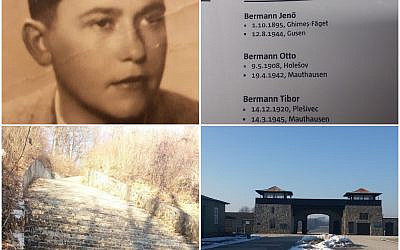
My father was nineteen when he was deported from Marosvasarhely in May 1944. By then, life had already been narrowing, restrictions, forced residence, weekly police reporting, and the quiet disappearance of people who no longer wanted to be seen with you. And yet, there was still a belief that life would somehow continue.
That belief ended when Hungarian gendarmes came to their home at dawn, lined them up, and took them to the ghetto at the brick factory.
For weeks, they lived there under armed guard, waiting without knowing for what. They were told they would be relocated to work together with their families. Instead, they were taken to the train station and forced into cattle cars, packed together, with almost no air or food. A bucket in the corner served as a toilet. My grandfather refused to eat so that his children of his community could.
When the doors opened, it was Auschwitz-Birkenau.
They were told to leave their belongings and line up. Instructions came quickly, say you are healthy, say you are older. Then the separation: men, women, children. Left or right. My grandfather, already exhausted, was sent to the left. My grandmother as well. That was the last time my father saw them. He was sent to the right, not because of a decision he made, but because a stranger pushed him, a small, almost incidental act that determined the rest of his life.
He would later say that at that moment he did not understand what “left” meant. Few did. Not yet.
He was shaved, given clothes, and placed in overcrowded barracks. There was a constant smell in the air, heavy and inescapable, but even then, many refused to believe what it meant. From there he was transported again, to Mauthausen, then to Melk, where he worked in a factory carved into a mountain and later in a mine. He was beaten, reassigned, pushed beyond what the body can endure. At one point he weighed thirty-two kilograms and was certain he would not survive.
By chance, he was transferred to the infirmary. By chance, he lived.
In May 1945, as the war was ending, the prisoners were ordered into a mine under the pretense of protection. Some refused. Only later did they understand the tunnels had been rigged with explosives. Soon after, American soldiers arrived. He was liberated and, by the end of June 1946, returned to Marosvasarhely, where nothing remained as it had been.
This is the story I grew up with, not retold in detail, but always present.
What I remember most, though, is something else.
Mornings. Cocoa and a pretzel with butter. And my father asking me, almost every day, if I had eaten. At the time, it felt like routine. Only later did I understand that for him, it carried something else, the memory of a world in which even that could not be taken for granted, and the quiet insistence on restoring order, one small act at a time.
Years later, walking beside him through those same camps, I didn’t really have expectations. I was twelve. I didn’t know what to ask, or what could be explained. He didn’t narrate his past, didn’t point or explain. But when he collapsed in Mauthausen, I understood something more enduring than any explanation, that there are experiences that are not meant to be explained, only carried.
After everything, Miklos Berman built a life. Not an idea of life, but a real one, work, responsibility, family, continuity. He did not define himself by what he had endured, and he did not speak about resilience. But the way he lived made it clear that resilience is not something you declare, it is something you practice, quietly, over time.
Today, living in Israel, where sirens interrupt routine and uncertainty is never far away, I return to his story not for comparison, because there is none, but for proportion. It reminds me that even in fragile realities, people continue to build, to work, to raise families, to insist on normalcy.
This is not only my father’s story.
It is also a remembrance of the six million who did not return, whose lives were never rebuilt, whose mornings never resumed.
What remains is not only memory, but responsibility, to live with intention, to build with purpose, and to carry forward what could not be taken from them.