Between Worlds: Seeing Myself in Hockney
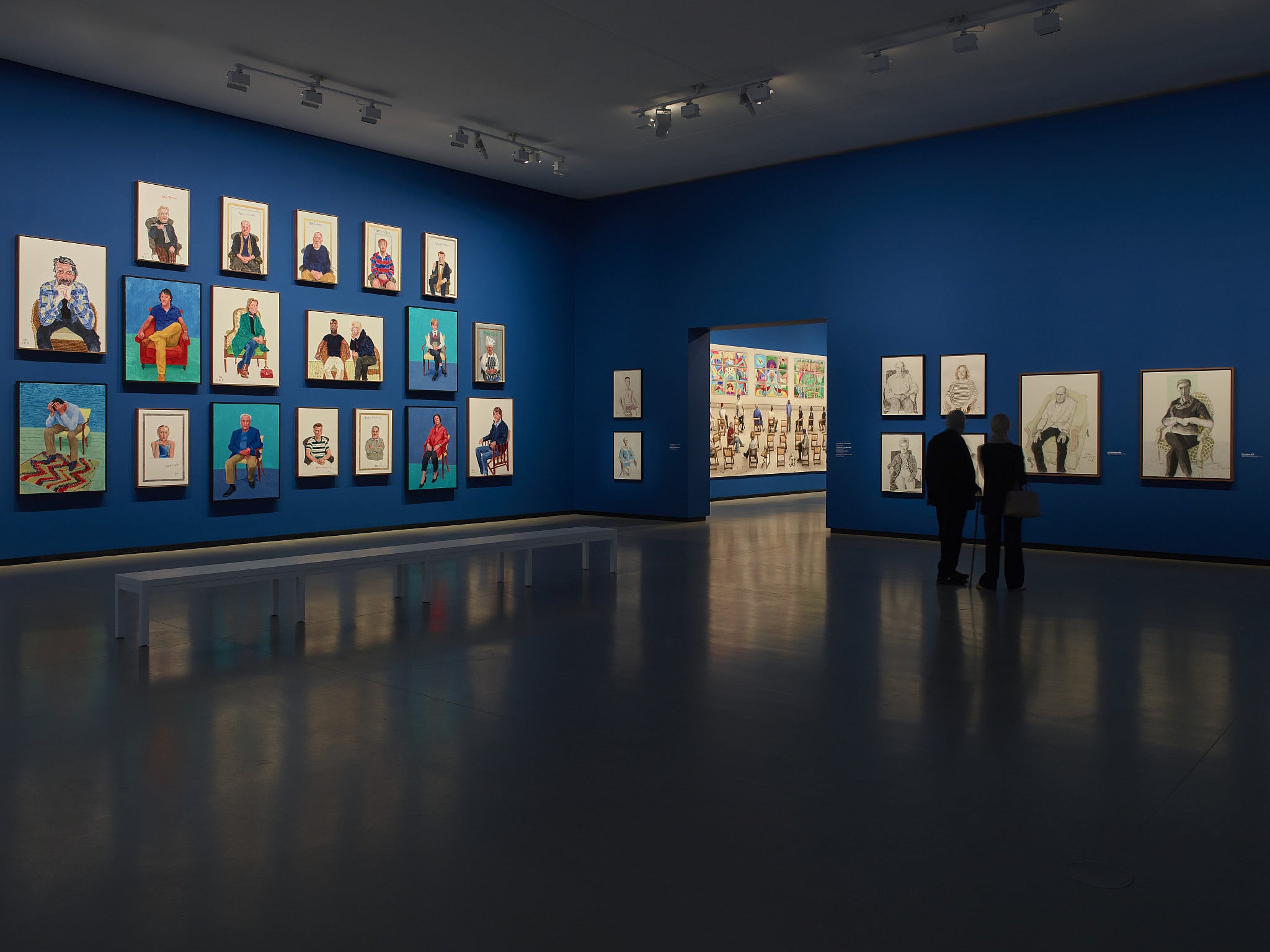
I wrote this essay over the summer, while David Hockney 25 was on view at the Fondation Louis Vuitton in Paris (9 April–31 August 2025).
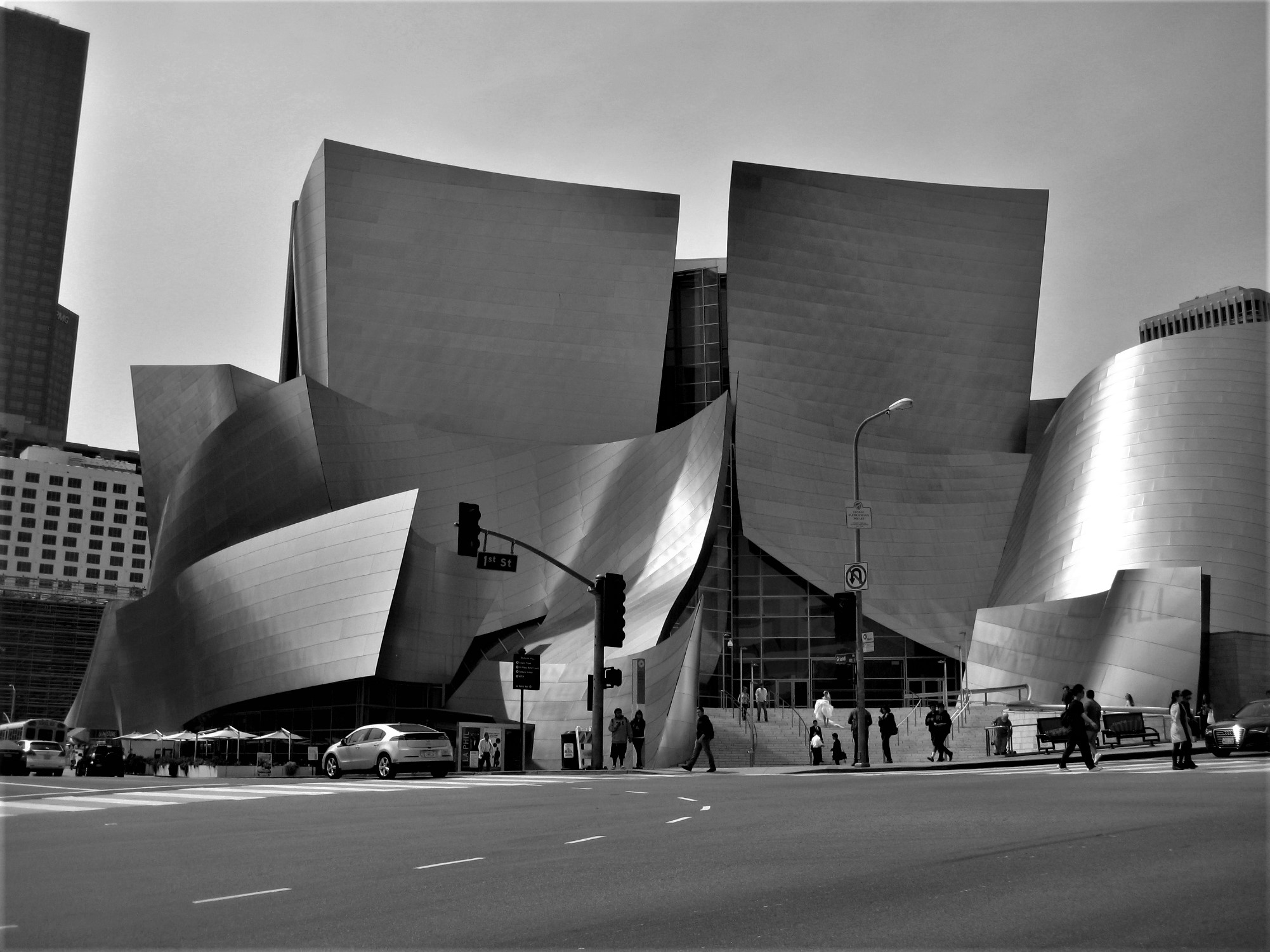
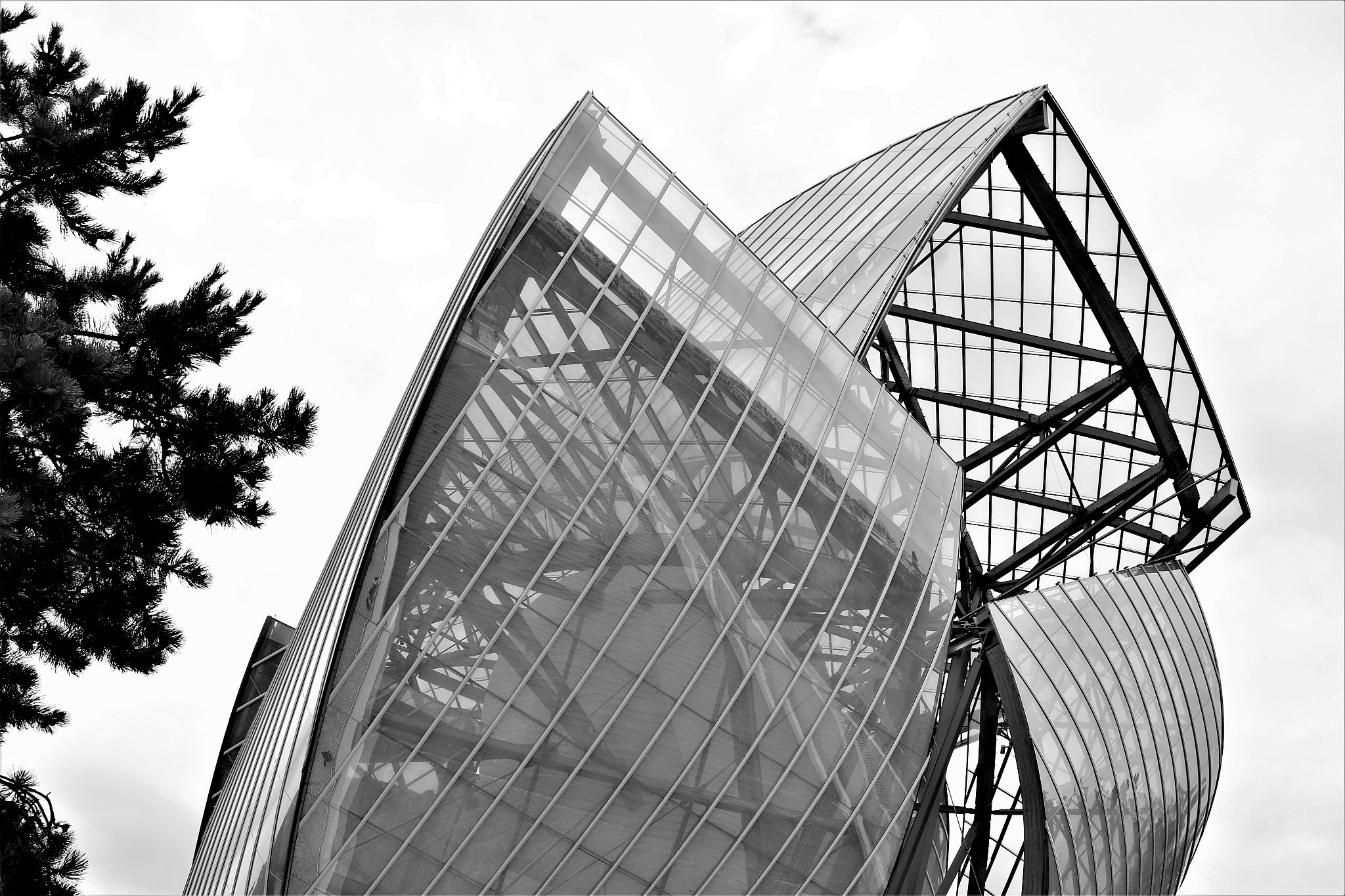
With the recent passing of Frank Gehry (28 February 1929–5 December 2025), the architect of the Fondation Louis Vuitton and the Walt Disney Concert Hall, I thought it might be of interest. Gehry’s buildings have long fascinated me, and his friendship with Hockney was quite important and suggested through a portrait included in the retrospective.
David Hockney 25
What does it mean to belong when your life is woven through many places? This question stayed with me as I visited David Hockney 25 at the Louis Vuitton Foundation. In February 2020, after twenty-five years in California, my life was upended when my green card application was denied. The reason? I had not won an international prize. Neither my memberships at the Los Angeles Press Club and the International Association of Art Critics, nor the fact that I interviewed Holocaust survivor and painter Kalman Aron for Public Access TV, nor that I helped a German film crew with their comedy documentary by introducing them to composer William Goldstein and filmmaker Henry Jaglom, counted. Nor did it matter that I appeared in the film myself or that I opened my home to the crew for filming. My work as a research assistant to the Berlin Prize Fellows was ignored as well. It did not matter that one of them, civil rights lawyer Michael Meltsner, had helped boxer Muhammad Ali, Cassius Clay, return to boxing, or that I did the research for composer Betsy Jolas, daughter of Maria Jolas and Eugène Jolas, founders of the Paris literary journal transition, which published sections of James Joyce’s Work in Progress, later known as Finnegans Wake. I was not born into these circles. I had to work my way up, starting with degrees at Santa Monica College, studying at UCLA, and earning a Master’s degree, to be allowed to participate in this intellectual circle. All of this did not matter.
During my exile in France, I found comfort in Hockney’s work, which challenges both art-making and ways of life. Like me, he first left his hometown, then Berlin, and sought a life of true freedom in California.
On a May morning, after walking through woods and hearing the soft murmur of a nearby stream, the upper contours of the Louis Vuitton Foundation emerged. I thought no setting could be more fitting for Hockney’s art.
Frank Gehry’s masterpiece, reminiscent of the Walt Disney Concert Hall, nestles in the Bois de Boulogne. It creates a striking dialogue between nature and modernity, much like Hockney’s work, which bridges the natural world with technology, including iPads and iPhones. Gehry’s friendship with Hockney is subtly honored through a portrait of the architect titled Frank Gehry, 24th, 25th February 2016. Its turquoise and marine blue background evokes the luminous spirit of the Côte d’Azur, where Hockney spent time.
Near the entrance, two contrasting landscapes greeted me: a swimming pool and Nichols Canyon, beside pear and hawthorn trees from Yorkshire and Normandy. Together, they reflect a life stretched across continents. This theme feels urgent amid global migration caused by the climate crisis and social upheaval.
The retrospective spans four hundred works, curated by Suzanne Pagé and Norman Rosenthal, with Hockney’s guidance. It unfolds like a three-act opera, breaking free, transitioning, and returning. The show pulses with constant movement, mirroring Hockney’s fluid lifestyle, shifting gaze, and refusal to settle on a single perspective. Sometimes he uses several cameras to capture a scene, as Act Three reveals. This spirit of experimentation and openness pushes against fixed views and invites the viewer into a dynamic way of seeing.
The exhibition opens with Portrait of My Father (1955), which Hockney painted with dignity. This roots the show in working-class Yorkshire, a world shaped by conformity and class hierarchy. Hockney broke from it with a rebellious style, more influenced by Jean Dubuffet and Art Brut than by British tradition. He painted satirical heterosexual scenes alongside tender depictions of homosexual love, such as Two Men Taking a Shower (1963). Inspired by visits to Germany’s capital, these works emerged when homosexuality was still forbidden in Britain, reflecting early queer visibility.
Although Berlin’s art scene offered glimpses of freedom, it was Los Angeles that marked Hockney’s turning point. I imagined him arriving before Tom Bradley Terminal existed, leaving gray northern skies for endless California summers. Like me, he saw turquoise pools and grid-like streets from above. He then descended into a world of bougainvillea, citrus trees, coastal mountains, the Pacific Ocean, and architecture by Neutra, Schindler, Wright, and Gehry. Pools became symbols of freedom, intimacy, and sun-drenched escape, transforming his work into a distinctly Californian, yet universal, language of liberation and pleasure.
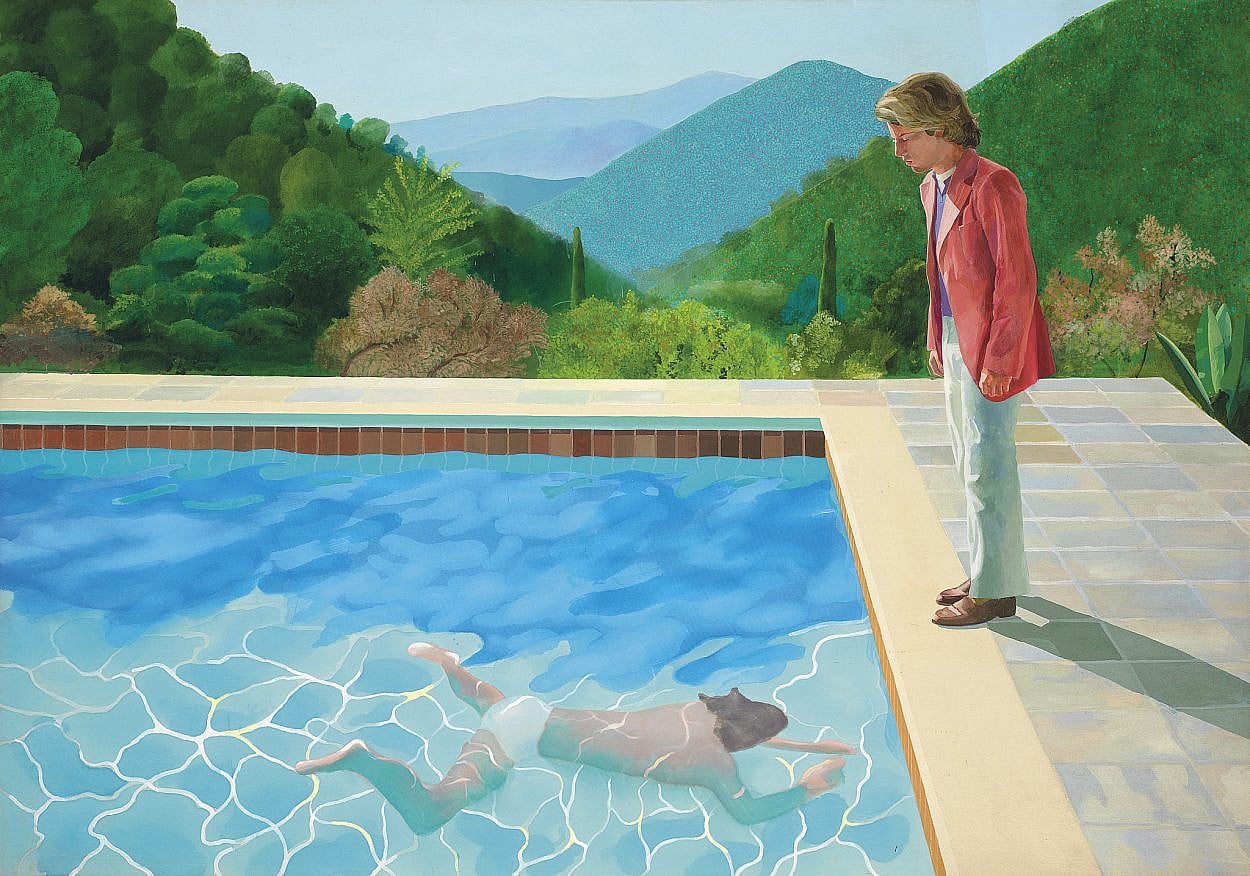
Act Two explores this life through iconic works such as A Bigger Splash (1967) and Portrait of an Artist (Pool with Two Figures) (1972). The splash marks a fresh sensual awakening. It feels almost audible and evokes energy, while the ripples in cool water suggest relief in sunbaked air stirred by Santa Ana winds. The figure dressed in a salmon-colored jacket is Peter Schlesinger, Hockney’s former student, muse, and lover. It captures a moment of rupture within their relationship. This piece holds the most emotional depth of the show.
Among the highlights is A Bigger Grand Canyon (1998), a monumental work of sixty canvases, each like a drawing contributing to a larger whole. The canyon bursts with exuberant color as bright oranges collide with deep purples and soft yellows. The painting is accompanied by two audio moments, such as Hockney arriving by car over a dusty road, followed by the haunting rush of wind as he sits before the view. Together, they create a sensory immersion that blurs the line between painting and experience.
What makes the work remarkable is its attempt to capture space through time rather than a fixed perspective. Hockney weaves multiple viewpoints, inviting viewers to look down, gaze across vastness, and feel themselves moving within it. The result feels closer to lived experience than a static image, as it captures time and space across shifting perspectives. It echoes Cubist ideas but expands them through scale, color, and immersive composition.
Amid present beauty, he begins to long for what is absent. California’s Indian summer differs from European fall, and spring is barely felt. This yearning for native land, tied to his mother’s aging and passing, drew him back to Yorkshire and Normandy, where spring unfolds. This return signals a contemplative phase, linking personal history with broader cultural cycles.
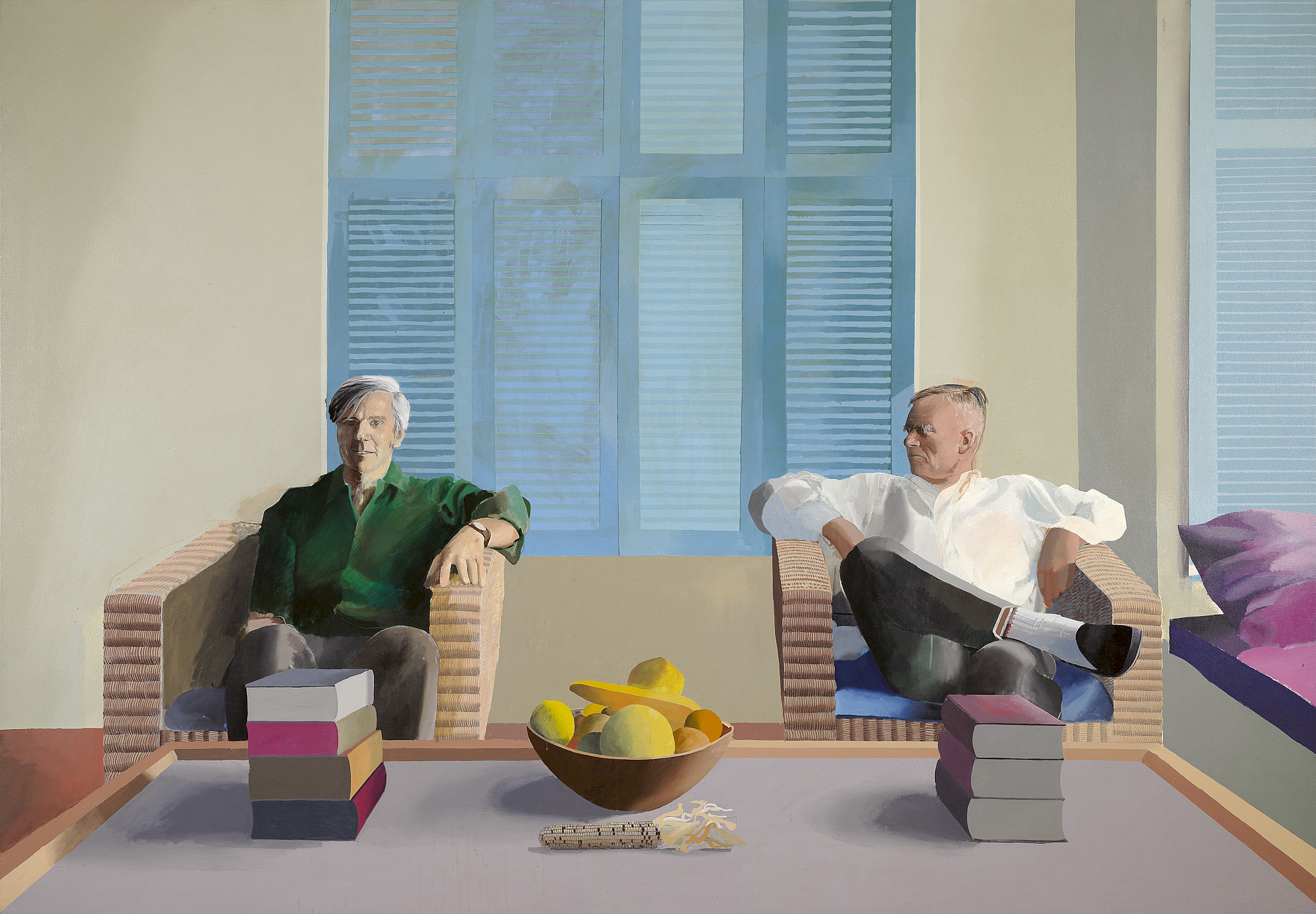
Returning to England in the 1990s also meant confronting a world that once oppressed him. Before the hall of his Yorkshire phase hangs Mr and Mrs Clark and Percy (1971), a double portrait of a fashion and textile couple in elite London. It reflects on gender dynamics and Hockney’s social ascent. Nearby, the painting Christopher Isherwood and Don Bachardy (1968) shows the subtle affection between two lovers. Isherwood, author of Goodbye to Berlin (1939), lived in Nollendorfplatz, a queer neighborhood during the rise of fascism, which lends the work historical and emotional depth. These pieces situate Hockney in queer modernism and social critique.
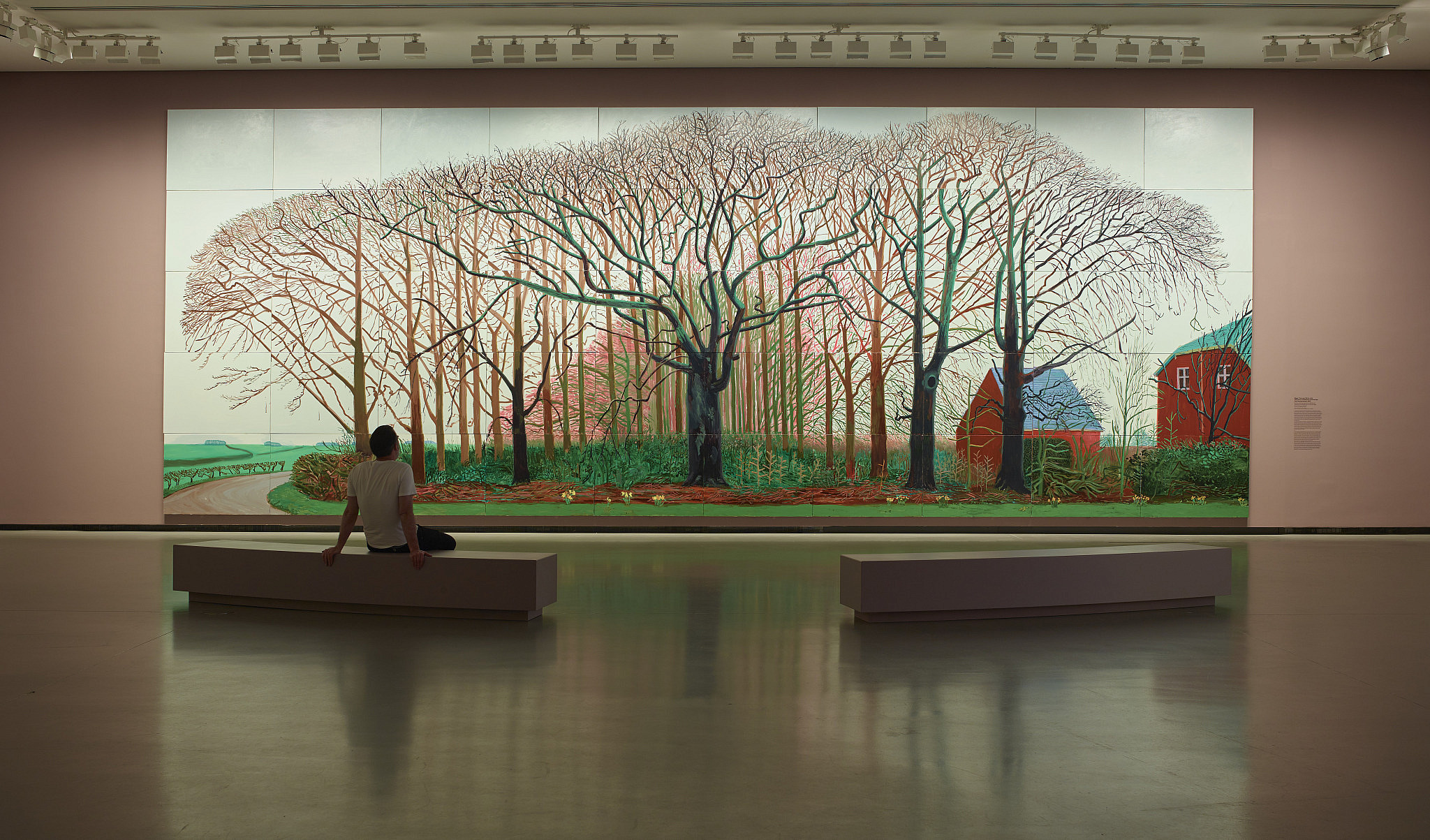
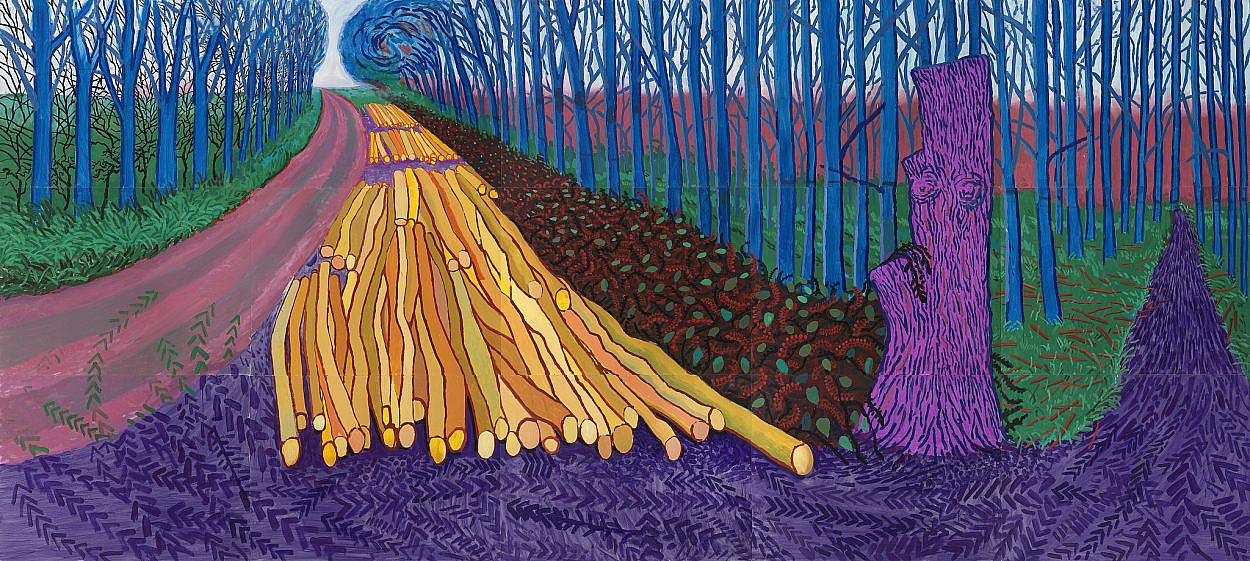
Like Odysseus returning to Ithaca, or fallen leaves drifting back to their roots, this homecoming marks the beginning of Act Three. The monumental Bigger Trees Near Warter (2007) is a highlight. Composed of fifty canvases, it forms a vast winter landscape. Instead of lush gardens, the bare trees evoke the harsh conditions in which they endure and symbolize family roots and quiet resilience. This large-scale work, connected to his late mother’s home, recalls Monet’s Water Lilies (1927) at the L’Orangerie, not through aesthetic similarity, but as a shared meditation on grief and peace.
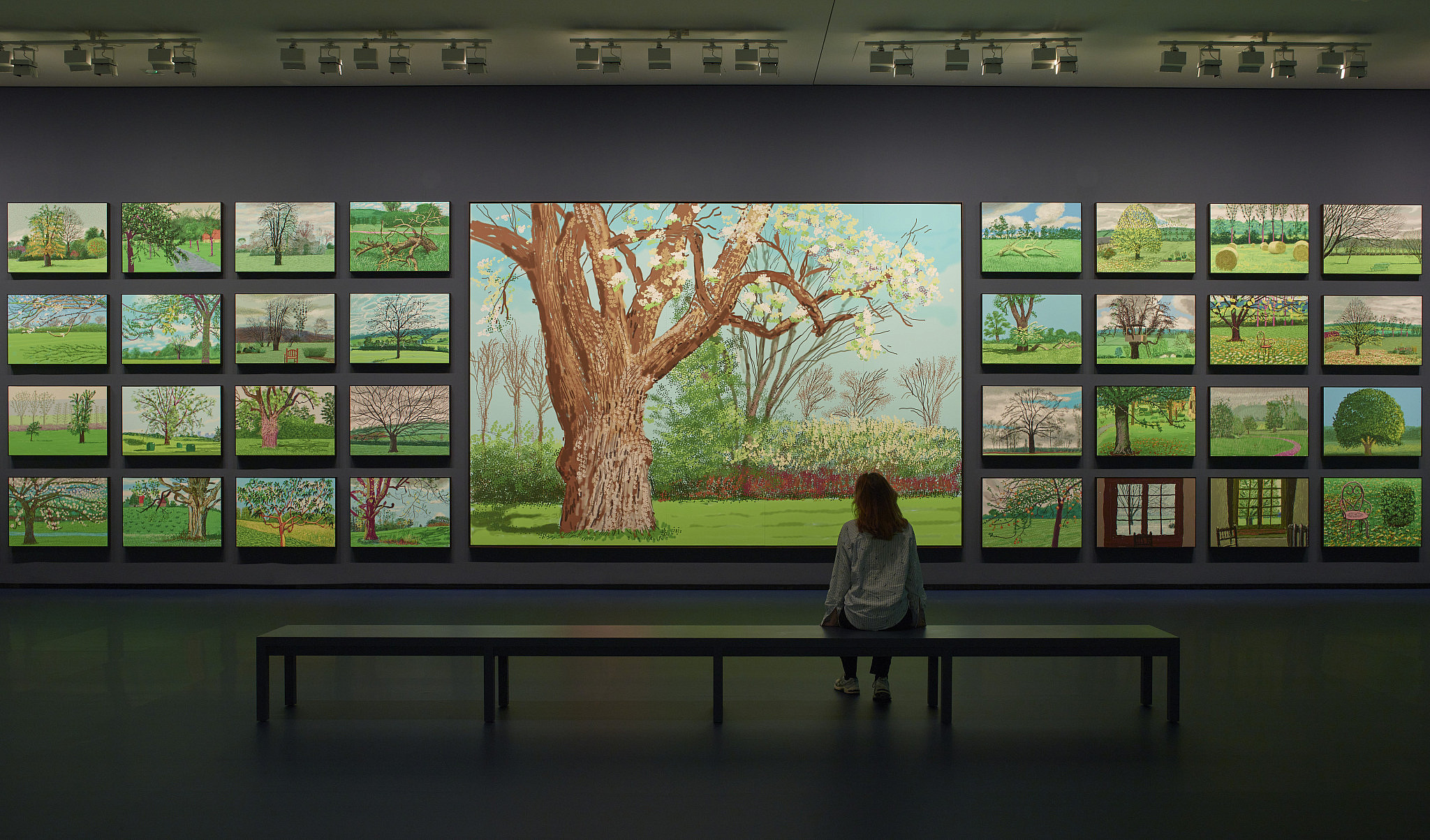
Another highlight is Hockney’s 220 iPad drawings made between 2019 and 2023 in Normandy. Confined to a village, he sent these luminous sketches with a defiant note, “They cannot cancel the spring.” This body of work blazes with hope, reflecting a world in flux yet alive with creative force. This section features an iPad drawing of the hawthorn tree on the promotional wall, titled 27th March 2020, No. 1, and a branch with pink blossoms titled 18 April 2020. Nocturnal works in the Moon room reveal his fascination with literature, astronomy, and the unseen, based on Maupassant’s Claire de Lune.
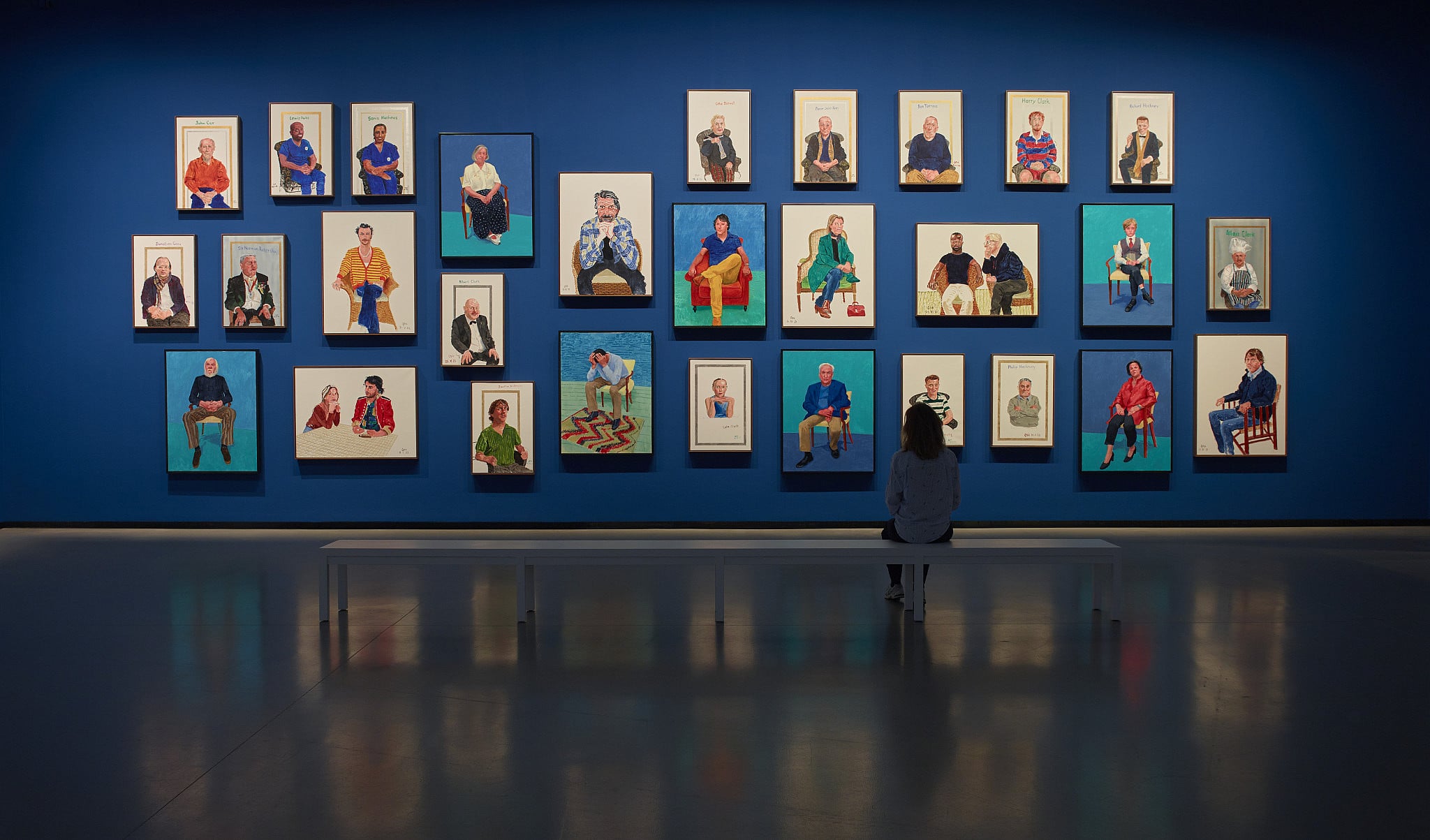
Portraiture of friends, family, himself, and flowers remains vital in Hockney’s work. J-P Gonçalves de Lima 11th, 12th, 13th July (2013), from his series 82 Portraits and 1 Still Life (2013–2016), stands out. This triple-date portrait reflects Hockney’s sittings and intimate approach. Depicting his assistant Jean-Pierre in a pose recalling Van Gogh’s Sorrowing Old Man (At Eternity’s Gate) (1890), it conveys a subtle expression of personal suffering. The vivid reds of the zigzag rug contrast with cool blues, creating emotional tension. This homage to Van Gogh highlights Hockney’s engagement with art history while asserting his contemporary voice.
One striking aspect is how Hockney transforms looking into art. In 25 June 2022, Looking at the Flowers, he places himself twice before his bouquet paintings, each viewed from different angles. The viewer watches him watching, partaking in layered perception and reflection. This meta-awareness challenges conventional painting.
Throughout, I felt an uncanny kinship with Hockney despite never meeting him. Our lives intersected in small ways. We shared a mutual friend, the late British pop artist Derek Boshier, whose portrait appears here. After leaving California in 2020, I moved to Paris, then the South of France, where I saw his flower portraits at the Matisse Museum in Nice, and finally Normandy, where Hockney completed his Normandy series. I, too, have connections to Berlin and London.
In the final rooms, the exhibition reaches a jubilant climax. Hockney’s panoramic La Grande Cour (2019), inspired by the Bayeux Tapestry and perhaps Chinese handscrolls, animates still-life imagery in an unfolding narrative. No battle appears, only peaceful Normandy vignettes suggesting a history privileging everyday beauty over conflict.
Philosophical questions of existence, time, and perception ripple through Hockney’s late works. After Munch: Less is Known than People Think (2023) stands apart, while After Blake: Less is Known than People Think (2024) refers to Dante’s Divine Comedy, adding epic literary depth. In Play within a Play within a Play and Me with a Cigarette (2024–2025), Hockney positions himself as the protagonist of his epic.
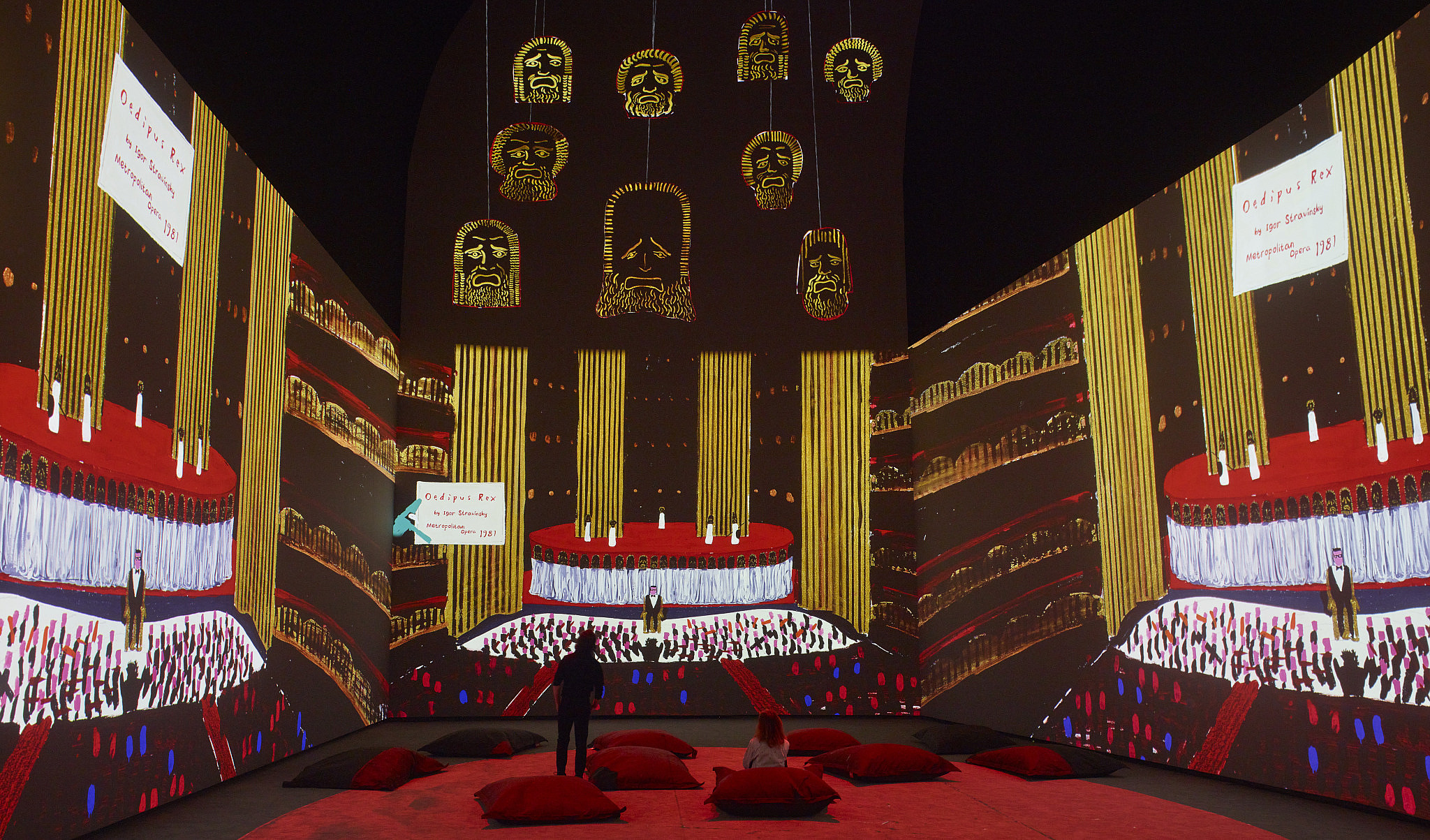
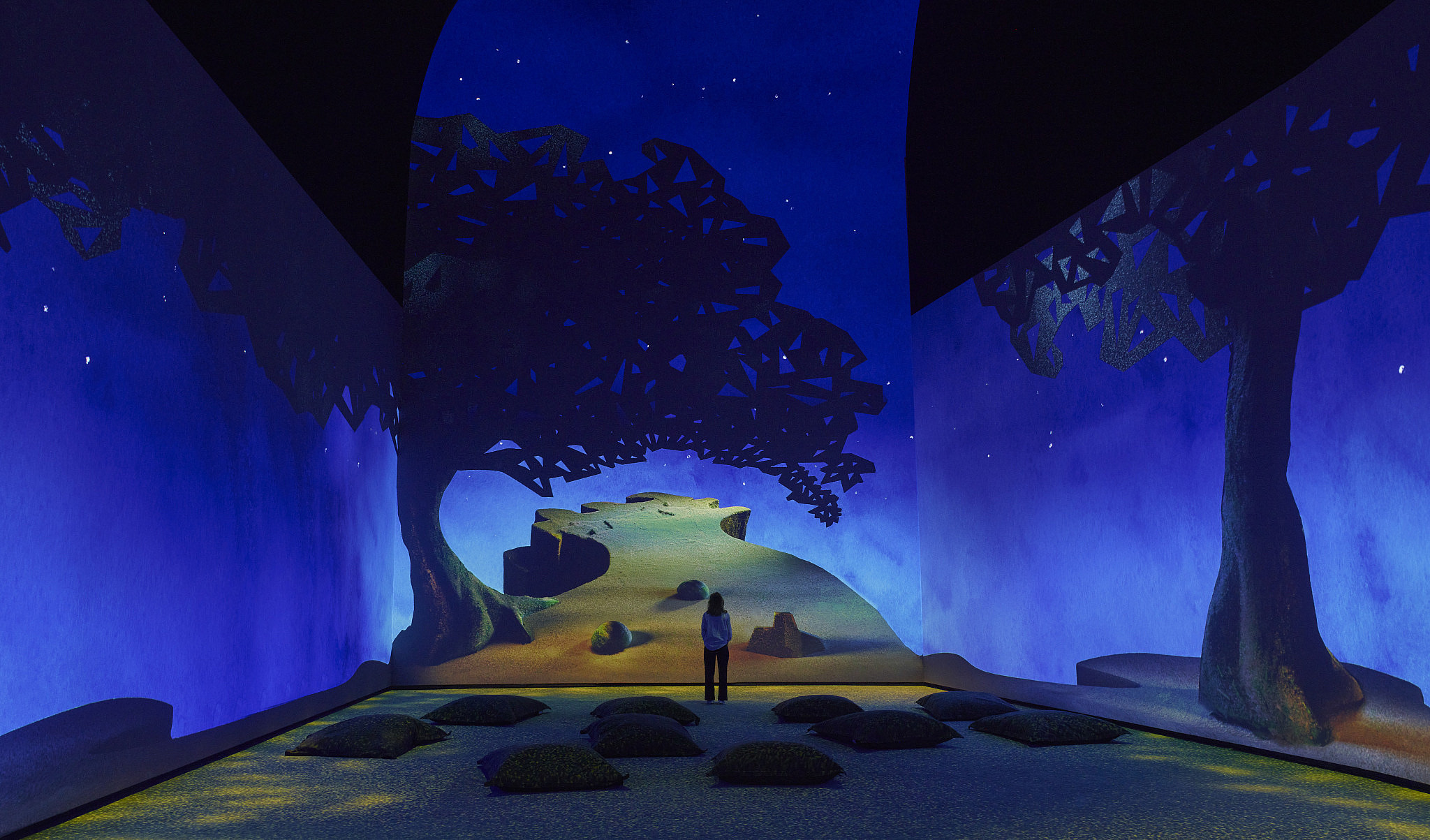
The exhibition concludes with immersive recreations of Hockney’s opera set designs. Although hearing loss altered his musical experience, bold reds and deep blues intensify the drama of love, loss, transformation, and transcendence. His sets for Wagner’s Tristan und Isolde capture the profound emotional depths of the music, telling a story of forbidden love like Hockney’s own love for Peter Schlesinger, once forbidden. Turandot, inspired by the Persian collection One Thousand and One Nights and set in a fantastical version of China, gained global recognition through Pavarotti’s iconic performance of Nessun Dorma. Mozart’s Magic Flute recalls both my first opera experience and a standing ovation I once received from Beijing Opera singers on Gulangyu Island, a moment that beautifully bridged my cross-cultural experiences.
As I stepped back into sunlight, one uneasy aspect of the retrospective struck me: its strong emphasis on Act Three, his more settled years. While the show beautifully presents his iPad drawings of idealized nature and charcoal sketches inspired by English landscape painters like John Constable and J.M.W. Turner, this focus sometimes softens the rebellious edge that defines much of his earlier work. However, looking once again at Hockney’s white-pink hawthorn blossoms on my way out, these delicate blooms reminded me of the cherry blossoms of China and Japan, carrying profound cultural and spiritual resonance. They remind us that cycles of nature and love endure beyond borders. This unifying element is exquisite. Thus, Hockney’s art is a celebration of enduring love for life itself.