Can you handle a Hanukkah donut?
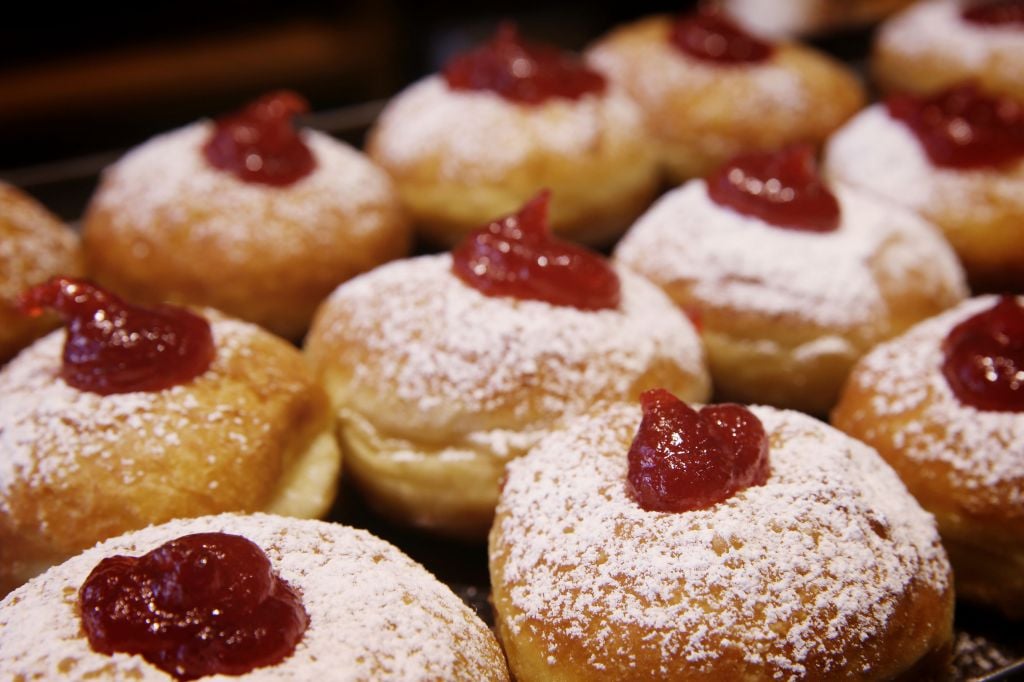
My high school friends — whom I have known for over four decades — and I have a WhatsApp group. Thankfully, most of our conversations revolve around happy occasions, personal milestones, and the ordinary goings-on of our lives. Every so often, someone comes across something particularly funny or interesting and shares it with the group.
With Hanukkah already in the air, one of my friends recently posted a clip from Eretz Nehederet, the Israeli satirical television show. Some of you may be familiar with it. It’s an animated sketch about a woman choosing a jelly donut (sufgania) in celebration of Hanukkah, and what happens to that donut once it is consumed.
My fellow WhatsAppers watched the clip and thought it was uproariously funny. I watched it and, despite it being a silly little cartoon, came away feeling upset and depressed.
Watch the video above, if you can. If you can’t, here’s the gist: The donut arrives in the stomach and is greeted by a maître d’, complete with all the mannerisms of a stereotypically pretentious restaurant host. He welcomes the donut and politely asks where it would like to go, explaining that the body has many different departments, all of which might benefit from its contribution.
The donut is not interested. It wants to go yashar la-tachat — straight to the woman’s “bottom.”
The maître d’ persists. Other foods contribute to different parts of the body. Surely the donut might consider doing the same? Couldn’t it participate in the larger enterprise, spread itself around, be part of something greater?
Yashar la-tachat, the donut repeats.
No amount of persuasion, reason, or appeal to the common good makes any difference. Eventually, other donuts arrive, join in the chant, and become an unruly crowd, all demanding to go straight to the bottom. The maître d’ finally gives up.
“Wow,” I wrote to my friends. “That’s some pretty clever political skewering. And depressing.”
Silence.
Then someone asked, “What do you mean?”
“I think it’s a commentary on Haredim,” I explained. “The sufgania wants to go straight to the bottom rather than share the weight — or burden — with the rest of the body. The maître d’ keeps trying to explain that everyone needs to contribute to the collective good, but the donut refuses to listen. And when all the other donuts join in, it looks just like the hafganot, the mass demonstrations over the draft.”
Silence again.
Finally, a friend responded. I was completely wrong, she informed me. The sketch was from 2017, long before the judicial reform protests, October 7, and the renewed urgency of the Haredi draft debate. It wasn’t political at all. It was simply a funny cartoon about the unfortunate destination of Hanukkah calories.
She was right, of course. Or at least, she was right about the chronology. The sketch could not have been a commentary on events that had not yet occurred.
But I couldn’t shake my interpretation. And I suspect I’m not alone.
I have come to realize that I, probably like many of you, can no longer look at the world with entirely innocent eyes. Everything I read, watch, and encounter is colored — and, I will admit, sometimes distorted — by the way I have come to see the world, particularly since October 7. The political divisions, the competing claims of obligation and sacrifice, the arguments over who bears the burden of sustaining Israeli society: these have become so deeply embedded in my consciousness that I see them even where they may not exist.
As I thought about this, I couldn’t escape the concept of reader-response theory. In its various formulations, the theory emphasizes that meaning is not simply deposited in a text by its author and then passively retrieved by a reader. The reader brings something to the encounter as well: experiences, assumptions, fears, expectations, and the particular circumstances of the moment. All of these shape what the text comes to mean.
The creator’s intention matters, of course, but the person encountering the work is also participating in the creation of meaning.
And that, I see, is what happened to me.
In 2017, a jelly donut barreling toward someone’s backside may have been nothing more than a clever joke about the consequences of holiday indulgence. In 2026, I watched the very same clip and saw a community refusing to share a collective burden and ignoring appeals to mutual responsibility. I could not see the humor in any of it.
The sketch hasn’t changed, but I have. The world in which I’m watching it has as well. And, although my friend was of course correct about what the creators intended, after thinking about it, I’m not convinced that my interpretation is entirely wrong.
There is something profoundly sad about that realization. I miss being able to watch a silly Hanukkah cartoon and simply laugh. I miss the luxury of not finding a political argument lurking behind every joke, image, or seemingly innocuous exchange.
Maybe one day that ability will return to me.
But for right now, in this post-October 7 world, I’m not sure that a sufgania is ever just a sufgania.