
Beyond COP31: Why the Mediterranean Must Lead Through Climate Reciprocity
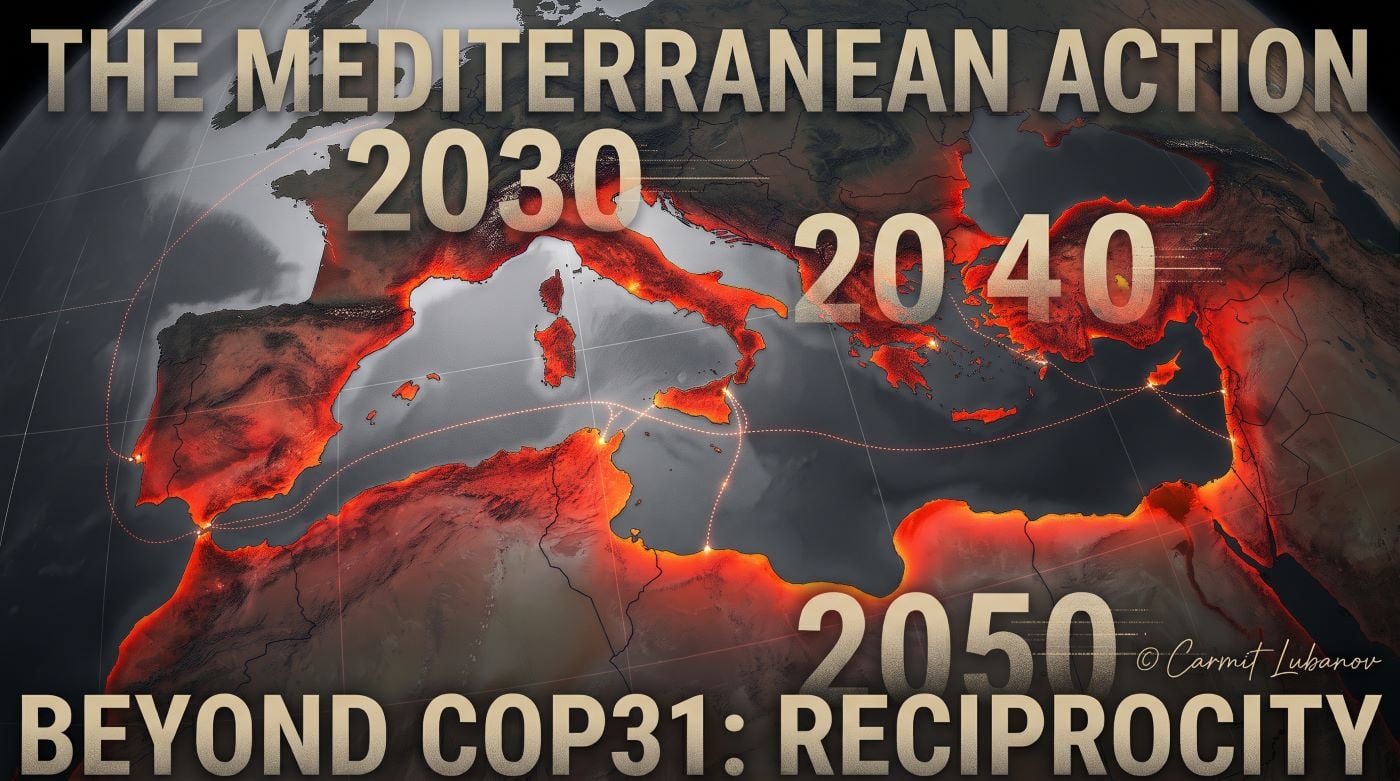
As the old diplomatic adage goes, victory has a hundred fathers, but defeat is an orphan. In the aftermath of COP31, failure remains conspicuously unclaimed. While plenty of fingers are pointed at entrenched fossil fuel interests, few leaders are willing to own the deeper political vacuum exposed at the summit: the absence of strategic leadership among major oil-exporting states and the exhaustion of a global negotiation model that struggles to turn pledges into enforceable reality.
This sense of diplomatic stalemate is not new. In 2009, the Copenhagen summit (COP15) collapsed in its attempt to produce a binding successor to the Kyoto Protocol. It took six years of painstaking regional groundwork, bilateral trust-building, and bottom-up pragmatism before the international community reached the Paris Agreement in 2015. The lesson from Copenhagen to COP31 is clear: when global multilateralism stalls, the engine of progress must shift to the regional level.
Nowhere is this shift more urgent—or more viable—than in the Mediterranean basin. Warming roughly 20 percent faster than the global average, the Mediterranean is a climate hotspot where water scarcity, energy security, and socio-economic stability are inextricably linked. Yet for too long, regional climate policy has been framed as a unilateral European Union agenda exported southward. That paradigm has reached its limit. What the region requires today is not another EU-centric directive, but a genuine Euro-Med framework uniting the northern and southern shores around a single organizing principle: reciprocity.
In a pragmatic climate realism approach, reciprocity means moving beyond declarative aid or top-down targets toward binding, mutually beneficial infrastructure partnerships. Rather than viewing the Mediterranean through a lens of geopolitical division, countries across the basin can leverage their complementary strengths—abundant solar radiation and land in the south and east; capital, grid technology, and demand in the north; and advanced water desalination and grid-management capabilities in the eastern basin.
Crucially, this is not a theoretical blueprint. The empirical foundations of a Euro-Med energy and climate architecture are already taking shape on the ground, proving that interdependence works even amid geopolitical friction:
- The Spain–Morocco Corridor: Across the Strait of Gibraltar, two submarine electricity interconnectors already operate with a combined capacity of 1,400 megawatts (MW), with a third 700 MW cable advancing toward completion to bring total capacity to 2,100 MW. Backed by Morocco’s rapid renewable expansion—where renewables already account for roughly 40 percent of installed capacity on the path to a 52 percent target by 2030—this corridor demonstrates how North–South grid integration strengthens resilience on both shores.
- Jordan’s Regional Integration Model: In the eastern Mediterranean, Jordan has emerged as one of the Middle East’s leaders in renewable grid integration, generating roughly 27 to 29 percent of its electricity from solar and wind. Alongside regional grid interconnections linking Jordan with Egypt and neighboring territories, the Prosperity Blue & Green framework—pairing 600 MW of Jordanian solar power with 200 million cubic meters of desalinated Mediterranean water from Israel—illustrates the exact logic of resource reciprocity: trading comparative advantages in sun and water to secure shared survival.
- Subsea Bridges Across the Basin: Projects such as the 600 MW ELMED interconnector linking Italy and Tunisia (backed by €850 million in European and World Bank financing) and the Great Sea Interconnector designed to link Greece, Cyprus, and Israel further prove that cross-border grids are transitioning from diplomatic concepts into bankable infrastructure.
To transform these bilateral and sub-regional projects into a durable Mediterranean climate-energy framework for the post-COP31 era, policymakers and energy leaders across the region should anchor future cooperation in three core principles:
First, infrastructural reciprocity over unilateral dependency. Agreements must guarantee two-way energy and resource flows, ensuring that southern and eastern partners are co-owners and primary beneficiaries of grid stability, rather than mere raw-energy exporters.
Second, socio-environmental equity. The green transition cannot be designed solely to decarbonize European markets while leaving local Mediterranean communities vulnerable to rising energy and water costs. Every cross-border project must allocate tangible capacity and tariff relief to domestic populations, ensuring climate action narrows—rather than widens—socio-economic gaps.
Third, geopolitical insulation through interdependence. Decentralized, interconnected regional grids reduce vulnerability to global fossil fuel shocks and create shared economic stakes that stabilize bilateral relations during periods of political tension.
COP31 demonstrated that waiting for global consensus is a luxury the Mediterranean cannot afford. The region already possesses the solar capacity, the water technology, and the early grid infrastructure to chart its own course. By scaling existing Euro-Med partnerships into a structured framework of climate reciprocity, Mediterranean nations—north, south, and east—can turn a global diplomatic failure into a blueprint for regional resilience.