
Former journalist, now a grumpy old man
The identity crisis of the Green Party of England and Wales
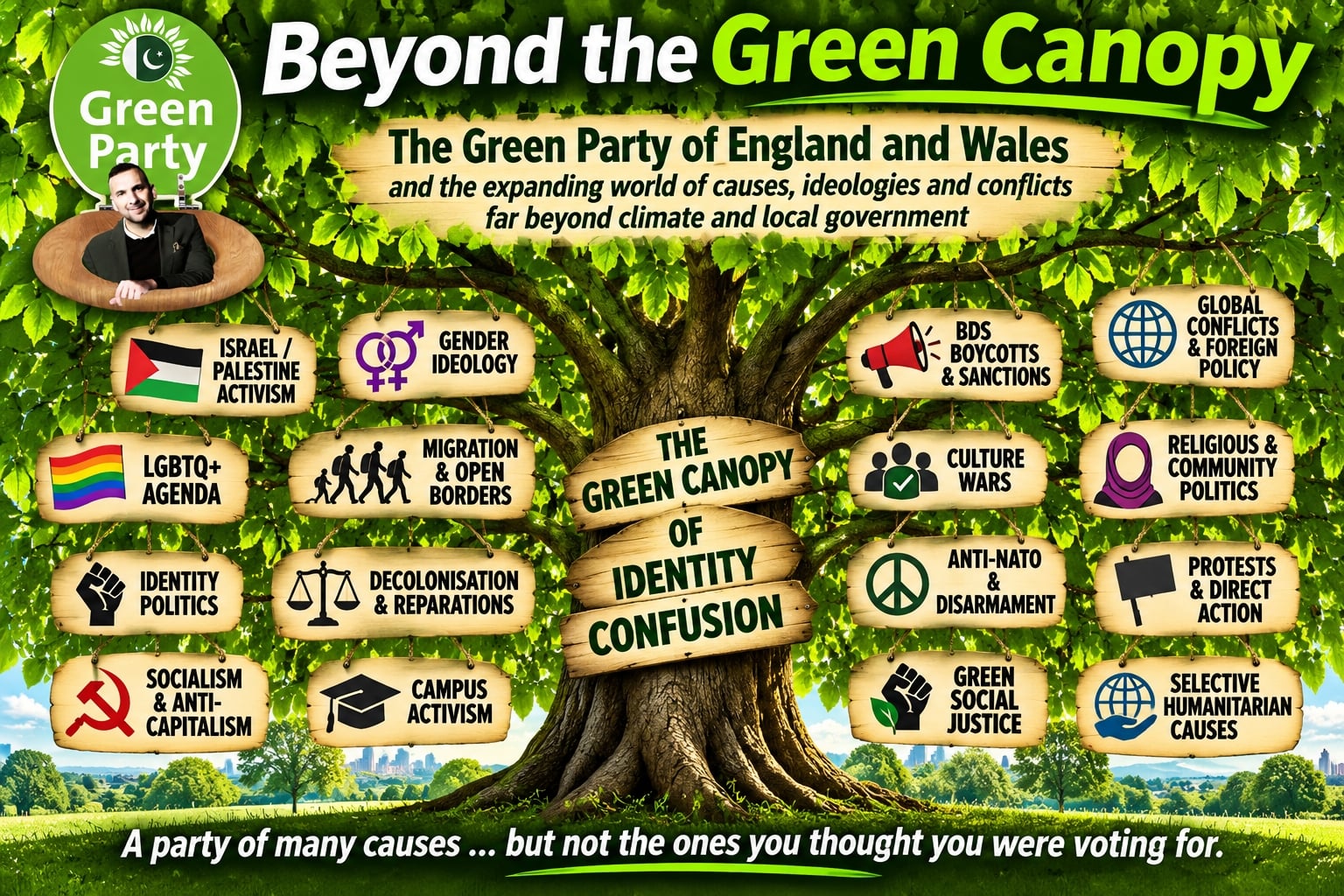
Created with relevant prompts by the author using AI
- Beyond the “Green Canopy” and a fixation on foreign policy with little or nothing to do with all but a very small minority of British voters, and the inability to do anything unless wearing a kaffiyeh wrapped around their necks.
The Green Party was originally founded in 1973 as the People Party before evolving into the Ecology Party and then into the Green Party of England and Wales. They arrived in British politics with their singular, urgent shout of environmental alarm. We humans were living beyond the ecological limits of our planet, and something had to be done as a matter of urgency.
While it may originally have seemed an “Oh no, not another green welly brigade here to interrupt our lives and strap themselves to old Christmas trees in the middle of our busy roads”, it did, on the surface, carry out laudable, if at times irritating, climate-associated activities.
There was nothing at all wrong with the Party’s original call for the public to take better care of biodiversity, to start to act with increased environmental responsibility and to be more active in climate issues with respect to the necessity for industrial growth.
Yet, in recent years, especially in the wake of the Gaza conflict and their recent conference, the Green Party has increasingly found itself defined not by its original raison d’etre, the climate and environment, but by its fierce, polarising and frankly often hateful, partisan engagement with the Israeli-Gaza conflict, rarely, if ever, mentioning Hamas as the perpetrators and repeated antagonists, which is as morally repugnant as it is reprehensible.
To its critics, this shift is not so much an ideological drift, but seriously questions whether a party originally founded on ecological pragmatism has become totally overtaken by performative radicalism. With a foreign policy fixation solely on one small country over 2,000 miles away, it seemingly now has only one narrow, partisan rhetoric that completely alienates not just Jewish communities, but many mainstream voters too. But they appear to have a very selective blindness to all this.
To understand why the Green Party is so, in essence, obsessed with Palestine, it’s necessary to look at how it evolved both structurally and ideologically. It operates on a supposedly strictly grassroots, member-led “democratic” model. Party policy is not dictated from the top down by parliamentary leadership. It is voted on directly by conference attendees. And needless to say, aside from the physical conference accommodation that will limit the number of attendees, it is no longer those with purely a green or British-orientated agenda who attend. That is not to say that other parties are any different, as they too are faced with the conference attendance limitations of a chosen venue. But there seems now to be a total lack of traditional British Values within the Green Party.
Over the past decade, and certainly sped up following the welcome collapse of Jeremy Corbyn’s leadership of the Labour Party, the Greens attracted an influx of disaffected hard-left activists as their new political home. Especially the political types who followed Len McCluskey’s abhorrent Palestinian flag-waving debacle at the Labour Party conference in Liverpool in September 2018, emboldening the antisemitism that flowed through the Labour Party unhindered at that time.
For many modern-day activists in the Green Party, environmentalism is inseparable from “anti-imperialism,” decolonisation”, and “global social justice”. Within this ideological framework, the Israeli-Palestinian conflict is not viewed merely as a complex geopolitical dispute, but as the ultimate moral example of global oppression. But is it really that moral to consistently and constantly choose one single conflict only? One started with terrorist aggression on 7 October 2023 that is never mentioned, and one maintained by a leadership, that of Hamas, which is as far removed from morals as it is possible to be?
The oppressed Rohingya of Myanmar, the Uyghurs of China, the thousands of Christians murdered in Nigeria and the 10,000+ churches destroyed since 2009, the 35million starving in Yemen and Sudan and the civilians of Ukraine might disagree with the Green Party of England and Wales. But then, the Green Party not only have never asked them, but certainly does not refer to them with the same enthusiasm they have for decrying Israel and Jews in the UK recently at every available opportunity. Unless, unbeknownst to the electorate, Hamas are releasing some of the billions of dollars they have misappropriated from their own people to pay for potholes and bin collections. Hamas do, after all, appear to be experts in underground tunnelling!
This dynamic reached a flashpoint at the party’s October 2026 conference, where members voted to pass a motion explicitly designating Zionism as a form of racism and calling for a single state across historic Palestine.
Notably, this motion was pushed through by grassroots members despite opposition from senior figures, including former leader Caroline Lucas and several sitting Green MPs, who warned against the rhetoric and its consequences. They never chastised Pakistan, formed in 1947 under a similar British mandate to that of Israel a year later. In that conflict, over 1 million were killed and 14 million displaced. And all Mohammad Ali Jinnah wanted at the time was a homeland for South Asian Muslims, in the identical manner as Zionism is all about Jews wanting their own homeland. This parallel is dishonestly never mentioned in the Green Party Urdu-language election videos!
The fallout of their racist motion about Zionism, clearly demonstrating their total lack of understanding of what Zionism is, was immediate. The Equality and Human Rights Commission opened inquiries into potential discrimination, Labour severed local council power-sharing agreements across eleven authorities, and the Chair of the Jewish Greens called for leader Zack Polanski’s resignation following his subsequent by-election defeat.
Critics argue that when a political party’s membership prioritises passing symbolic, theatrical resolutions on the Middle East, knowing they will fracture local governing coalitions and alienate the vast majority of British Jews, it demonstrates an obsession that borders on political self-sabotage.
Opponents of the party frequently characterise this fixation as a form of pathological tunnel (no satire intended!) vision, colloquially derided as “Israel Derangement Syndrome”, and point to a glaring hypocrisy in how that activism is practised. Rather than focusing on diplomatic feasibility, humanitarian logistics, or nuanced peacebuilding, much of the party’s grassroots activism relies heavily on aesthetics and, despite not being the least bit amusing, comic virtue signalling.
Across university campuses, local council chambers, and protest marches, the wearing of the keffiyeh has become a ubiquitous uniform of progressive solidarity. Yet critics are quick to point out how thoroughly shallow and repulsive this has become. The vast majority of these scarves are mass-produced in factories in China rather than by traditional Palestinian weavers in Hebron, meaning the gesture generates zero economic benefit for the people it purports to champion. “Have kaffiyeh, will travel.” Although nothing is mentioned about the carbon footprint of all the kaffiyehs and Palestinian flags possibly manufactured in China!
Furthermore, by adopting those uncompromising stances that mirror the rhetoric of rejectionist factions and refusing to acknowledge legitimate Israeli security concerns or Jewish national self-determination, critics rightly ask whether the party’s activism offers any practical pathway to improving the daily lives, governance, or the economic prosperity of ordinary Palestinians. Or offers any peace.
This persistent accusation leads everyone down the one path. That the party’s obsessive scrutiny of the world’s only Jewish state crosses the line from legitimate criticism of Israeli government policy firmly into institutional antisemitism. And you only have to observe the self-publicised actions of some of the party grandees on social media to witness this for yourself. Support for Palestine Action, the Iranian IRGC regime and Hamas. With added Greta Thunberg.
While party spokespeople routinely insist, almost in parrot-fashion, that anti-Zionism is distinct from anti-Jewish prejudice, critics highlight a stark double standard. The Green Party conference rarely, if ever, devotes comparable emotional energy, emergency motions, or boycott campaigns to human rights abuses elsewhere in the world. When a party singles out only Israel as uniquely illegitimate, and goes as far as to declare the foundational movement for Jewish self-determination inherently racist, it tells a different story. This effectively tells the roughly two-thirds of British Jews who identify as Zionists that their core identity is incompatible with progressive politics.
For critics, this is not just a foreign policy disagreement. It is an ideological blind spot that fosters hostility toward Jewish members and their communities in the UK. As this sole Green foreign policy dominates the headlines, one glaring question emerges.
What precisely has happened to the environment? The Member of Parliament elected for the Manchester constituency of Gorton and Denton didn’t even refer to the environment in her maiden speech to Parliament. And she supported the new form of British apartheid from the highly antisemitic BDS movement, that of Jew-bating on the doorsteps of British citizens, in a similar fashion to the manner with which the similarly veracious antisemitic German National Socialists did in 1933. This is out-and-out racism of the worst kind.
In theory, the Green Party still maintains a supposed ecological platform. Its manifestos call for massive investments in renewable energy, the nationalisation of water companies to stop sewage dumping, the protection of 30 per cent of UK land and seas by 2030, and strict standards for new housing. All very laudable concerns, but not when they are being discussed as lip service to their supposed reason for existing.
At the local council level, Green representatives continue to campaign on active travel, home insulation, and biodiversity. But this cannot be sustained. Every piece of news on rows over Gaza motions, banned leaders, and council coalition collapses is proof that the party is not leading the national conversation on climate adaptation, energy security, or nature recovery as it should be.
By allowing its internal democracy to be steered by single-issue foreign policy activists, the party has diluted its core brand to a level of very bad comedy. Voters who might naturally turn to the Greens out of frustration with mainstream parties’ slow progress on net-zero targets or river pollution are increasingly deterred by the perception that the party has morphed into a vehicle for radical left-wing culture wars.
Ultimately, the direction the Green Party of England and Wales has taken is a highly distasteful vision about an ideology that is starting to resonate negatively with British voters. Its deluded and sometimes ignorant members may view their intense focus on Palestine as an extension of a universalist commitment to justice. However, the practical result has been bitter internal division, accusations of institutional prejudice, and a diminished capacity to enact environmental policy in local government.
Until the party reconciles its grassroots activism with political pragmatism and once again places the urgent crisis of the natural world back at the forefront of its public identity, all it appears to be is a protest movement defined by symbolic gestures and racism, rather than a serious force for ecological transformation.
It may want to harness the power of the wind for cleaner energy, but all it is succeeding in being seen as at the moment is a performative party full of racist and vacuous hot air.
Related Topics