
Beyond GDP: Why the World is Failing the Climate Justice Test
While global leaders showcase carbon reduction targets and green transition plans, a starker reality unfolds beneath the surface. The climate crisis is not merely a physical threat of rising temperatures; it is, first and foremost, a structural crisis of social and spatial inequality that divides the globe into the protected and the exposed.
For decades, we have measured national resilience and economic development through rigid indicators like Gross Domestic Product (GDP). Yet, these metrics remain entirely blind to the most critical question of our era: Who pays the environmental price of industrial pollution, and who is safeguarded against its escalating consequences? Reducing the climate debate to green technologies and carbon market quotas misses the point. To catalyze real systemic change, we must pivot toward a more profound concept: environmental justice and climate democracy.
To enable empirical comparison and offer an objective view of this reality, we have formulated the Global Environmental and Climate Justice Index (GECJI) at the Tahadhari Center and the Mediterranean Climate Justice Network. The index evaluates the performance of four major geopolitical systems—the European Union, the United States, Israel, and the Middle East—against three straightforward yet revealing parameters: the spatial distributional burden, localized infrastructure gaps, and the depth of civil space enabling public participation in decision-making.
The Western Illusion and the Reality on the Ground The initial findings of our index dismantle some of the most comfortable assumptions of the developed world. The European Union, leading with a composite score of 71.7 (of 100), is frequently viewed as the standard-bearer of green progress. Yet, our index uncovers a disturbing asymmetry: progressive policies have not prevented the concentration of waste and industrial hazards near marginalized populations, most notably ROMA communities across Central and Eastern Europe, or cross border transfer between EU member state to non- EU member state. “The gap between soaring international declarations and the physical reality of resource allocation in impoverished communities and peripheral regions is where climate justice is buried.” Similarly, the United States (scoring 60.0) exhibits a profound structural failure in its spatial distribution (scoring a mere 45 in 1st Parameter). Despite sophisticated monitoring tools like the EPA’s EJScreen, systemic environmental racism persists. Toxic industrial zones and petrochemical corridors remain disproportionately situated in low-income, Black, Indigenous, and community-of-color neighborhoods, while wealthier demographics enjoy well-funded climate defenses and cleaner air.
Israel and the Middle East: Peripheral Neglect and Existential Vulnerability Israel (scoring 56.7) falls into the moderate-low tier, reflecting a stark domestic divide. While its highly centralized planning frameworks are theoretically open to public challenge, localized realities reveal an entrenched infrastructure gap (55) and an uneven spatial burden (50). These structural disparities disproportionately impact peripheral regions, Bedouin, and Arab communities, leaving them vulnerable to urban heat island effects and severe flooding, while resources remain concentrated in the affluent central districts. The most alarming revelation, however, emerges from the broader Middle East, which lags behind with a critical score of 25.0. Here, the ecological crisis is a daily struggle defined by chronic water scarcity and extreme heat. When physical vulnerability intersects with a near-total absence of protective infrastructure (25) and a severely restricted civil space (20) that silences local communities, the result is an immediate humanitarian and geopolitical threat.
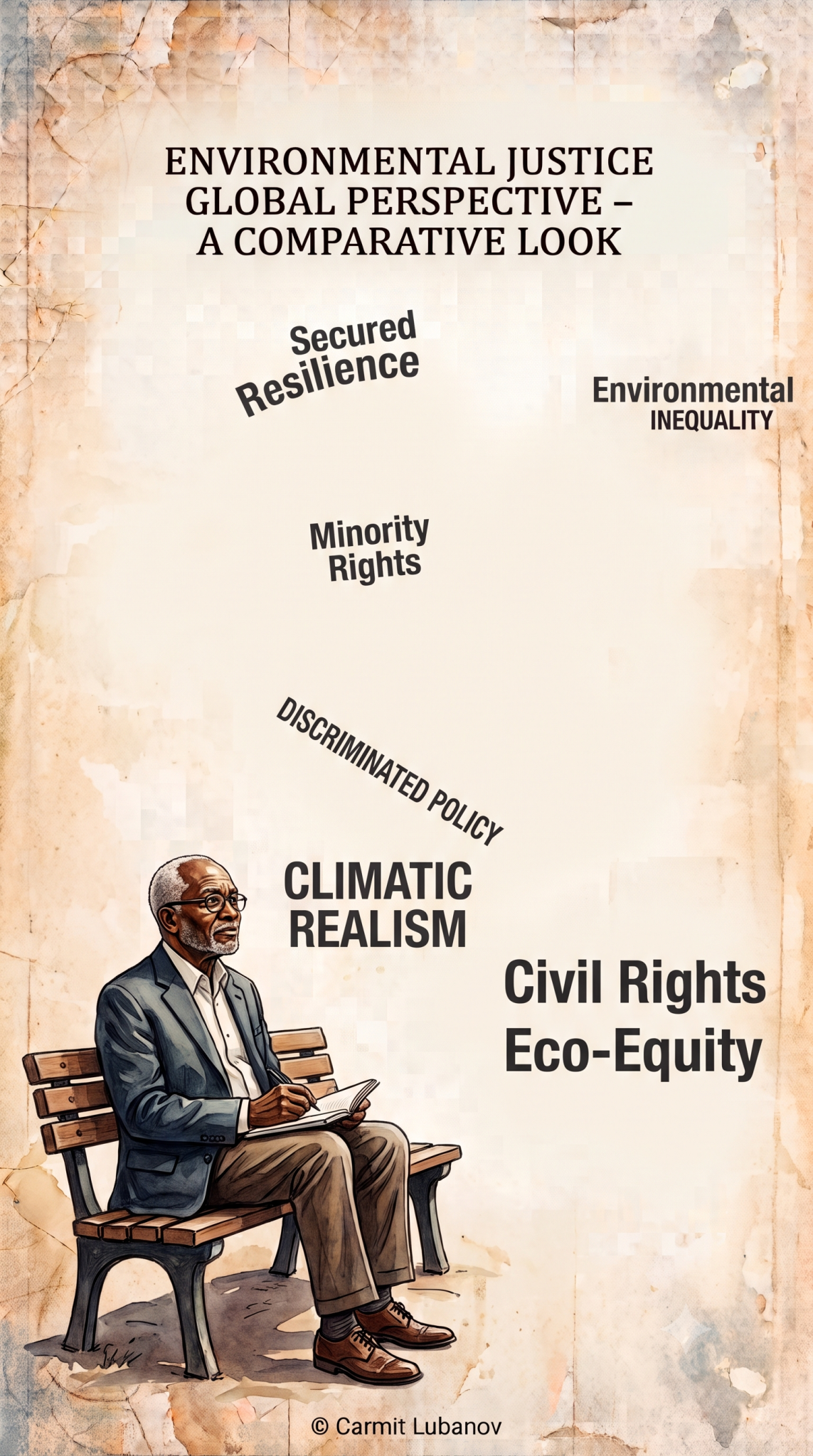
A Call for Climate Realism The GECJI demands that we adopt a posture of Climate Realism. True societal resilience cannot be measured by national averages or macro-economic capital flows; it is defined by the state’s ability to guarantee a “secured resilience” to the most vulnerable. So long as we overlook procedural justice and fail to include local communities in designing their ecological future, the grandest climate plans will remain empty promises on paper. It is time to place climate justice at the center of international policy—not as an act of charity, but as a prerequisite for our collective survival.