Beyond the ‘Art of the Deal’: Why the Levant Needs Climate Realism
For decades, international diplomacy in the Middle East has followed two equally flawed tracks. On one side are the utopian dreamers, proposing grand, multi-lateral “environmental peacebuilding” summits that assume ecological cooperation will magically pave the way for final-status political treaties. On the other side is the hyper-transactional “Art of the Deal” paradigm—a business-first approach that views complex geopolitical and existential crises as mere commercial transactions, easily brokered over a handshake and just as easily dismantled by a single late-night social media post.
But physics does not negotiate, and climate change is moving far faster than our outdated diplomatic machinery.
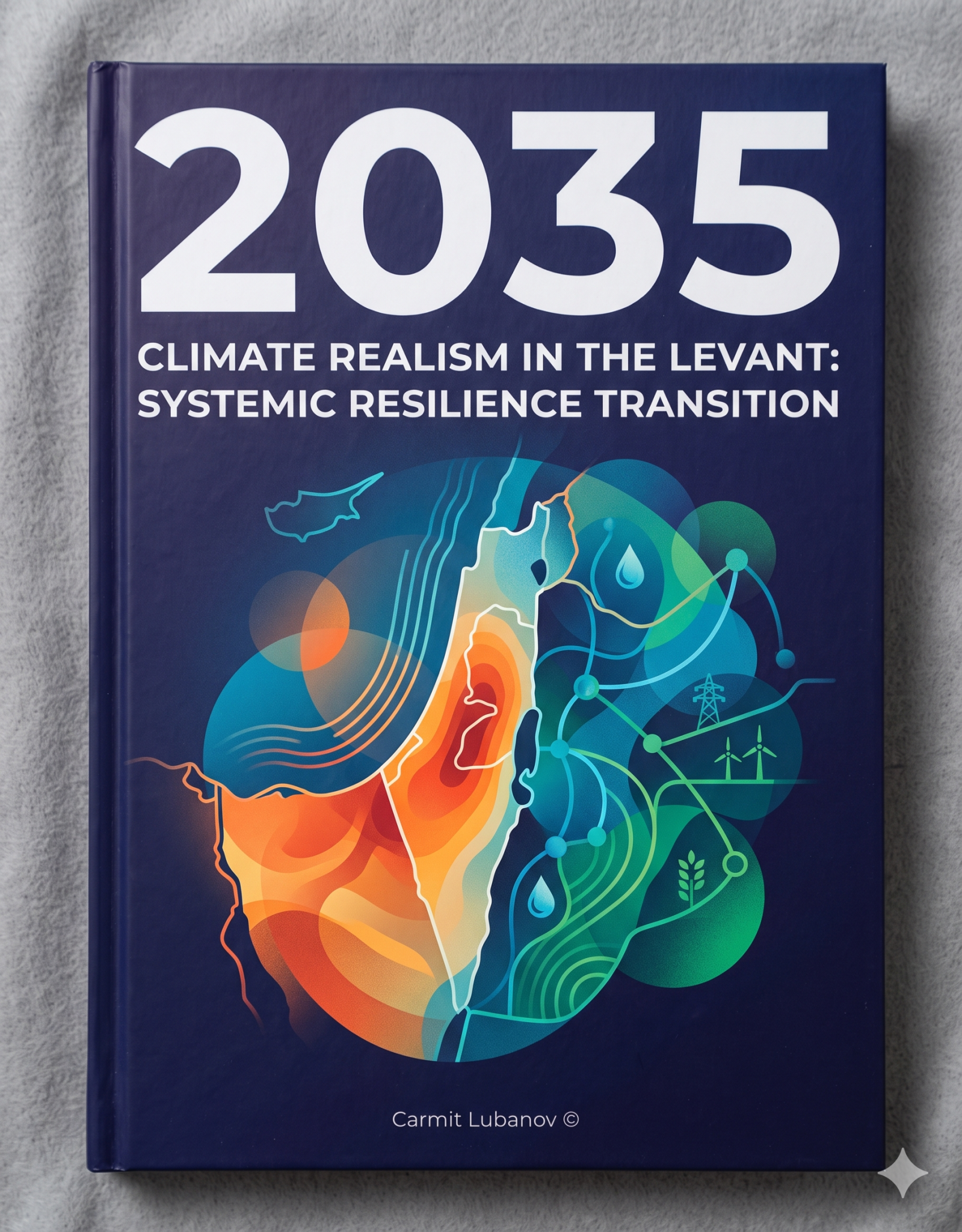
As we look toward the critical horizon of 2035, the Levant—comprising Israel, Jordan, Palestine, Lebanon, and Egypt—is facing an accelerating environmental crisis that ignores sovereign borders, and political boycotts. To survive, the region must abandon both utopian sentimentality and volatile transactionalism. It is time for a new paradigm: Climate Realism oriented toward Secured Resilience.
The Illusion of Separation
Climate Realism starts with a cold, hard truth: political borders can be hardened, but ecological systems cannot be uncoupled. Under our current geopolitical status quo—characterized by frozen Israeli-Palestinian negotiations, a cold peace with Jordan, a tense security relationship with Egypt, a volatile Gaza, and a collapsing Lebanon under the de facto control of Hezbollah—the region is sleepwalking into a catastrophic “adaptation deficit.”
In this fragmented reality, Jordan’s water levels are dropping past the absolute scarcity threshold, forcing Amman into desperate, ad-hoc emergency water purchases from Israel. These agreements are politically toxic and subject to immediate suspension during security escalations.
Meanwhile, a lack of structural capital in the West Bank and Gaza means millions of cubic meters of raw, untreated transboundary sewage flow directly into shared aquifers and the Mediterranean Sea. This pollution drifts north, forcing frequent, prolonged shutdowns of Israel’s vital coastal desalination plants. Unilateralism, in this case, directly sabotages the sovereign critical infrastructure of the stronger state.
This is the real cost of our geopolitical freeze. It is not a diplomatic stalemate; it is an active multiplier of physical, environmental, and national security risk.
Rejecting the Volatile “Deal”
In response to these vulnerabilities, some point to transactional diplomacy as a quick fix. We are told that economic normalization and commercial “deals”—where resources are bartered like commodities—will solve the crisis.
But there is a fundamental difference between a transaction and resilience. A transactional deal, driven by narrow, short-term business calculations, is inherently fragile. It lacks structural depth. If political winds shift, or if a leader decides a deal is no longer profitable, the infrastructure can be turned off, weaponized, or abandoned.
Instead, Climate Realism demands Secured Resilience.
Secured Resilience means hardwiring our vital resource networks—water, energy, and agriculture—so deeply across borders that sabotaging a neighbor’s infrastructure automatically cripples your own. It is about creating a state of Mutually Assured Resilience. When Jordan’s solar fields are structurally connected to power Israel’s coastal cities, and Israel’s desalination plants are contractually and physically locked into supplying Jordan’s municipal water grid, cooperation ceases to be an act of goodwill or a temporary “deal.” It becomes a permanent, structural parameter of national survival.
The New Security Triad: Tech, Capital, and Regulation
Our Think-Tank at Tahadhari center discussed The New Security Triad: Tech, Capital, and Regulation.
How do we transition from the fragile status quo to Secured Resilience by 2035? It requires unlocking a powerful, realistic triad of regional and global forces:
1. Israeli Technology and Knowledge: Providing world-leading desalination capacity, advanced wastewater reclamation systems, smart grid management, and climate-adapted precision agriculture.
2. Gulf Capital and Strategic Interest: Pivoting from regional charity to investing in high-yield, long-term commercial assets—such as regional solar arrays, high-voltage transmission lines, and water transport infrastructure.
3. European Union Institutional and Regulatory Stability: Serving as the structural anchor that de-risks these massive capital investments.
For too long, the European Union has chosen to be a passive bystander, watching the US-Iran-Gulf dynamics play out from the sidelines. When the EU does engage, it acts as a “technocratic firefighter”—spending precious capital on short-term Operational Expenditure like emergency grain imports and basic water trucking just to prevent immediate migration waves.
This must change. Under a Climate Realist framework, the EU must step up as an active Institutional Anchor. By integrating Levantine green energy networks into the EU Green Deal and offering Carbon Border Adjustment Mechanism (CBAM) exemptions for regional green hydrogen and solar energy, Europe can turn the Middle East into a prime, secure green energy corridor.
The EU’s role is to provide the regulatory standards, legal transparency, and sovereign risk guarantees that transform regional climate adaptation from a high-risk gamble into a highly investable, commercially viable asset class.
The Realist Imperative
Climate Realism does not ask the nations of the Levant to forget their historical traumas, abandon their defenses, or love one another. It assumes that geopolitical tensions will persist.
But it insists that we stop treating ecological survival as a bargaining chip for final-status peace treaties. The climate is moving faster than our negotiators.
By 2035, the Levant will either be a network of interconnected, climate-adapted nations secured by joint infrastructure, or a collection of isolated, collapsing states managing cascading humanitarian disasters.
We can no longer afford to wait for the perfect political climate, nor can we rely on the volatile whims of transactional “deal-making.” We must build Secured Resilience under the grid, brick by brick, pipeline by pipeline. The pure sake of our survival depends on it.