
CEO of Time to Stand Up for Israel
Beyond the Ballot Box: What Kind of Israel Will We Leave to the Next Generation?
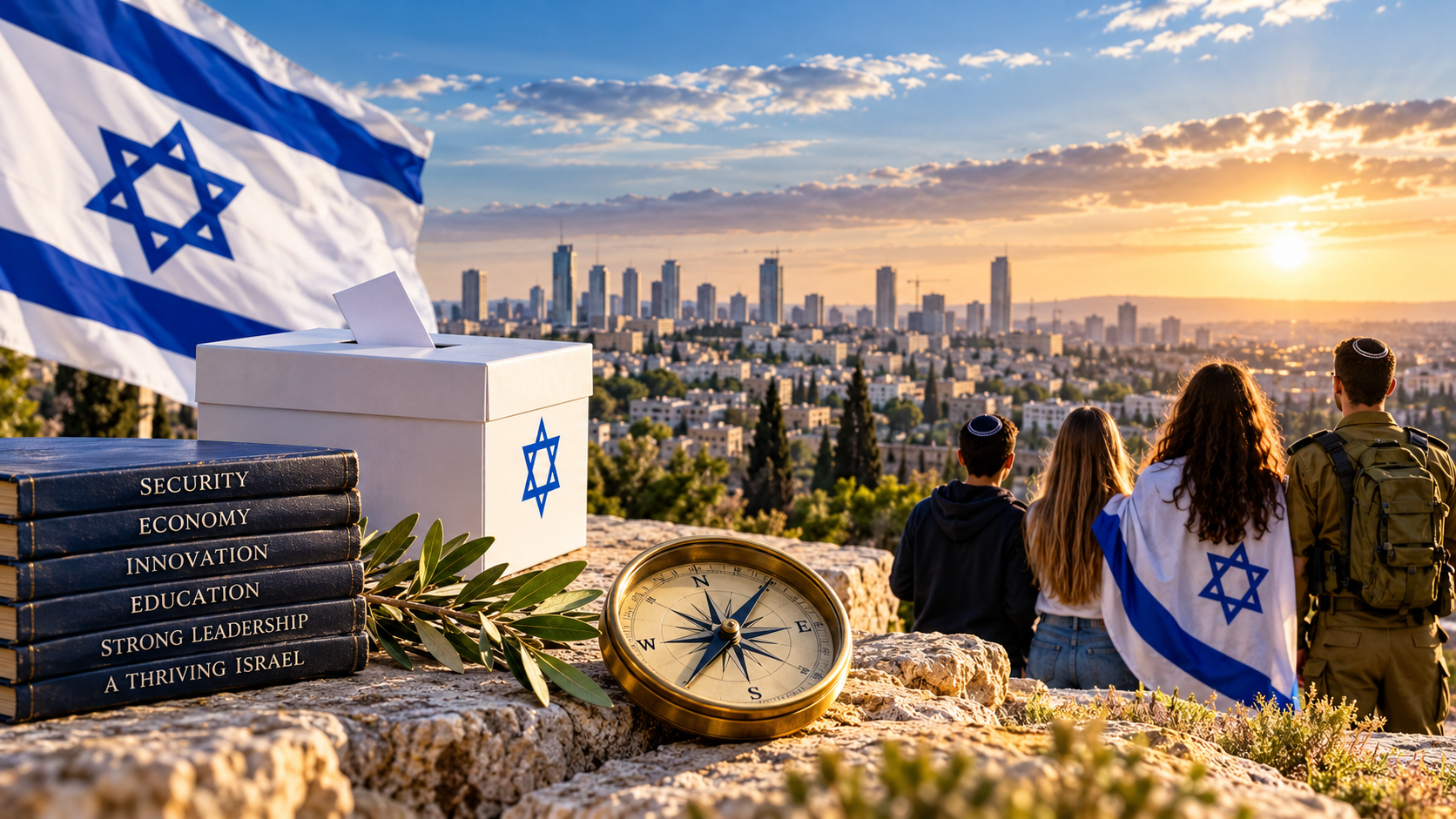
Photo Credits: Sabine Sterk ( AI)
The Israeli elections of October 27, 2026, may eventually be remembered not for who won, but for whether they became the beginning of a much needed transformation in Israeli politics. With an extraordinary voter turnout of 77.7% and preliminary results suggesting another political deadlock, one question should dominate the national conversation: What kind of Israel are today’s politicians preparing for tomorrow’s generations?
Elections are usually presented as a competition between political parties, personalities and ideologies, but perhaps Israel should approach this moment differently. Instead of concentrating exclusively on who will become the next prime minister, Israelis should be asking what their country must look like in ten, twenty or even fifty years. The world is changing at an extraordinary pace, the Middle East is undergoing profound geopolitical transformations, technology is redefining national security, and Israel faces challenges that cannot be solved by politicians whose primary concern is surviving another parliamentary term. The question is no longer simply who is capable of governing Israel today, but who possesses the vision, courage and intelligence to prepare Israel for tomorrow.
The preliminary election projections illustrate the complexity of this moment. Major exit polls suggest that neither Benjamin Netanyahu’s bloc nor the opposition led by Gadi Eisenkot has secured the 61 parliamentary seats necessary for a governing majority. Likud remains a major political force, while the opposition has demonstrated considerable electoral strength. Yet the absence of a decisive majority means that the political future remains uncertain until the votes are counted and coalition negotiations determine what is possible.
But perhaps this uncertainty offers Israel an opportunity to reconsider what it expects from political leadership.
A Country of Innovation Deserves Innovative Leadership
Israel has earned its reputation as the Start Up Nation through extraordinary achievements in medicine, science, agriculture, cybersecurity, artificial intelligence and technological innovation. It is a country where problems are frequently approached as challenges waiting for solutions, where creativity is encouraged and where people are willing to question established methods rather than simply accept them.
Yet when we look at Israeli politics, we repeatedly encounter the same personalities, familiar arguments and longstanding rivalries. Political experience is valuable, particularly in a country facing complex security challenges, but there comes a moment when experience must be complemented by renewal. A nation that produces some of the world’s most innovative entrepreneurs, scientists and military strategists should also be capable of developing a new generation of political leaders.
Where are the young visionaries who will shape Israel’s future? Where are the people capable of looking beyond ideological boundaries and developing practical solutions to problems that have remained unresolved for decades? Why does political leadership so often appear to be a closed circle, while extraordinary talent exists throughout Israeli society?
Israel does not necessarily need younger politicians simply because they are younger. It needs fresh ideas, independent thinking and leaders who understand that the challenges of 2040 will be fundamentally different from those of 2020. Artificial intelligence, cyberwarfare, demographic developments, water security, energy independence and economic competition will increasingly determine the strength of nations. Political leadership must anticipate these developments rather than react to them after they have already become crises.
Israel cannot afford to remain politically trapped in yesterday while the rest of the world is preparing for tomorrow.
National Security Must Become a Long Term Strategy
For Israel, security has never been an abstract political subject. It is a fundamental condition for national survival. Yet the security challenges of the coming decades will require more than military superiority and successful intelligence operations. They will demand a comprehensive national strategy that integrates defense, diplomacy, economic resilience, technological independence and social cohesion.
Israel must prepare for a future in which conventional military threats increasingly coexist with cyberattacks, autonomous weapons, artificial intelligence, economic warfare and sophisticated international campaigns designed to undermine its legitimacy. Iran and its regional networks will remain central security concerns, but Israel must also anticipate threats that have not yet fully emerged.
The next government should therefore be judged not only by its ability to respond to immediate dangers, but also by its willingness to invest in the security architecture of the future. This means strengthening intelligence capabilities, supporting technological research, protecting critical infrastructure and ensuring that Israel maintains the ability to defend itself independently when necessary.
Equally important is the development of a coherent diplomatic strategy. Military strength can protect borders, but diplomacy can create opportunities that military power alone cannot deliver. The Abraham Accords demonstrated that relationships once considered politically impossible could become reality when countries recognized the benefits of cooperation. Future Israeli governments should build upon that principle by pursuing regional partnerships based on mutual interests, economic development and realistic security arrangements.
Peace cannot be built on wishful thinking, and agreements without credible security guarantees can become dangerous illusions. Nevertheless, refusing to explore opportunities for cooperation would be equally shortsighted. Israel’s future requires leaders who understand both the necessity of military strength and the strategic value of diplomacy.
The Economy Is Also a Matter of National Security
One of the most important questions facing Israel’s next government concerns the economic future of the country. Israel may be internationally admired for its technological achievements, but that success does not automatically translate into affordable living conditions for every Israeli family.
Housing costs, the cost of living, economic inequality and the financial pressures associated with prolonged security challenges are issues that cannot be postponed indefinitely. A country cannot build its future exclusively around military preparedness while allowing everyday economic insecurity to undermine the confidence of its citizens.
Young Israelis should be able to imagine a future in which they can purchase a home, raise a family, develop a career and contribute to their country without constantly worrying about financial survival. Entrepreneurs should encounter opportunities rather than unnecessary obstacles, and businesses should operate in an environment that encourages investment, innovation and sustainable growth.
Economic strength also provides Israel with greater strategic independence. A financially resilient country is better equipped to maintain advanced defense capabilities, withstand international pressure and invest in the infrastructure required for future generations.
The next government must therefore understand that affordable housing, education, employment opportunities and responsible economic management are not secondary domestic concerns. They are essential components of national resilience.
Israel Must Invest in the Generation That Will Inherit the Country
Perhaps the most important responsibility of any government is preparing the next generation to inherit a country stronger than the one it received.
Education should be central to that ambition. Israel needs an educational system that encourages critical thinking, scientific excellence, historical knowledge, civic responsibility and mutual respect. Young Israelis must understand the history of their country and the extraordinary sacrifices that made its existence possible, but they must also be equipped to navigate a world that will look dramatically different from the one their parents experienced.
This requires investment in teachers, universities, technological education and opportunities for communities that have historically experienced unequal access to economic development. It also requires serious consideration of how different sectors of Israeli society can contribute to the country’s future while preserving their cultural and religious identities.
Israel’s diversity should become a source of strength rather than a permanent political battlefield. Jewish communities with different traditions, secular and religious citizens, Arab Israelis, Druze and other minorities all form part of the country’s social reality. Their interests will not always coincide, but a functioning democracy must create a framework in which disagreements can be managed without undermining the national institutions on which everyone depends.
A successful future Israel will not be one in which everyone thinks alike. It will be one in which citizens can disagree profoundly while remaining committed to the country’s democratic institutions, security and prosperity.
The World Is Watching What Israel Does Next
The significance of these elections extends far beyond Israel’s borders. Governments, investors, international organizations and regional powers are observing not only the election results, but also the political decisions that will follow.
Israel’s international position will increasingly depend on its ability to demonstrate strategic consistency, economic strength and credible leadership. Countries considering closer cooperation with Israel will want to know whether agreements can survive changes of government, whether major infrastructure and technological projects will receive sustained support and whether Israeli institutions can function effectively despite political disagreements.
Meanwhile, Israel’s adversaries will continue assessing its vulnerabilities. Political uncertainty does not automatically translate into national weakness, but prolonged governmental paralysis can complicate strategic planning and create opportunities for those seeking to exploit instability.
The answer is not to suppress political disagreement or demand artificial unity. The answer is to develop a political culture in which national interests remain central even when governments change.
A mature democracy should be capable of producing different governments without repeatedly questioning the fundamental direction of the state.
Israel needs continuity in its long term national priorities, regardless of whether its next prime minister comes from the right, the center or the left.
A New Political Culture Must Begin Somewhere
There is another uncomfortable question that Israelis should consider. Why must every election become a struggle between political personalities rather than a serious competition between visions for the future?
Political campaigns naturally involve criticism, disagreement and ideological competition, but voters deserve more than accusations and promises. They deserve detailed explanations of how parties intend to strengthen the economy, improve education, maintain security, encourage innovation and address the country’s long term challenges.
Perhaps Israel should begin demanding something different from its politicians. Instead of asking only what they oppose, voters should ask what they intend to build. Instead of concentrating exclusively on past achievements or failures, political leaders should explain what measurable improvements they expect to deliver during the next decade.
Political renewal does not necessarily require replacing every familiar face. It requires changing expectations, encouraging new talent and rewarding politicians who demonstrate competence, integrity and a willingness to cooperate when the national interest demands it.
Israel’s next government, whatever its composition, should recognize that the country cannot afford another period in which political survival becomes the dominant objective of governance.
The Future Is More Important Than the Winner
The 77.7% turnout is an extraordinary demonstration of democratic participation. Israelis have shown that they care deeply about the direction of their country, even after years of extraordinary national challenges.
But democracy should not end at the ballot box.
The responsibility now moves to the politicians who have asked the public to place its trust in them. Whether the final outcome produces a new coalition, a unity government, a minority administration or eventually another election, the central challenge remains unchanged.
Israel must prepare for a future that will demand exceptional leadership.
A future in which technological developments transform warfare and economic competition. A future in which regional alliances may become increasingly important. A future in which demographic changes require difficult decisions about education, employment and national responsibilities. A future in which Israel must remain capable of defending itself while offering its citizens prosperity, freedom and opportunity.
Above all, a future in which the Jewish state remains secure, democratic and confident in its identity.
The world will continue to judge Israel, sometimes fairly and often through deeply politicized narratives. Its enemies will continue searching for weaknesses, while its allies will expect stability and responsible leadership. But Israel’s ultimate success should not be measured exclusively by international approval or military achievements.
It should also be measured by the quality of life it offers its citizens, the opportunities it creates for its children and the strength of the institutions it leaves to future generations.
Israel has spent generations proving that it has the determination to survive. The challenge for the next generation of leaders is to ensure that it also has every opportunity to thrive.
The elections of 2026 may not produce an immediate political winner, but they could still become a turning point if Israelis begin demanding something greater than another coalition agreement.
Not simply a new government, but a new political vision.
Not simply promises of security, but a comprehensive strategy for national resilience.
Not simply familiar politicians competing for power, but leaders willing to prepare the country for challenges they may never personally experience.
Because the true measure of leadership is not how long someone remains in office, but what kind of country remains when that person eventually leaves.
Israel’s future must never become a prisoner of its political past.
And perhaps that is the most important lesson of these elections.
The question is not merely who will lead Israel tomorrow, but what kind of Israel they intend to leave behind.
Related Topics