
Beyond the False Choice: Israel’s Dilemma
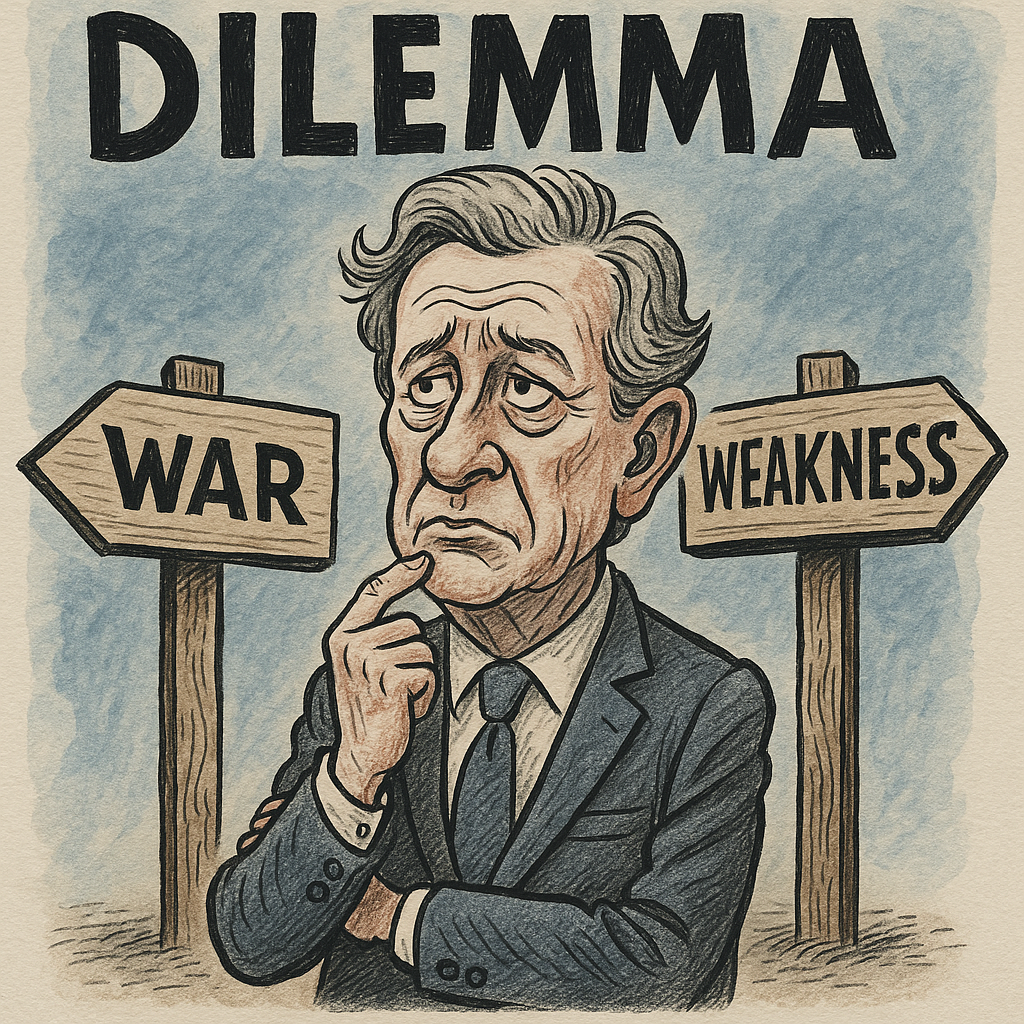
We are told, often with the solemn nodding of pundits and the hand-wringing of diplomats, that Israel faces a dreadful binary. If she defends herself too vigorously against those who seek her annihilation, she risks alienating friends in the West, who will purse their lips and intone that her conduct is “disproportionate.” If she fails to defend herself, she risks emboldening her enemies in the Middle East, who will take her restraint as weakness and return with something worse, something far more ruinous in the future. And so the script runs: Israel is damned if she does and damned if she doesn’t. The diaspora too, watching from London or New York, feels this dilemma keenly. To speak forcefully in Israel’s defence risks social exile in polite Western company. To remain quiet risks complicity in a silence that permits lies to flourish.
But let us not be so gullible as to accept this false dichotomy. It is not war or weakness, annihilation or appeasement. There is a third way — harder, nobler, more demanding. It is the path of strategic defiance married to moral clarity.
Permit me to pause for a moment on the theatre of terror. For it is theatre, make no mistake. The terrorist understands, perhaps better than the general or the politician, the power of costume. Thus the gunman who sprays bullets at a bus stop in Jerusalem is never a murderer; he is a “resistance fighter.” The bomber who detonates himself in a café is never a criminal; he is a “martyr.” It is murder in fancy dress, barbarity stitched together with the threadbare fabric of grievance. And how quickly we in the West applaud the costume change. Journalists, eager for balance, write of “militants.” Academics, intoxicated by grievance studies, deliver earnest lectures on “armed struggle.” Diplomats mutter about “cycles of violence” as though the corpses were chess pieces in some tragic but abstract game. We congratulate ourselves on nuance, on refusing to see things in black and white. In truth, it is cowardice. It is moral myopia dressed up as sophistication.
The third way is not to abandon force — Israel has, after all, the inalienable right of self-defence enshrined in Article 51 of the UN Charter. To demand that she fold her arms while rockets rain down is to demand that she commit suicide politely. But equally, the third way is not to reduce strength to steel and fire alone. It is to fight in another theatre: the realm of words, of legitimacy, of moral imagination. Israel must resist not only the rockets but the rhetoric. She must answer every libel — of genocide, apartheid, colonialism — not with defensiveness, but with relentless clarity, law, and history. She must insist that the language by which she is judged not be allowed to degenerate into a parody where terror is called liberation and murder is christened resistance. This is not weakness. It is strength deployed in the arena where democracies are most often defeated: the court of perception.
And what of us, scattered across the world, reading of Jerusalem while sitting in London, Paris, or Chicago? The diaspora is not condemned to silence, nor to shrillness. Our third way is to build alliances — with Christians, Muslims, Hindus, humanists — anyone who still believes that terrorism is not a cause but a crime. We must say, and say again, that to murder civilians is never resistance. To abduct children is never a liberation. To accuse Israel of genocide without evidence is not solidarity but slander. Our task is not to soften our tone until we are acceptable in dinner parties, nor to rage so loudly that we isolate ourselves further. It is to speak with precision, with dignity, with the unyielding reminder that truth itself is a form of resistance — resistance against lies, against euphemism, against the corrosion of civilisation.
Too often, peace is presented to us as the absence of war, as if the stillness of the grave or the silence of hostages in tunnels were peace. No: peace is the presence of justice, of dignity, of sovereignty recognised. It is not pacification; it is the establishment of conditions under which terror cannot flourish. The third way insists upon this harder peace. A peace where terror is not excused but confronted, where truth is not bent to appease murderers, and where Israel is judged by the same standards as any other democracy: imperfect, fallible, but entitled to life.
The dilemma, then, is not the crude binary of strike or surrender. The dilemma is whether we allow ourselves to be cornered by it. Israel’s third way — and the diaspora’s — is to defend ourselves with arms when we must, but also to defend the very words by which civilisation stands. For if civilisation means anything, it is that even the humdrum life of waiting for a bus is sacred. To murder civilians is not resistance. It is an affront to humanity. And our duty — however fraught, however costly — is not to rationalise it, but to resist it. Not only with weapons. But with words, with memory, with moral clarity.