
Beyond the Nuclear Umbrella: What South Korea Can Learn from Israel
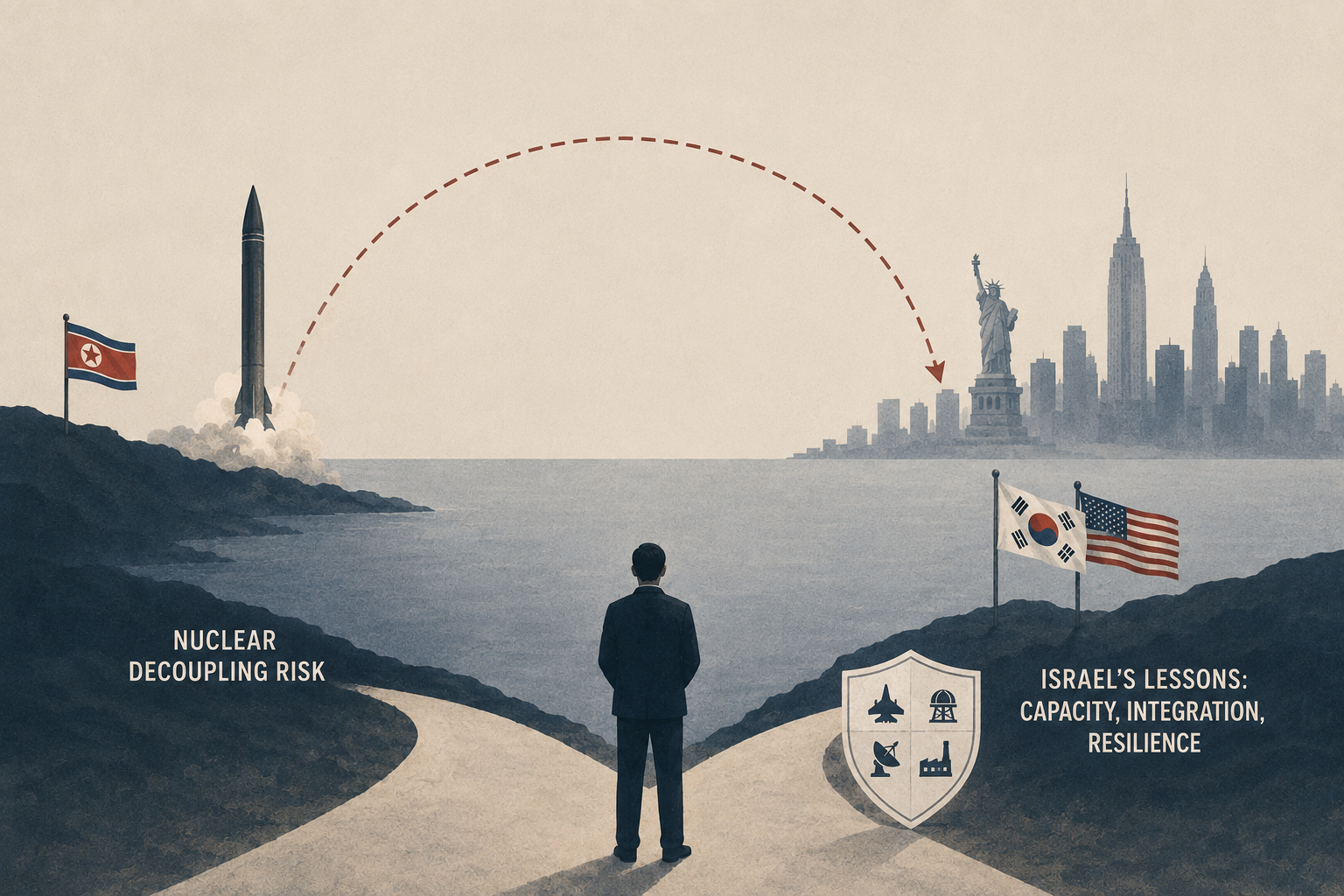
South Korea is facing a growing danger of nuclear decoupling: the possibility that North Korea could use its capability to threaten US cities to make Washington hesitate before defending Seoul.
As North Korea accumulates its nuclear arsenal—as of July 2026, the DPRK is estimated to possess 60 to 100 nuclear weapons—and develops intercontinental ballistic missiles (ICBMs), such as the Hwasong-18, that could reach the continental United States, Pyongyang might increasingly believe that it could weaken the U.S.-ROK alliance. If the current trend continues, a North Korean leader might at some point calculate that a US president would be reluctant to risk Los Angeles or New York to protect Seoul.
The key objective of such a strategy would not necessarily be to initiate a large-scale nuclear war. Instead, North Korea could politically isolate South Korea by using nuclear blackmail, restrict Seoul’s military options, weaken public confidence in the alliance, and ultimately force Seoul to negotiate alone.
Such a risk is contributing to growing support in South Korea for an independent nuclear capability—80 percent of South Koreans favored an indigenous nuclear weapons capability according to a poll conducted this year. Nevertheless, nuclear development incurs serious diplomatic, economic, technological, and alliance-related costs. Meanwhile, the United States has been unsupportive of redeploying tactical nuclear weapons to the Korean Peninsula.
Israel Offers Useful Lessons to South Korea
Unlike South Korea, Israel is not protected by a formal US extended deterrence guarantee. Although Washington provides a wide range of support to Israel and repeatedly affirms its commitment to Israel’s security, the United States has not publicly promised to carry out nuclear retaliation on behalf of Israel.
Israel has instead combined American support with strong conventional forces, a multi-layered missile defense architecture, an independent intelligence capability, indigenous arms production, national resilience, and the ability to act without waiting for another country’s authorization.
To be sure, South Korea cannot simply adopt the model. Israel is widely understood to possess an undeclared nuclear capability, whereas South Korea is a treaty ally of the United States and a non-nuclear member of the NPT. The two countries’ geographical and strategic circumstances also differ.
Nonetheless, Israel demonstrates how a close American partner could avoid fully relying for its security on Washington’s willingness to escalate.
Preserving the Capacity to Act Independently
The first lesson of the Israel case is that an alliance commitment should complement, not replace, a nation’s military capacity.
Israel’s conventional superiority has historically offered options that could be used below the nuclear threshold. Its value lies not only in its capability to inflict damage, but also in allowing Israel to respond to threats without relying on direct US intervention.
South Korea already has qualitative superiority vis-à-vis North Korea when it comes to conventional arms. However, conventional superiority should not be assessed by the aggregate number or performance of platforms such as aircraft and armored vehicles.
A more relevant question is whether South Korea could preserve sufficient war-fighting capability after North Korea’s initial nuclear and conventional attacks.
North Korea may not necessarily need to wipe out the entire South Korean military. Pyongyang might paralyze the South Korean government, damage a number of major air bases, jam communications, saturate missile defense systems, and create public pressure for immediate concessions.
Hence, South Korea should strengthen hardened and mobile command facilities, redundant communication systems, protected leadership succession arrangements, alternate runways, dispersed fuel and ammunition depots, and trained military forces that could operate in contaminated environments.
Furthermore, South Korea should disperse precision-strike assets, intelligence assets, aircraft, mobile missile launchers, and command systems. Highway airstrip operations and alternative headquarters should be routine elements of defense planning.
Needless to say, these measures would not make South Korea invulnerable. Nevertheless, they could demonstrate that a limited nuclear attack could not immediately neutralize organized resistance.
Meanwhile, South Korea should maintain a survivable conventional retaliation capability. Even without nuclear weapons, it should be able to strike North Korea’s key targets, including nuclear-related infrastructure, after absorbing the first round of attacks. Although the current Korea Massive Punishment and Retaliation (KMPR) framework is designed to carry out retaliatory strikes, the munitions required for this mission should be made more survivable and increased in number.
The objective should not be to promise the destruction of the North Korean regime. Instead, it should be to ensure that Pyongyang understands that the use of nuclear weapons would inevitably entail serious and unbearable military consequences.
Make American Support Operational Before the Nuclear Decision
Israel’s second lesson is that alliance credibility depends not on mere political declarations, but on operational integration.
Israel’s multi-layered defense system—which is designed to address rockets, UAVs, cruise missiles, and ballistic missiles—does not provide perfect protection. Its primary purpose is to reduce damage, safeguard critical infrastructure, preserve military operations, and give political leaders time and latitude to make better decisions.
South Korea should apply similar logic.
South Korea does need upper-tier defense systems against ballistic missiles—an indigenous interceptor, the L-SAM, is planned to be fielded starting in 2027—but it also needs to protect those systems from cheaper threats. Before launching nuclear-tipped missiles, North Korea could attack South Korea’s radars, Patriot and M-SAM batteries, command centers, and air bases using UAVs, cruise missiles, special forces, or conventional rockets.
Therefore, key air and missile defense facilities should be equipped with short-range air defense (SHORAD), counter-unmanned aircraft systems (C-UAS), electronic warfare protection, and passive sensors.
The objective is not to claim that every incoming North Korean missile can be intercepted. Rather, it is to make the result of any attack uncertain and prevent Pyongyang from confidently surmising that a small-scale strike would neutralize the allied defense architecture.
Israel’s experience also illustrates that US support becomes most credible when it begins before the American president decides whether to employ nuclear weapons.
When Iran conducted a massive missile and drone attack on Israel in April 2024, Israel’s defense systems were jointly activated with the capabilities of the United States and other partners. Such a response was possible thanks to pre-existing intelligence sharing, military dispositions, sensors, and interception procedures.
Likewise, the United States, Japan, and South Korea should develop an integrated regional missile defense network. This network should include real-time missile-tracking data, the coordinated allocation of interceptors—which would eventually necessitate at least the partial integration of Japan’s enemy-base strike capability and South Korea’s Three-Axis System—pre-agreed naval engagement procedures, joint damage assessment, and a mechanism enabling US and Japanese sensors to assist South Korean territorial defense.
Such integration would make nuclear decoupling more difficult. North Korea would not confront three countries that make completely different decisions. Instead, North Korea would be faced with an operational network in which the United States and Japan would participate from the very early stages of a crisis.
Deny North Korea the Political Benefit of an Attack
The 1991 Gulf War offers the clearest historical analogy.
Iraq launched Scud missiles at Israel in order to fragment the US-led coalition and partly to provoke an Israeli response. Saddam Hussein hoped that, if Israel joined the war, Arab coalition members would come under pressure to withdraw.
The United States deployed Patriot batteries and provided support while urging Israel to exercise restraint. Eventually, Israel refrained from directly entering the war.
By luring Israel into the fray, Saddam intended to break the coalition. North Korea could attempt to do the opposite: dissuade the US from intervening on the Korean Peninsula by threatening American cities. In both cases, alliance cohesion would be the genuine target.
The lesson for South Korea is that restraint should be backed up by concrete allied action.
In a future crisis, Washington could request that Seoul either delay or limit retaliation after North Korea’s initial wave of attacks for the sake of preventing additional nuclear escalation. South Korea should not necessarily decline such a request. Yet the alliance should determine in advance what type of quid pro quo the United States would offer.
A request for Seoul’s restraint should automatically trigger measures such as the deployment of additional US forces, continuous intelligence support, missile defense reinforcement, the immediate transfer of interceptor missiles, and public reconfirmation of the US commitment.
Equally important is the existence of a clear timetable for reassessing restraint. Otherwise, North Korea would misinterpret Seoul’s delayed retaliation as evidence that Washington—which is unwilling to confront Pyongyang—is controlling Seoul.
Last but not least, the Israel case showcases that national resilience itself is one form of deterrence.
North Korea could opt for a limited nuclear attack, not to decimate South Korea, but to generate panic, government paralysis, economic chaos, and public pressure to abandon the alliance for good.
Thus, South Korea should prepare its civilian population and institutions to continue functioning even after a nuclear attack. In that sense, South Korea needs credible emergency broadcasts and continuity plans for banking, telecommunications, electricity, water, and transportation. Clear public guidance on radioactive exposure and evacuation could reduce the political value of nuclear blackmail.
South Korea cannot rule out the possibility that a US president would hesitate when American cities are under threat. Meanwhile, conventional forces cannot fully replace nuclear deterrence.
Nevertheless, Seoul could make it extremely difficult for North Korea to exploit such hesitation.
The core lesson of the Israel case is not that South Korea should replicate Israel’s nuclear posture or adopt unilateral militarism. It is that an alliance becomes more credible when it is strengthened by national resilience, independent intelligence capabilities, survivable conventional forces, a multi-layered missile defense system, domestic industrial capacity, and operational agreements that involve the ally before the final question of nuclear retaliation arises.
Between complete reliance on the US nuclear umbrella and South Korea’s immediate pursuit of an independent nuclear capability, there exists a broad range of practical measures.
South Korea should begin implementing these measures before a nuclear crisis tests whether existing alliance assurances are operationally credible.