Rooted in Hope, Driven by Vision
Beyond the Word “Jew”: Returning to Ivriyut
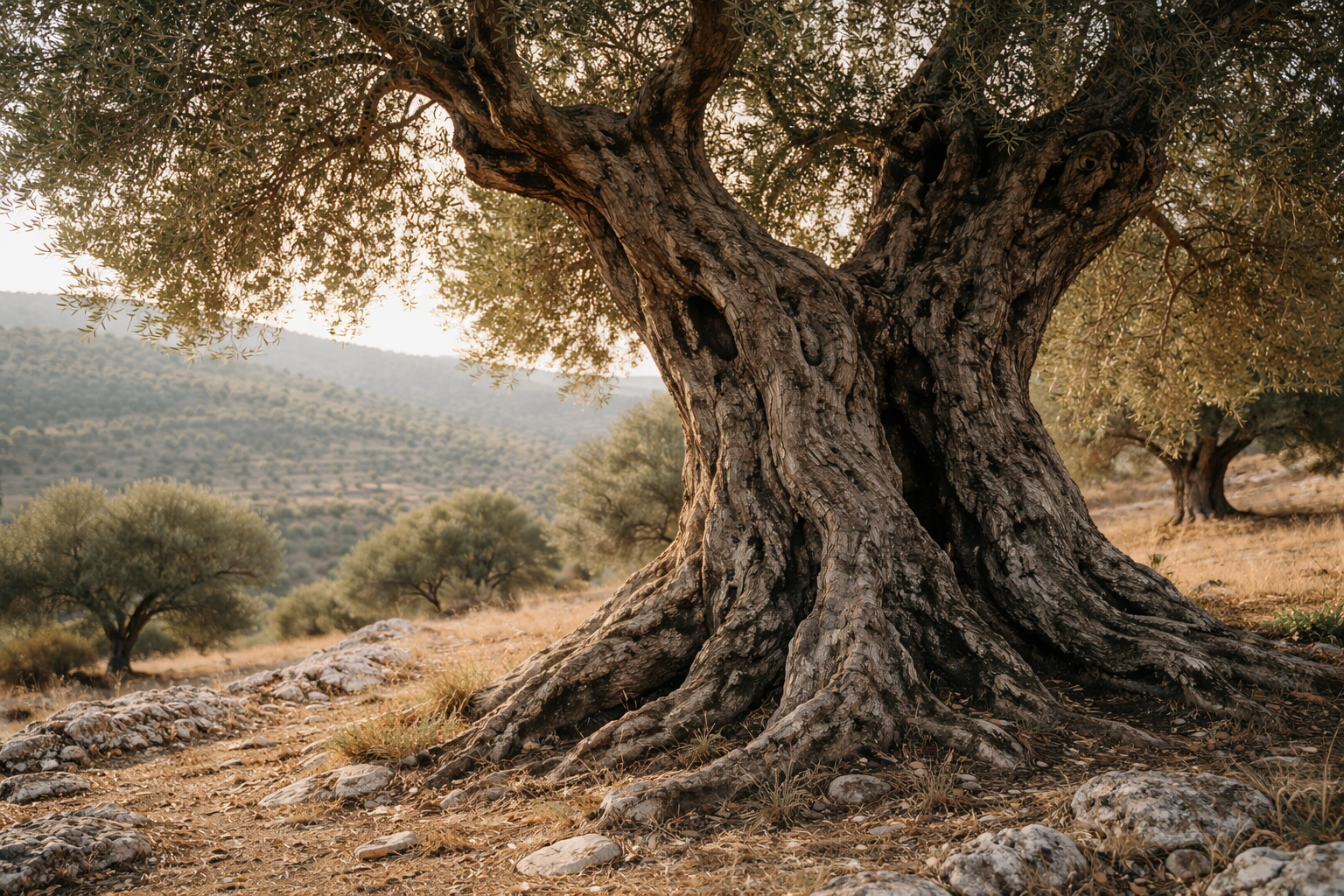
Roots of Ivriyut (Image AI generated)
The word “Jew” has always bothered me.
I remember the first time I heard it. I was very young—under five—living in the San Fernando Valley where I was born. I was in the car with my grandmother Baba, my 20-year-old cousin Tami, and my mother. We were driving home, when I noticed a man walking down the street dressed in a way I had never seen before: a long black coat, a white button-down shirt, black pants, shiny shoes, a fancy top hat, and a beard. He looked elegant, but also strange to my young eyes.
I’d said something out loud—maybe, Look at that man. And my cousin Tami had said, casually, That’s an Orthodox Jew. And I remember that my grandmother immediately corrected her.
“You don’t say that,” she’d said firmly. “You say Jewish person. Orthodox Jewish person.” That moment lodged itself somewhere deep within me, and it never left.
When I was in my early 20’s, I would live for a year amongst the ultra-Orthodox Jews, in a seminary in Har Nof. I loved them. And the only person who came to visit me was my grandmother Baba, who walked through the neighborhood with me, wide-eyed and amused, saying with a hint of a smile, I can’t believe you live here.
Her smile carried history. Her father had been a yeshiva boy in Poland until the age of sixteen, when he ran away—desperate to see more than four walls. He was arrested almost immediately in Russia and spent thirteen years in prison. And that’s just the beginning of that story.
So when I say the word Jew has always bothered me, it’s not about rejection. It’s about language. And what language does to people.
As I’ve learned Hebrew more deeply, I’ve begun to understand something essential: our name changed as our way of life changed. At the beginning, we weren’t “Jews.” We were Ivrim || עברים—“Hebrews.”
That name comes from Avraham HaIvri—the one who came me’ever hanahar—from the other side. Not just geographically, but existentially. Ivriyut || עבריות belongs to a tribal, nomadic people organized around kinship, ritual, movement, and memory—a people who go me’ever ha gvul, crossing back and forth over boundaries.
Then something radical happened—we entered the land.
And when we entered Eretz Yisrael, we stopped being a wandering people and became a settled one. We became Bnei Yisrael—a people rooted in a specific place, with borders, seasons, responsibilities, and consequences.
Our language changed because our lives changed. Suddenly we needed words that did not exist in nomadic life—words for things like fields, terraces, boundaries, harvest cycles, land tenure. Ancient Hebrew expanded to meet an agricultural reality. Words emerged, evolved, and sometimes disappeared entirely—like kar || כר, an early word connected to cultivated land, which later gave rise to karem || כרם, aka “vineyard.” The older word fell away because life itself had shifted.
This wasn’t abstract theology. It was a civilization learning how to live responsibly on the land. And the Torah reflects this reality. There are mitzvot that only make sense in Eretz Yisrael—laws of agriculture, rest, debt release, justice, and care for the vulnerable. When those responsibilities broke down—socially, ethically, politically—the kingdom fractured.
And then came exile.
Which did not just remove us from the land.
It also renamed us.
In exile, we became known by other nations as Yehudim || יהודים—“Jews,” named after the Kingdom of Judah, the last surviving Israelite polity after the northern kingdom fell to Assyria. “Judaism,” as we know it, emerges here as an adaptation, becoming deliberately portable: a rule-of-law system capable of holding a dispersed people together across borders, cultures, and centuries of dispersion and assimilation. Yahadut || יהדות—“Judaism” was a word created out of a need in exile. Before that, there wasn’t a word for it. It was just our tradition, it was just our way of life.
Yehudim || Jews is not our original identity. It is the name of a survivor polity. And that legacy still shapes us today.
From the very moment of its founding, the modern State of Israel entered into a formal state of emergency under the Law and Administration Ordinance of 1948—a declaration that was never rescinded and has been renewed year after year by the Knesset without interruption ever since.
This is not a slogan. It is a structural reality. A society that lives in a “permanent state of emergency” is a society that lives in survival mode. And as a person who wishes to be living in October 8, I am repelled by that status. Because survival mode, by definition, postpones long-term responsibility. This is not only social or political, as we have seen; it is civilizational. Many mitzvot tied to Eretz Yisrael—shmitta, yovel, land-based systems of rest, release, and social repair— remain unrealized not because they are obsolete, but because they require a people no longer governed by constant crisis.
That realization re-frames exile itself. Exile is not our eternal identity; it was a historical condition. “Judaism” carried us through it, but it was never meant to be the final form.
Today, some of us live in Israel. We are Yisraelim, citizens of a state, heirs to sovereignty again. Some of us live in the diaspora. We are called “Jews,” still carrying an exile name. Some of us live in Israel as if we are still in exile, forcing extreme separatism upon our own kind in our own land.
But beneath the borders, passports, denominations, and politics, there is something older and deeper that connects us all.
Ivriyut || עבריות—“Hebrewness” is that bond.
Ivriyut is the connective tissue of the tribe—me’ever la’gvul, beyond the borders of time, place, and exile. If Eretz Yisrael is the heart, then Ivriyut is the circulatory system—pulsing through veins that reach Ivrim everywhere.
And for that circulation to hold, the center must hold too. In a world of division— between Israelis and diaspora Jews, between religious and secular, between memory and future—we do not need another argument about who is right.
We need to remember what we are.
Not just Jews.
Not only Israelis.
Ivrim.
Related Topics
Related Posts