
Urban sociologist and geopolitical commentator
Bhojshala: The Living Wound of Indian Memory
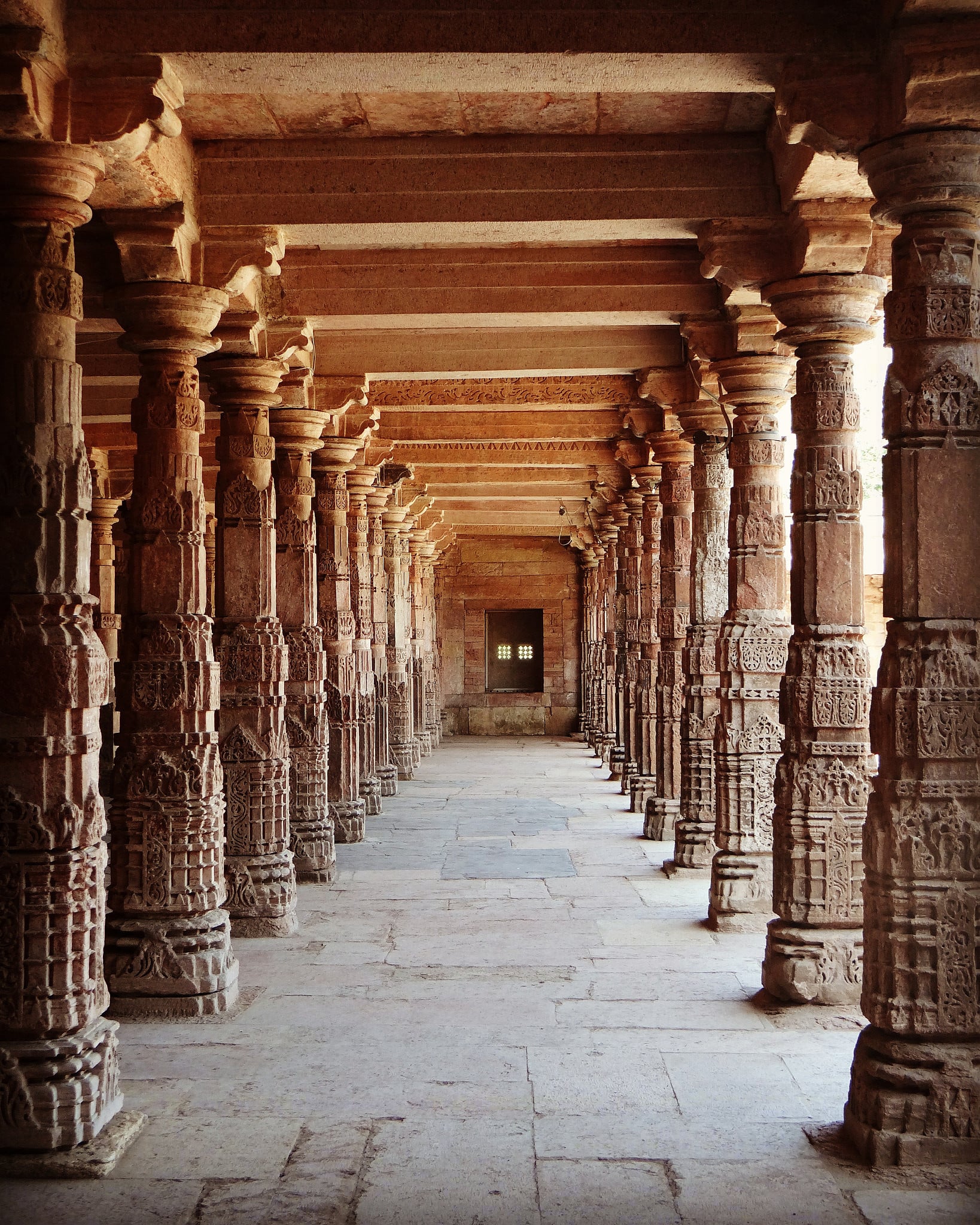
Arcade of the pillared hall known as the Bhoj Shala. 7 September 2021, Saumysbag (Source: Wikimedia Commons)
On a Monument That Is Also a Civilization’s Unfinished Argument With Itself
“Yā Kundendutusārahāradhavalā, yā śubhravastrāvṛtā.” She who is white as jasmine, white as the moon, white as the garland of Kunda flowers – Goddess Saraswati.
The Error of the Monument
We have been asking the wrong question about Bhojshala.
For decades, the debate has been conducted in the diminished vocabulary of real estate: whose land, whose structure, whose prayer, whose Friday. Courts have issued rulings. Archaeological surveys have issued reports. Political parties have issued proclamations. And beneath all this noise, Bhojshala has sat quietly in Dhar, doing what monuments do when human beings fail them: it has waited.
But the monument is not waiting to be claimed. It is waiting to be read.
This is the first and most consequential distinction. A monument that is merely claimed becomes a trophy: inert, frozen, available only as a symbol of victory or grievance. A monument that is read becomes something else entirely: a living argument, a surviving voice, a compressed archive of civilizational intelligence that still has the capacity to disturb, to instruct, and to transform. Bhojshala belongs in the second category. And the tragedy is not that it has been disputed. The tragedy is that in all the heat of the dispute, almost nobody has actually read it. A monumental error!
To read Bhojshala properly, one must first unlearn almost everything that the standard narrative of Indian history has taught about medieval India, which is to say, one must unlearn quite a lot.
The Crime of the Periodization
There is a violence that historians commit that leaves no blood and no body, and is therefore rarely prosecuted. It is the violence of periodization: the act of chopping a living civilization into administrative slabs and then pretending the slabs are the civilization itself.
Indian history, as it came to be narrated through the twentieth century by the dominant schools, was periodized into Ancient, Medieval, and Modern. In practice, this meant: glorious Hindu antiquity, followed by Islamic medieval centuries, followed by British modern rupture. Within this schema, “medieval India” became, by quiet default, “Sultanate and Mughal India.” The political vocabulary of Islamic rule became the only vocabulary through which the medieval centuries were permitted to speak.
What was lost in this is not merely a collection of facts. What was lost was an entire epistemic world.
Between the tenth and fourteenth centuries, precisely the centuries that this periodization renders most obscure, India was not a continent in civilizational retreat. It was a continent in extraordinary civilizational ferment. Sanskrit scholarship was at one of its most productive peaks. Vernacular literary traditions, such as Tamil, Kannada, Telugu, Marathi, Bengali, Brajbhasha, Apabhramsha, were flowering into forms of stunning sophistication (see Pollock 2006, Ch.2). The mathematical traditions that would eventually transmit trigonometric and algebraic knowledge westward were being actively developed in temple universities and monastic academies. Philosophical debates between Advaita, Vishishtadvaita, Dvaita, Nyaya, Mimamsa, Buddhist Madhyamaka, and Jain Anekantavada schools were at an intensity that Europe’s scholastic tradition can barely parallel. Sacred architecture was achieving structural and symbolic heights that remain, to this day, among humanity’s greatest accomplishments. And networks of knowledge transmission, through pilgrimage routes, through guru-shishya lineages, through royal patronage, through merchant-funded libraries, were connecting Kashmir to Kanyakumari, Malwa to Mithila, the Deccan to Bengal, in a single pulsing intellectual circulation.
This civilization – productive, self-aware, philosophically demanding, artistically ambitious – is almost invisible in the standard narrative of medieval India.
Bhojshala is one of the few surviving sites where it is still visible.
Bhoja: The Philosopher-King as Civilizational Category
Before Bhojshala can be understood, Bhoja himself must be recovered, and Bhoja is one of the most systematically underestimated figures in the history of the Indian subcontinent.
Bhoja Paramara, who ruled Malwa from approximately 1011 to 1055 CE, was not simply a capable medieval king. In the Sanskritic tradition, he achieved something that very few historical figures achieve: he became an archetype. The king who also thinks. The sovereign who also creates. The ruler for whom power is not an end but an instrument: an instrument for the preservation and expansion of jñāna, of knowledge itself. Describing his genius, Sheldon Pollock (2006) writes:
“His literary-critical works present a kind of summa poeticae, assembling and reordering the preceding seven or eight centuries of reflection on what literature was believed to be.”
The scale of Bhoja’s intellectual output is, by any standard, extraordinary. He composed or substantially contributed to works in grammar (Sarasvatīkaṇṭhābharaṇa), poetics and aesthetics (Śṛṅgāraprakāśa, which runs to forty chapters and constitutes perhaps the most comprehensive treatise on rasa theory ever attempted), medicine (Rājamṛgāṅka), yoga (Rājamārtaṇḍa), architecture and iconography (Samarāṅgaṇasūtradhāra, a text of such technical sophistication that modern architects and archaeologists still consult it), astronomy, and political philosophy. He built temples, constructed a vast artificial lake, the Bhojsāgar, whose scale astonished contemporaries, founded academies, and drew scholars from across the subcontinent to Dhārā, his capital.
No comparable figure, a working sovereign who was simultaneously a practicing, producing scholar of the first rank across multiple disciplines, exists in medieval European history. The closest analogues are perhaps Harsha, or the Chola emperor Kulottunga, or certain philosopher-kings of the Vijayanagara period. But Bhoja’s range, and the depth of his theoretical work in poetics and grammar particularly, place him in a category almost entirely his own.
The tradition sensed this. In later centuries, the name “Bhoja” detached almost entirely from specific historical memory and became a floating signifier for the ideal of the scholar-king. Folktales, Subhāṣita-saṅgrahas/Bhoja-Prabandha, proverbial wisdom, all invoked Bhoja as the archetype of cultured sovereignty. When Indian tradition wished to imagine what it would look like for a ruler to love knowledge as much as power, it imagined Bhoja.
Bhojshala, the “Shala of Bhoja,” the Hall or Academy of Bhoja, is the surviving architectural remnant of this civilizational imagination. It is not merely a building. It is a thesis about what governance should be, what knowledge is for, and what the relationship between the sacred and the intellectual should look like.
Saraswati and the Epistemology of the Sacred
The presiding deity of Bhojshala is Goddess Saraswati. This is not incidental.
In the Hindu intellectual tradition, particularly in the Sanskritic tradition that Bhoja inhabited, extended, and helped transmit, Saraswati is far more than a goddess of learning in the devotional sense. She is a cosmological principle. She is vāk – primordial speech, the vibratory ground of all that can be known, expressed, or communicated. She is the principle by which consciousness articulates itself into intelligible form.
This theological claim has radical epistemological implications. If knowledge is sacred because speech is divine, then the institution of learning is not a secular utility. It is a ritual act. The scholar’s work is not merely professional; it is a participation in the self-disclosure of consciousness. The academy is not a building; it is a yajñaśālā – a site of sacrifice, of transformation, where the raw material of ignorance is offered into the fire of inquiry and transmuted into something that partakes of the divine.
This is the world Bhoja was building at Dhārā. Not a university in the modern, bureaucratic sense. Not a madrasa in the transmission-of-fixed-texts sense. Something more ambitious: an institution whose physical form, spatial organization, theological symbolism, and curricular range were all in alignment with a single overarching claim, that ordered consciousness, expressed through disciplined inquiry, through refined language, through structured aesthetics, through mathematical precision, through philosophical rigor, is itself a form of worship.
The implications of this for how we understand the dispute over Bhojshala are significant. When this space is reduced to the binary of “temple versus mosque,” something very specific is lost: the recognition that for the civilization that built it, there was no meaningful distinction between the sacred and the intellectual. The building was both, and not because it hybridized two separate functions, but because it proceeded from an epistemology in which that distinction did not exist.
The loss of this epistemology, that is, the fragmentation of the sacred from the intellectual, of knowledge from worship, of grammar from metaphysics, of aesthetics from philosophy, is arguably the deepest wound that medieval disruption inflicted on Indian civilization. Bhojshala, as a surviving artifact of the unitary vision, gives us the extraordinary opportunity to remember what was lost, and to ask whether it can be recovered.
The Deccan Suppression
The civilizational network of which Bhojshala was a part did not stop at the borders of Malwa.
One of the most consequential suppressions in Indian historiography has been the subordination of the Deccan’s intellectual history to its political history. The Deccan, that vast and extraordinarily complex plateau that forms the subcontinent’s center of gravity, has been narrated, in the dominant historiographies, almost exclusively through the sequence of its Islamic sultanates: Bahmani, Bijapur’s Adilshahi, Golconda’s Qutbshahi, Bidar’s Baridshahi, Berar’s Imadshahi, and eventually the Mughal absorption and Maratha emergence.
This political sequence is real. It happened. But it is not the Deccan.
The Deccan, prior to and beneath and alongside these political transformations, was one of the most intellectually productive regions in the history of the world. The Chalukyas of Badami and Kalyani, the Rashtrakutas, the Yadavas of Devagiri, these were not merely political powers. They were the patrons, transmitters, and often themselves the practitioners of a scholarship that connected Deccan to the wider “Sanskrit cosmopolis” (Pollock 2006), with extraordinary energy.
Kannada literary tradition, beginning with Pampa, Ponna, and Ranna, collectively known as the “three gems” of Kannada literature, in the tenth century, represents one of the most sophisticated early vernacular literatures anywhere in the medieval world, and it emerged from precisely the intersection of Sanskritic learning and regional creative energy that Deccan patronage made possible (Pollock 2006, Ch.9). The Veerashaiva philosophical movement, centered in the twelfth century on figures like Basavanna and Allama Prabhu, produced a corpus of vachana literature, in Kannada, that is among the most philosophically penetrating mystical writing in any language, anywhere. The Telugu literary tradition, the Marathi sant tradition, the extraordinary mathematical and astronomical work of the Kerala school (which had deep roots in Deccan transmission networks), all of these were products of a civilization that was very far from dead in the “medieval” centuries.
The crucial point for our purposes: this civilization was connected. Connected to Malwa through shared patronage networks, through pilgrimage routes, through the circulation of Sanskrit texts, through trade that carried manuscripts alongside merchandise. Bhoja’s Dhārā was not an isolated northern outpost. It was one node in a pan-Indian network of knowledge transmission whose other nodes included Sringeri, Kanchipuram, Varanasi, Mithila, Nabadwip, the Deccan temple universities, the Kerala grāmams, and scores of regional centers now mostly forgotten. (Pollock 2006, Ch.8).
When Bhojshala is recovered, not merely as a disputed structure in Madhya Pradesh, but as a surviving node of this network, the history of the Deccan itself changes. The sultanates cease to be the founding moment of Deccan civilization and become, instead, a political overlay on top of a civilization that was already ancient, already sophisticated, already self-aware. The Deccan before the Bahmanis becomes visible. And with it, the connections, northward to Malwa, southward to Tamil Nadu, eastward to Bengal, that make Indian civilization a single story rather than a collection of regional fragments.
What the Pāṭhaśālā Knew That the University Has Forgotten
There is a temptation, in recovering institutions like Bhojshala, to translate them into modern categories: to call them “universities,” to compare them to Bologna or Paris or Oxford, to claim for them the prestige of modern academia by assimilation.
This temptation should be resisted. Not because the comparison is entirely wrong, but because it is not ambitious enough.
The medieval European university, whatever its considerable achievements, was organized around the transmission of a relatively fixed corpus of authoritative texts. Its epistemology was fundamentally conservative, knowledge was something already possessed by the ancients (scriptural or classical), to be carefully preserved, commented upon, and applied. The institutional form reflected this: the lecture, the commentary, the disputation over interpretation. (also see, the history of scholastic tradition in Pieper, J. 2024).
The Sanskritic pāṭhaśālā (loosely, school, as recorded by Ernest Barnes in 1904) tradition of which Bhojshala was an expression had a different epistemological orientation. It was certainly concerned with the transmission of authoritative texts, i.e., the Vedas, the śāstras, the philosophical traditions, but it was simultaneously concerned with something more: the expansion of the knowable through original composition, through the creation of new śāstra, through philosophical debate that was designed not merely to confirm existing positions but to genuinely test them against the best opposing arguments.
Bhoja’s own intellectual production exemplifies this. His Śṛṅgāraprakāśa does not merely compile existing aesthetic theory. It proposes a comprehensive synthetic framework, rasa theory extended and transformed, that represents genuine original philosophical work. Yoshichika Honda (2002), in an article titled, An Aspect of Bhoja’s rasa Theory in his Srngaraprakasa, notes:
“Bhoja’s Śṛṅgāraprakāśa is the largest in scale among the extant treatises on rasa theory and poetics. As its title itself suggests, its defining feature lies in establishing śṛṅgāra, which Bhoja also calls ahaṃkāra and abhimāna, as the sole rasa (trans. from original Japanese).
His Samarāṅgaṇasūtradhāra does not merely repeat existing architectural treatise material. It systematizes, extends, and applies principles, referred as Vāstuvidyā (see Hardy 2015), in ways that show a genuinely creative architectural intelligence at work. Mattia Salvini (2012:43), in the conclusive remarks on the nature of this text, notes:
“What the text surely does is to place Vãstu within a wider context, and also, to locate a great variety of specialised topics and activities (such as choosing materials, building machines, identifying regional temple-styles, and so forth) within the broader framework of Vãstu, and within the intellectual world of its author(s). It subsumes Vãstu into the world, and at the same time, the world into Vãstu.”
The institution Bhoja built was designed to produce this kind of work: work that is simultaneously rooted in the tradition and genuinely advancing beyond it. This is an epistemological orientation that modern Indian academia, largely organized around imported Western models, has largely abandoned. The irony is considerable: India’s ancient and medieval institutions may have been more genuinely committed to original intellectual production, in the deepest sense, than the modern institutions that have replaced them.
Bhojshala, recovered fully, poses this question to contemporary India with uncomfortable directness: What happened to this intellectual ambition? Where did it go? And is it recoverable?
The Epistemic Catastrophe
The destruction of Bhojshala, and here I mean not merely the physical alterations of the medieval period but the more protracted destruction of the intellectual world it represented, was not a single event. It was a process, and it had multiple agents.
The first wave was political: the raids and destructions of the Sultanate period, which targeted precisely the kind of sacred-intellectual institutions that Bhojshala represented, because the targeting was ideologically deliberate. Temple universities, manuscript libraries, sacred academies, these were understood, by those who destroyed them, to be the reproductive organs of the civilization they sought to replace. The destruction was therefore not random but systematic. It aimed, with considerable success, at breaking the institutional continuity through which civilizational knowledge was transmitted.
The second wave was subtler and, in some ways, more damaging: the colonial recategorization of Indian civilization. British scholarship, with honourable individual exceptions, organized its understanding of Indian history in ways that deeply distorted the civilizational picture. Ancient India was acknowledged as having produced philosophy and literature of some merit. Medieval India was rendered primarily as a political history of “Muslim rule.” The intellectual production of the medieval centuries was either ignored or attributed, where possible, to Islamic influence. Sanskrit scholarship was museumified, treated as a dead tradition of purely antiquarian interest rather than a living intellectual system. The result was an India that had forgotten how to read its own civilizational archives in the categories those archives actually used.
It is also important to note that scholars such as Sheldon Pollock have themselves cautioned against overly direct or monocausal explanations of Sanskrit’s historical transformation. In his work, Pollock acknowledges the complex and still partly unresolved relationship between the colonial period and the changing status of Sanskrit learning (Pollock 2001), and further emphasizes that the causal link between colonial rule and the decline of Sanskrit intellectual culture requires more careful historical specification rather than assumption (Pollock 2002:431). In contrast, I argue that the institutional taxonomy that came to structure Indian academic historiography, dividing the past into “ancient/Sanskritic,” “medieval/Islamic,” and “modern/colonial” periods, was significantly shaped by British colonial epistemic frameworks, which in turn influenced how intellectual traditions were categorized and interpreted.
The third wave, and this one must be named clearly, was the ideological historiography of independent India’s dominant academic establishment (namely, Marxist/historical materialist), which inherited the colonial framework more thoroughly than it acknowledged and compounded the distortion with politically motivated suppressions of its own. The decision to narrate medieval India primarily through the vocabulary of composite culture and Mughal achievement, while real and valuable aspects of Indian history, produced, as its shadow, the near-complete invisibility of the indigenous intellectual traditions that were running in parallel, and often in tension, with those political developments.
Bhojshala fell between all three waves. Too medieval to be safely claimed by those who romanticized Hindu antiquity. Too Hindu to be comfortably incorporated into narratives of medieval Islamic achievement. Too regionally specific to fit easily into either the all-India narrative of Mughal grandeur or the anti-Mughal counter-narrative of nationalist historiography. The result was a monument that survived physically as damaged, altered and contested, while the intellectual world it represented was almost entirely erased from the historical imagination.
The Goddess Speaks
Let us attempt, briefly, to imagine what Bhojshala was at its height, to reconstruct, however partially, the intellectual world that once animated these stones.
It is approximately 1030 CE. Bhoja has been on the throne for two decades. His capital at Dhārā is, by contemporary accounts, one of the most intellectually active cities in the world. Sanskrit scholars come from Kashmir, from Bengal, from the Deccan, from the Tamil south, some to compete with the scholar-king in verse contests, some to consult the vast library he has assembled, some to submit their compositions for his evaluation, some simply to be in the presence of a sovereign who can read their work with genuine critical intelligence.
In the institution that will be remembered as Bhojshala, learning is organized according to a principle that modern education has entirely forgotten: the unity of disciplines. Sanskrit intellectual tradition treated disciplines as interconnected (śāstra systems). Grammar is not taught as a separate subject from poetry. Poetry is not taught separately from metaphysics. Metaphysics is not taught separately from mathematics. Mathematics is not taught separately from astronomy. Astronomy is not taught separately from sacred geography. Sacred geography opens back onto theology, which opens back onto grammar, which is the ground of everything, because vāk, speech, is the ground of everything.
The presiding image of Saraswati (Vāgdēvī) does not merely symbolize “education” in the anemic modern sense. She presides, which is to say, she organizes. Her presence is a constant reminder that all disciplines are aspects of a single inquiry: the inquiry into the nature of consciousness and its self-expression in the world. The student who masters grammar is not merely learning to speak correctly. She is learning to participate, more fully and consciously, in the fundamental creative act of the universe.
This is the world that the stones of Bhojshala once held. This is what the dispute has covered over: not merely a building, not merely a prayer site, but a surviving fragment of one of the most ambitious educational philosophies ever attempted.
The Restoration That India Needs
The restoration of Bhojshala cannot be, and must not be, merely physical.
A physical restoration, which implies, the removal of later accretions, the uncovering of original inscriptions, the archaeological documentation of the original structure, would be valuable. It would be necessary. But it would not be sufficient, because the deepest damage was not structural but epistemic.
The restoration India needs is the restoration of the ability to read Bhojshala, and, through it, to read the medieval centuries of Indian civilization in their own categories, on their own terms, with their own intellectual vocabulary.
This means, concretely: the establishment of serious scholarly institutions devoted to the study of the Paramara world: its literature, its philosophy, its architecture, its astronomical knowledge, its networks of transmission, its relationships with the wider Sanskrit cosmopolis. It means the translation and publication, in modern accessible forms, of Bhoja’s own works, which remain largely unavailable to the educated Indian public that they most concern. It means the rewriting of school and university history curricula to present medieval India not as a corridor between ancient greatness and colonial disruption but as a period of extraordinary intellectual activity in its own right. It means the recovery of the institutional history of knowledge in India – the story of the pāṭhaśālās, the temple universities, the manuscript libraries, the philosophical lineages – as a central rather than marginal chapter of Indian civilizational history.
It means, most ambitiously, the recovery of a way of seeing that understands civilization not as political succession but as intellectual inheritance: a living stream of inquiry, preserved and extended by each generation, connecting the living to the dead and the present to the ancient in a continuity that is not merely sentimental but genuinely cognitive.
When that restoration happens, Bhojshala will not need to be claimed by one community against another. It will speak, to all of India, across all communities, across all centuries, in the voice that was always its deepest identity: the voice of Saraswati, the voice of ordered consciousness, the voice of a civilization that once knew, and may yet remember, that knowledge is the most sacred thing.
The Unfinished Argument
Every great civilization has an argument with itself that it never fully resolves, an internal tension that generates its most productive energies and its most devastating conflicts simultaneously.
India’s great unfinished argument is about the relationship between knowledge and power, between the Brahmin and the Kshatriya, between the scholar and the sovereign, between the world-renouncing sage and the world-ordering king. This tension runs from the Mahabharata through the Arthashastra through the Natyashastra through the entire history of Sanskrit political thought, and it never reaches a final resolution, because it cannot. It is not a problem to be solved. It is a productive contradiction to be sustained.
Bhoja was remarkable precisely because he tried to hold both sides of this tension within a single person. The scholar-king who was genuinely both, who did not merely patronize scholarship as a royal duty but who was a scholar, who thought like a scholar, who produced like a scholar, while also commanding armies, building infrastructure, and managing the complex politics of a contested medieval sovereignty. In this, he was attempting to live out, personally and institutionally, the resolution of India’s great unfinished argument.
That resolution remains unfinished. India’s contemporary argument about Bhojshala is, at its deepest level, a continuation of this ancient tension: the tension between those who would organize civilization around the primacy of knowledge and those who would organize it around the primacy of power, the tension between those who experience the monument primarily as an intellectual inheritance and those who experience it primarily as a site of political contest.
The monument will be truly restored, not just physically, but historically and culturally, only when India is able to hold both of these with the sophistication that Bhoja himself attempted: to honor the political reality of what happened to the space while simultaneously recovering the intellectual reality of what it was built to be.
Until then, Bhojshala remains what it has been for several centuries: a sleeping archive, waiting to be read. A civilization’s argument with itself, suspended mid-sentence.
And Saraswati waits, as she has always waited, white as jasmine, white as the moon, for the moment when the argument resumes.
References:
Ernest Barnes, “Art. XI. – Dhar and Mandu,” Journal of the Royal Asiatic Society, Bombay Branch 21 (1904): 339-91. https://zenodo.org/records/10949373
Hardy, Adam. (2015). Theory and Practice of Temple Architecture in Medieval India: Bhoja’s Samarāṅgaṇasūtradhāra and the Bhojpur line drawings. New Delhi: Indira Gandhi National Centre for the Arts with Dev Publications.
Pieper, J. “Scholasticism.” Encyclopedia Britannica, March 19, 2024. https://www.britannica.com/topic/Scholasticism.
Pollock, Sheldon. “The Death of Sanskrit.” Comparative Studies in Society and History 43, no. 2 (2001): 392–426. http://www.jstor.org/stable/2696659.
_____________. “INTRODUCTION: WORKING PAPERS ON SANSKRIT KNOWLEDGE-SYSTEMS ON THE EVE OF COLONIALISM.” Journal of Indian Philosophy 30, no. 5 (2002): 431–39. http://www.jstor.org/stable/23496915.
_____________. (2006). The Language of the Gods in the World of Men: Sanskrit, Culture, and Power in Premodern India. Berkeley: University of California Press.
Salvini, Mattia. “The Samarāṅganasūtradhāra: Themes and Context for the Science of Vāstu.” Journal of the Royal Asiatic Society 22, no. 1 (2012): 35–55. http://www.jstor.org/stable/41490373.
Yoshichika Honda, An Aspect of Bhoja’s rasa Theory in his Srngaraprakasa, Journal of Indian and Buddhist Studies (Indogaku Bukkyogaku Kenkyu), 2001-2002, 50(2): 965-962, Released on J-STAGE March 09, 2010. https://www.jstage.jst.go.jp/article/ibk1952/50/2/50_2_965/_pdf/-char/en
Related Topics
Related Posts