
Urban sociologist and geopolitical commentator
The Seal and the River of Time
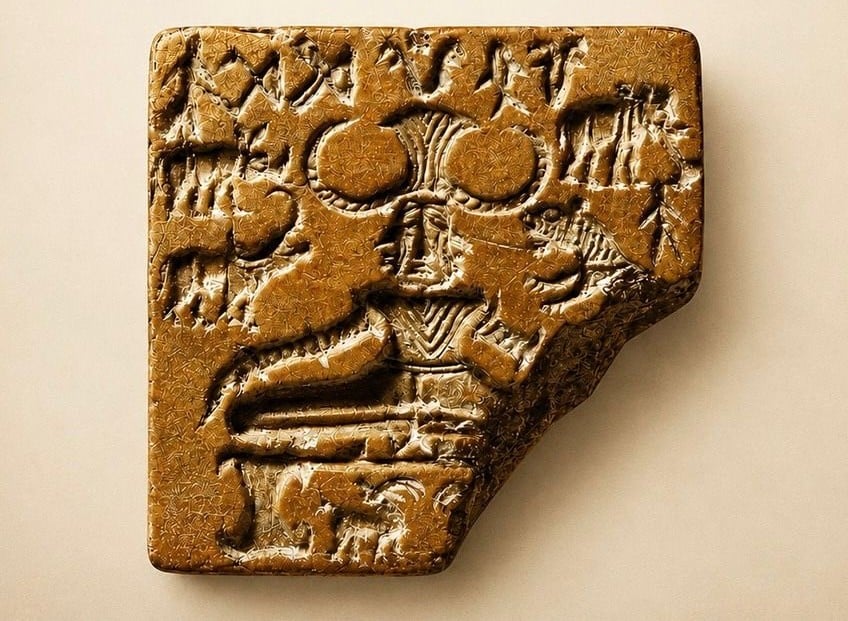
The Pashupati Seal: A 4,300-year-old steatite seal found at Mohenjo-daro. May 27, 2026 (Source: Ministry of Culture, Govt. of India, X.)
A Meditation on the Pashupati Seal, the Indian Civilizational Continuum, and What Humanity Owes to the Clay’s Memory
The Undeciphered Witness
There are objects that survive. Then there are objects that remember.
The Pashupati Seal of Mohenjo-daro, carved from steatite, no larger than the face of a wristwatch, pressed into wet clay by a hand five thousand years old, belongs to the second category. It has survived, yes. But more than survived: it has held. It holds a posture. A gaze directed outward from beneath a horned headdress. Animals attending to a figure that may be a deity, a shaman, a king, a priest, or something for which we no longer have a word. It holds a script we cannot read.
That silence is not emptiness. It is depth.
We should be careful not to mistake the absence of decipherment for the absence of meaning. The Pashupati Seal speaks constantly. We simply have not learned its full language yet.
But what we can read is this: the world that produced this object was already old when it produced it.
The Stage Before the Play
Every civilization is, in some sense, a response to a landscape. But few landscapes have ever issued so extraordinary an invitation as the Indian subcontinent.
Consider what was assembled here, as if by a patient geological architect.
To the north: the Himalayas, the youngest mountains on Earth, still rising, still shedding immense quantities of sediment into rivers whose carrying capacity was unparalleled. These mountains were not merely a wall. They were a factory. They produced the very soil, silt-rich, mineral-laden, perpetually renewed, upon which civilizations would be planted and replanted across millennia.
Beneath the mountains: the great plains of the Indus and the Ganga, stretching across thousands of kilometers of flat, navigable, irrigable terrain. Not desert. Not jungle. The precise middle zone, temperate, fertile and traversable, where human complexity tends to flower.
And governing all of it: the monsoon. The great annual breathing of the subcontinent, when the ocean exhales its moisture across the land, filling rivers, flooding plains, charging aquifers, renewing growth. Unlike the Nile, which flooded predictably and receded predictably, the monsoon was capricious enough to demand careful reading of the sky, but reliable enough to permit planning. It trained a civilization to be simultaneously attentive and patient.
Then: the coasts. Three coastlines, not one. The Arabian Sea. The Bay of Bengal. The Indian Ocean between them. Maritime horizons in every direction, offering access to Mesopotamia, Southeast Asia, East Africa, and eventually the world. The subcontinent was not a closed box. It was an open door, open in multiple directions simultaneously.
And threading through all of this: forests, plateaus, river deltas, mangrove coasts, high grasslands, arid zones in the northwest, volcanic soils in the south. Enormous ecological diversity compressed into a single landmass, producing an abundance not of uniformity but of variety.
Here is what this combination produced that was rare, perhaps unprecedented: A landscape that simultaneously supported large populations, diversified their subsistence strategies, connected them to each other and to the wider world, and renewed itself through annual hydraulic rhythms.
Scarcity teaches consolidation. Abundance, especially this kind of plural, varied, self-renewing abundance, permits experimentation. And the Indian subcontinent became the longest, richest, most productive human experiment in the history of civilization.
The City That Forgot How to Boast
When archaeologists first uncovered Mohenjo-daro and Harappa in the 1920s, they expected to find what they always found: kings, gods, and conquests. The temples of the powerful. The statuary of the triumphant. The mass graves of the defeated.
They found none of these things. What they found instead was almost incomprehensibly civic.
Drainage systems of a sophistication not matched in Europe for three thousand years. Standardized weights and measures suggesting a bureaucratic apparatus operating across eight hundred thousand square kilometers. Multi-story houses with private bathrooms. Grain storage facilities distributed across the city, not concentrated in a palace. A great bath, possibly for ritual, possibly for public use, suggesting a community that regarded cleanliness as a shared obligation. Streets laid out in grids, with underground sewers.
The Indus Civilization had, by every architectural indication, solved the problem of large-scale human cohabitation without resorting to the usual solution: terror.
This is not a small thing. It is, arguably, among the most important political achievements in human history. And we know almost nothing about how they did it. What we have, instead, is the Pashupati Seal.
It shows a figure seated in what scholars recognize as a proto-yogic posture: heels together, knees splayed outward, hands resting on knees, arms extended. Around it, a rhinoceros and a buffalo to the right; an elephant and a tiger to the left; below, two deer. Above the figure’s elaborately horned headdress, a row of glyphs in the undeciphered Indus script.
The animals are not subservient. They are not trophies. They are present, attending, as if in witness. The figure does not command them in the posture of a hunter. It sits among them in the posture of something else entirely: a meditator, perhaps. A lord of nature. An entity that has situated itself within the ecological order rather than above it. This is already a philosophical statement of considerable depth.
But the deeper statement is the seal’s existence at all.
Seals are administrative instruments. They stamp authority into soft clay on traded goods, on secured storerooms, on official communications. The Pashupati Seal was not decorative. It was functional. Which means the figure it depicts, this proto-yogi among attending beasts, was the symbol of someone’s authority. In a civilization without triumphant military monuments, this is what power looked like: Power as meditative composure. Power as attunement to the natural world. Power expressed not through domination but through relationship.
The ecology that shaped this civilization appears to have reached into its very symbolism.
The Method of Layers
Here is where India’s story diverges from every other major civilizational narrative.
Most great civilizations have a story of rupture. Conquest replaces what came before. A religion arrives and displaces its predecessors. A dynasty builds upon the erased foundations of the last. Babylon is conquered by Persia. Rome is Christianized. The Aztec world is demolished, stone by stone.
India has ruptures too. But they do not accumulate in the same way. They layer.
The Indus Civilization’s urban forms declined, possibly due to climatic shifts and river migrations. New peoples arrived from the northwest: the Indo-Aryans, bearing with them a tradition of oral literature whose sophistication staggers the imagination. They composed the Vedas: not books but living sound, preserved with phonological precision across three thousand years of purely oral transmission, without a single written character. No civilization on Earth has maintained an oral canon with such exactitude for such duration. This alone marks something extraordinary about the culture of memory that had taken root here.
The Vedic imagination gave rise to the Upanishadic quest: a philosophical revolution that asked not what should I do but what am I. The questions were radical. Is the self identical with the cosmos? What persists after death? What is the relationship between consciousness and matter? These were not folk questions. They were the questions of a civilization that had accumulated enough surplus and sophistication to turn its full intellectual power inward.
Into this conversation arrived the Buddhist revolution: Siddhartha Gautama, a prince from the foothills of the Himalayas, who sat beneath a tree and arrived at an account of human suffering and liberation that would eventually reshape the consciousness of half of Asia. But note what happened in India: Buddhism did not replace what came before. It joined the conversation. The Upanishadic tradition continued. The Vedic rituals continued. The older goddess traditions, some of which appear, in their iconography and ecology of feminine power, to trace back to the Indus Civilization itself, continued.
Simultaneously, in the far south, an entirely separate literary world was flowering: the Sangam tradition, composing in Tamil a body of poetry about love and war and the natural world whose beauty is fully the equal of anything produced in the ancient Mediterranean. The Sangam poets had their own ecological vocabulary, mapping human emotions onto landscape types, the mountain, the forest, the shore, the pastoral, the wasteland, in a system of correspondence between inner and outer worlds that has no parallel anywhere.
Then the mathematical schools. The astronomers. The logicians of the Nyāya tradition who developed systematic theories of inference that bear examination alongside Aristotle. The physicians of Charaka and Sushruta, who described surgical procedures, including rhinoplasty and cataract surgery, that would not appear in European medicine for more than a millennium. The grammarian Pāṇini, who in the fifth century BCE composed the most complete and formally precise grammatical description of any language in the ancient world, a document so advanced that modern linguists study it as a near-perfect precursor to formal language theory.
Layer upon layer. None canceling the others.
Then the temple traditions: not merely architecture but cosmological argument in stone. The Brhadeeswara temple in Thanjavur, the Khajuraho complex, the sun temple at Konarak, these are not buildings in the way a Roman basilica is a building. They are propositions. Their sculptures are not decorative; they are ontological. They encode entire systems of thought about the relationship between the human body, divine energy, the cosmos, and time into architectural form.
Then the Bhakti movements: popular, democratic, emotionally radical poets and mystics who sang of direct personal encounter with the divine in the vernacular languages of ordinary people, bypassing priestly hierarchy and Sanskrit exclusivity. Kabir, a weaver. Mirabai, a queen who abandoned her palace. Tukaram, a grain merchant. These were not marginal figures. They transformed the lived religious experience of the subcontinent.
Into and alongside all of this: Sufi mysticism, arriving with Islam but finding in the Indian cultural ecosystem a landscape already intimately familiar with the idea that the divine might be approached through love, music, poetry, and ecstatic dissolution of the ego. The Chishti order. The Dargahs that became sites of Hindu, Muslim, and Sikh devotion simultaneously.
Each arrival was absorbed, argued with, transformed by, and itself transformed the civilization it entered.
This is not tolerance in the modern, polite sense. It is something more philosophically interesting: a civilizational capacity to hold multiplicity without requiring resolution. A preference for conversation over conclusion. An epistemic culture that regarded the question as more sacred than the answer.
What the Seal Witnessed
The Pashupati Seal predates all of this. It sits at the bottom of the sediment. And yet it is already sophisticated.
The posture it depicts will be recognizable, in modified forms, across the subsequent millennia of Indian religious art. The animals it depicts will reappear. The concept it gestures toward, of a being who inhabits the interface between the human and the animal, the cultivated and the wild, the ordered and the untamed, will find expression in Shiva, in Vishnu’s avatar as Narasimha, in the forest-dwelling sages of the Upanishads, in the later Hindu iconographic tradition’s deep engagement with the non-human world.
Is this continuity? Or is it a case of later traditions independently arriving at a similar symbolic vocabulary because the subcontinent’s ecology continued to pose the same questions?
Perhaps both. Perhaps the distinction does not matter.
What matters is that across five thousand years, from a Bronze Age civic civilization in the Indus valley to the present, a certain set of questions has persisted on the Indian subcontinent with unusual tenacity. Questions about the relationship between the individual self and the cosmic order. About what human beings owe to the natural world. About whether knowledge can be separated from ethics. About what it means to live well in a body.
The Pashupati Seal does not answer these questions. It is these questions, crystallized into steatite.
The Deepest Claim
Now we must say something that is larger, and harder, than anything said so far.
The Cyrus Cylinder is rightly celebrated as one of civilization’s foundational documents. Issued by Cyrus the Great of Persia in 539 BCE, it records the liberation of enslaved peoples and the restoration of sacred objects to their homelands. Scholars debate whether it constitutes the first declaration of human rights. What is beyond debate is that it represents a moment of remarkable ethical articulation: a conqueror choosing to record not his conquests but his mercy.
The Dead Sea Scrolls are rightly treasured as among the most important manuscript discoveries in history. Found in caves near the Dead Sea between 1947 and 1956, they contain the oldest known surviving texts of the Hebrew Bible, documents of the Essene community (an ancient Jewish sect), and a window into the spiritual world of Second Temple Judaism at the moment Christianity was being born.
These are irreplaceable artifacts of human memory. They illuminate specific, defined moments in specific civilizational traditions.
The Pashupati Seal does something different.
It does not illuminate a specific moment. It illuminates a condition. The condition under which human flourishing of the most comprehensive and durable kind becomes possible. That condition is this: a landscape that invites diversity, a cultural ecosystem that learns to make diversity generative rather than destructive, and an epistemic tradition that treats the accumulation and reinterpretation of knowledge as more valuable than its possession.
The Cyrus Cylinder tells us that a conqueror once chose mercy. That is extraordinary. The Dead Sea Scrolls tell us that a community of seekers preserved its wisdom through catastrophe. That is extraordinary.
The Pashupati Seal tells us that before the categories of conqueror and conquered were established, before the categories of orthodox and heretic existed, there was already a civilization capable of symbolic thought about the relationship between human beings and the rest of living existence. And that the civilization which produced this symbol would go on, through continuous transformation, through arrivals and departures, through synthesis and argument, to generate one of the richest archives of human self-understanding ever assembled.
It is not merely of the Indian tradition. It is the beginning of a testimony about what human beings are capable of when geography marries ecology to create the conditions for the fullest expression of human intelligence.
That testimony has not concluded. It is still being written.
What It Asks of Us
Every great artifact presents itself as a question disguised as an object. The Pashupati Seal’s question is not: what religion did these people practice? That is a scholar’s question, and a worthy one, but it is not the deepest question the seal poses.
Its deepest question is: what does a civilization look like when it is more interested in flourishing than in conquest?
We have, across five thousand years of Indian civilizational history, one of humanity’s most sustained attempts at an answer. Not a perfect answer. Not a simple answer. A civilization that has known violence, hierarchy, exclusion, and injustice along with its extraordinary creativity and philosophical depth. A civilization that has been colonized, fractured, and has re-gathered itself. A civilization that is still, in the twenty-first century, arguing, sometimes bitterly, about its own identity. But a civilization that has, across all of this, never fully stopped the conversation.
The seal sits at the beginning of that conversation. Small. Undeciphered. Holding its posture among attentive animals, looking outward from five millennia away.
It asks: are you still listening?
The Indus script remains undeciphered. The Pashupati Seal is held in the National Museum of India in New Delhi. Its animals still attend. Its figure still meditates. Its script still waits.
Related Topics
Related Posts