
Bill Bradley: Playing the Long Game
More than 50 years ago, I was lucky enough to witness and root for one of the greatest basketball teams of all time – the 1969-1970 New York Knicks. They won 23 of their first 24 games played, won 60 games during the season, and eventually went on to beat the Los Angeles Lakers to win the NBA Championship.
Most of my friends and fellow Knicks fans at the time considered either Walt Frazier – the team’s flashy point guard – or Willis Reed – the team’s dominant center – as their favorite player. However, I was different – my favorite player on the team was the less-heralded and underappreciated Bill Bradley.
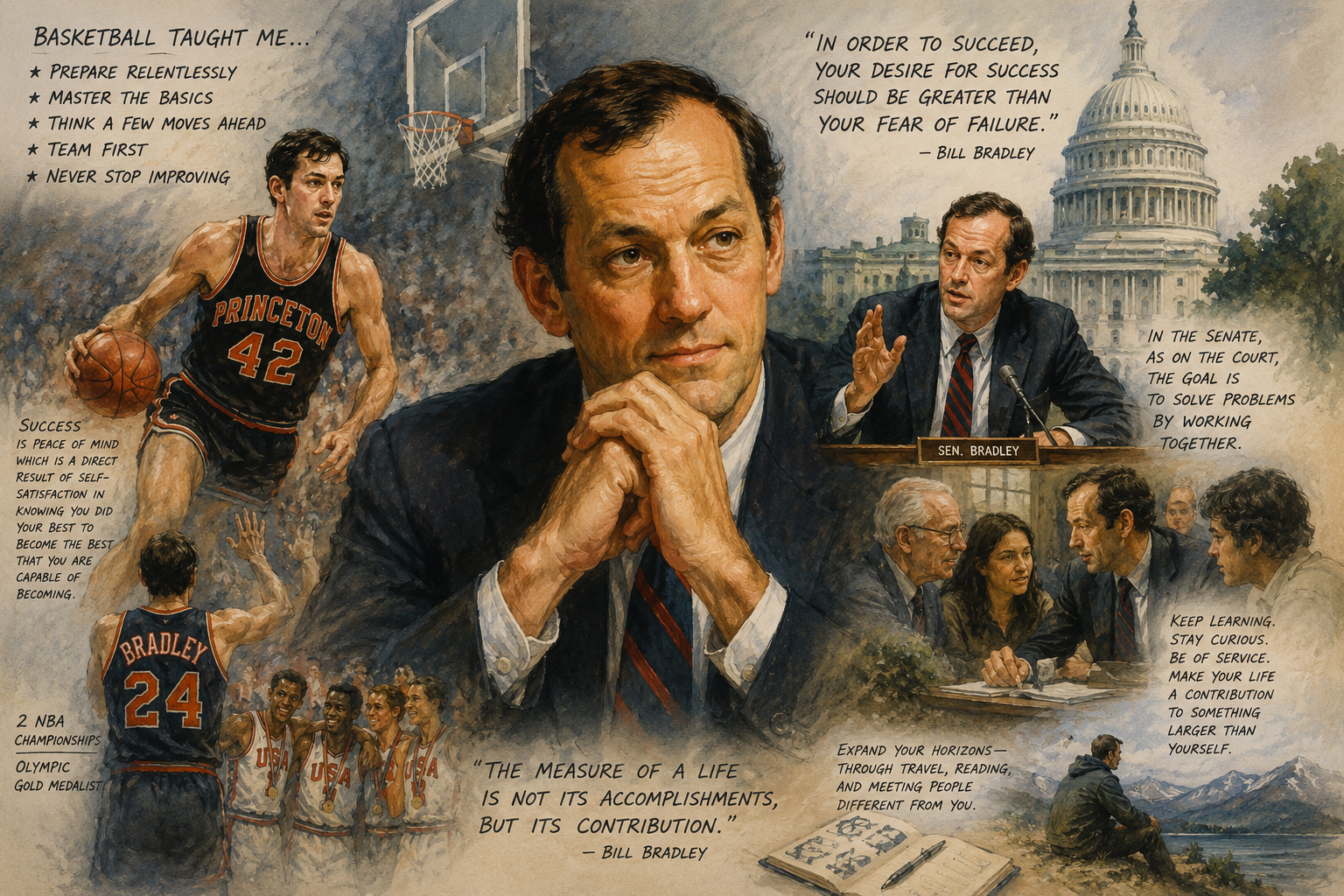
Bradley was an All-American at Princeton and a Rhodes Scholar, who quietly became a foundational piece of the legendary New York Knicks championship team. For Bradley, basketball was never just a game of physical dominance; it was a deeply cerebral, almost spiritual pursuit. The exact core values he relied on to win on the hardwood later became the bedrock of his legislative and political philosophy, when he became a United States senator after he retired from basketball.
Bradley wasn’t the fastest player on the court, nor could he jump the highest. Instead, his genius lay in anticipation, rigorous preparation, and selfless integration into a system. He possessed uncanny peripheral vision and spatial awareness. He famously practiced looking straight ahead while tracking objects to his side, allowing him to understand where every teammate and defender was moving at any given second.
Why was this important to him? Bradley believed that individual ego had to be entirely subordinated to the team. Success meant moving without the ball, setting the unselfish screen, and finding the open man. To Bradley, a perfect assist was just as beautiful, if not more so, than a scored basket. His philosophy was one of the main reasons why the 1969-1970 Knicks team was so successful.
His approach centered on several ideas: 1) Master the fundamentals. 2) Outwork everyone else. 3) Think several moves ahead. 4) Put the team above individual glory. 5) Never stop learning and improving.
Bradley believed success came less from natural talent than from relentless preparation. He famously practiced for hours in dark, empty gyms, repeating the same fundamental drills. And he often spoke about developing habits that would allow excellence to emerge under pressure.
Later he took the same philosophy that made him a great basketball player – and translated it to a long and successful political career as a United States senator.
When Bradley entered the US Senate in 1979, he didn’t view legislative politics as a theater for self-promotion. Instead, he treated the Senate chamber much like the Knicks’ locker room: a place where diverse individuals had to find a collective rhythm to achieve anything meaningful.
As an example, consider his work on the tax code. One of Bradley’s greatest legislative achievements was anchoring the Tax Reform Act of 1986. At the time, the US tax code was a chaotic mess of loopholes, special interest deductions, and sky-high top rates.
Bradley approached this monumental task exactly like a complex game plan: He spent several years quietly mastering the staggering minutiae of tax policy. He realized that a lone progressive Democrat couldn’t pass tax reform, so he partnered with conservative Republicans like Jack Kemp and President Ronald Reagan. Just as he used to draw defenders away to free up a teammate under the hoop, Bradley was entirely willing to let others take public credit if it meant getting the bill across the finish line.
In the Senate, he was known as a “workhorse, not a show horse,” arriving at committee hearings thoroughly briefed on the finest details of a bill. Just like when he played basketball, he was a disciplined worker who always came prepared. He believed that serious problems required serious study—not slogans.
In basketball, Bradley knew that even the greatest player cannot succeed alone. He carried this lesson into politics, where he emphasized coalition-building and bipartisan cooperation. Rather than seeking attention, he often focused on crafting legislation and building consensus.
Finally, he was willing to play the long game. A basketball game unfolds over four quarters. Bradley viewed public policy similarly. He favored long-term solutions over short-term political victories, and he often argued that leaders should think about future generations rather than the next election cycle.
In many ways, Bill Bradley saw life the same way he saw basketball: prepare thoroughly, think deeply, work with others, keep learning, and focus on something larger than yourself. That consistency of purpose is the main reason why I consider him one of my heroes.
Whether slashing without the ball through a crowded basketball court or navigating a gridlocked Congress, Bill Bradley operated on the belief that human beings are at their best when they look past their own immediate glory to build a harmonious, functioning whole.