
Bnei Brak Is Not a Failure of Modernity
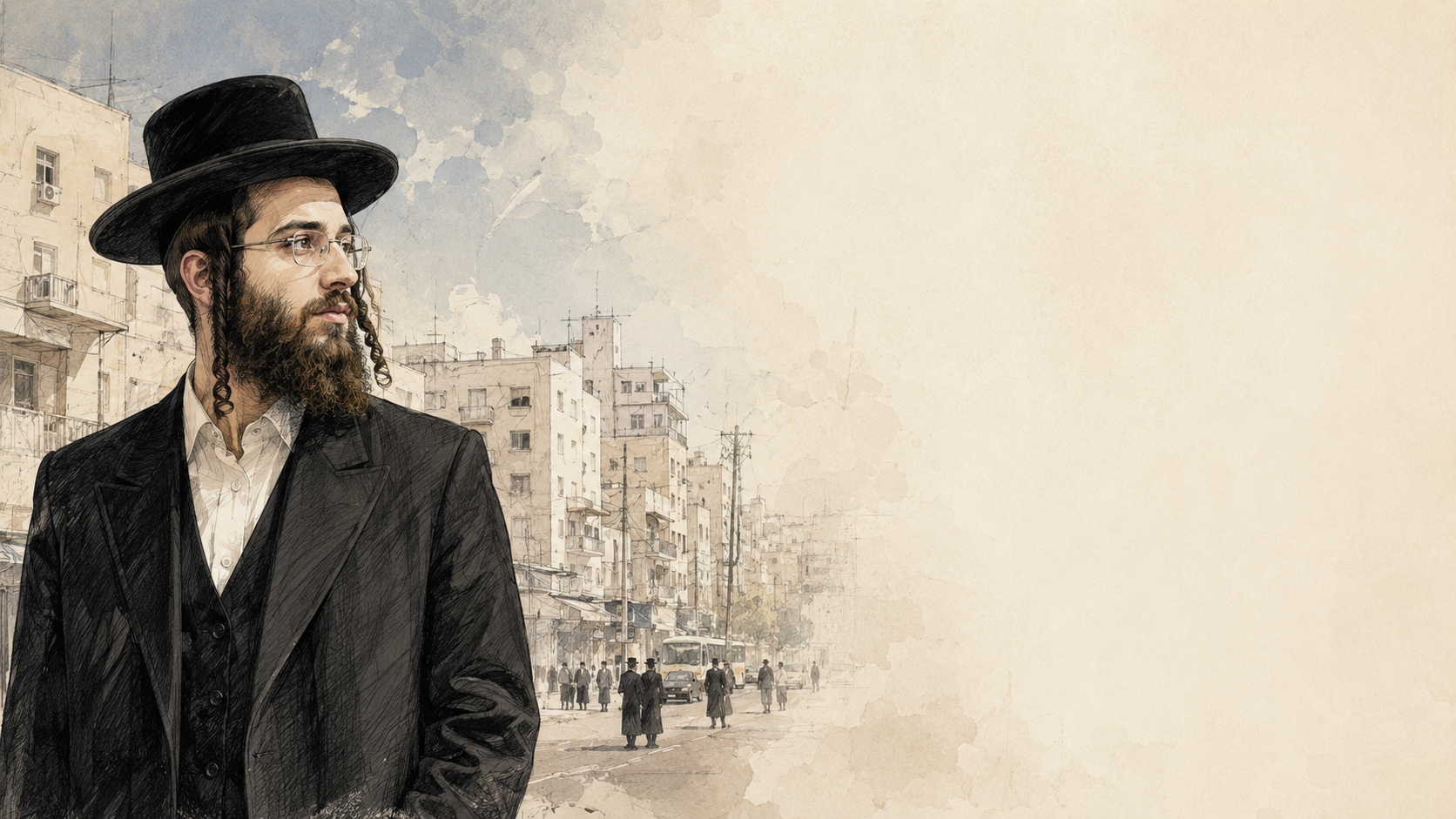
Illustration: Yochanan Schimmelpfennig
Bnei Brak should stop being discussed as if it were merely a demographic inconvenience, a political irritation, or an embarrassing relic at the edge of Israeli modernity. That description is too easy, and like most easy descriptions, it protects the observer from thought.
Bnei Brak is not a failure of modernity. It may be one of Israeli modernity’s most successful Jewish inventions.
This is precisely what makes it so difficult.
The usual secular account sees Bnei Brak as a problem: crowded streets, poverty, political bargaining, educational separation, rabbinic authority, non-participation in military service, and a civic structure that seems to draw heavily from a state it does not fully join. Much of this criticism is legitimate. None of it should be dismissed. But criticism becomes shallow when it begins from contempt. Contempt does not analyze. It merely enjoys its own superiority.
The usual Haredi account is no better when it presents Bnei Brak as if it were simply the natural continuation of an eternal way of life, untouched by history, politics, economics, urban planning, and state structures. That too is a comforting fiction. Bnei Brak did not fall from heaven fully formed. It was built, transformed, disciplined, financed, crowded, educated, and made into a city capable of carrying a particular form of Jewish continuity.
The real question is not whether Bnei Brak is admirable or troubling. It is both. The real question is how it became possible, and what price its possibility now asks from everyone else.
The early story of Bnei Brak interrupts the lazy caricature. It did not begin simply as an enclave of withdrawal. Its early imagination included land, work, settlement, Torah, economy, and religious aspiration. It belonged to a world in which the boundary between religious continuity and productive civic life had not yet hardened into the form we now recognize. The city that later became the capital of Israeli Haredi society began from a more mixed and more experimental grammar.
That matters because it shows that what exists today is not destiny. It is the result of a historical transformation.
Bnei Brak became a city where continuity was not merely remembered but infrastructurally produced. Schools, yeshivot, families, charitable networks, rabbinic authority, publishing, commerce, housing, marriage patterns, political representation, and daily rhythms formed a dense protective architecture. Tradition did not survive there as nostalgia. It became urban.
This is the point many critics miss. Tradition without infrastructure becomes sentiment. Tradition with infrastructure becomes a world.
That world deserves respect. In a century that shattered Jewish worlds, Bnei Brak helped create a new vessel for Torah life. Not a museum. Not a theatrical reconstruction of Eastern Europe. Not a folkloric object maintained for secular anthropologists. A functioning city: children, books, staircases, balconies, small shops, study halls, buses, charity boxes, wedding halls, mourning notices, arguments, obligations, repeated days.
There is something formidable in that.
A people whose continuity was repeatedly broken found a way to make continuity ordinary again. That ordinariness is not a small achievement. It is one of the quiet miracles of Jewish history after catastrophe: not the miracle of spectacle, but the miracle of a street where inherited language, obligation, study, and communal discipline still structure the day.
This is why Bnei Brak should not be reduced to the clichés of Israeli frustration. It is not merely “the place that does not serve.” It is not merely “the place that does not work enough.” It is not merely “the place that votes as a bloc.” These descriptions may name real tensions, but they do not yet name the mechanism. They describe the visible surface of a deeper achievement: the successful conversion of space into continuity.
But admiration is not immunity.
This is where the discussion must become more honest than both camps usually allow. What deserves respect as a form of survival must also be judged as a form of coexistence. A city that preserves Torah life cannot pretend that preservation has no civic cost. A community cannot indefinitely treat the surrounding state as the military, economic, medical, infrastructural, and fiscal condition of its own protected separation.
That is not antisemitic. It is not anti-religious. It is not secular hatred. It is the minimum honesty required by political life.
The problem is not that Bnei Brak exists. The problem begins when the architecture of continuity becomes an architecture of asymmetry. Protection can harden into enclosure. Enclosure can become leverage. Leverage can become a habit. And once a community learns that it can preserve its separateness while others carry the heaviest burdens of sovereignty, the question is no longer only religious. It becomes ethical, civic, and strategic.
Israel cannot build its future on contempt for Bnei Brak. But Bnei Brak cannot build its future on the assumption that others will indefinitely pay the full price of its protection.
Both fantasies must end.
The old secular fantasy imagined that modern Israel would gradually absorb, soften, and normalize Haredi difference. Bnei Brak disproved that fantasy. It did not dissolve into Israeli modernity. It reorganized modernity around itself and created a durable counter-form.
But the Haredi fantasy is equally exhausted: the fantasy that a dense Torah society can remain protected while the broader state endlessly absorbs the military danger, economic pressure, and civic obligations that make such protection possible.
A protected world cannot behave as if protection comes from nowhere.
This is the point at which Israeli language often collapses. Secular Israelis speak of “sharing the burden.” Haredi representatives speak of Torah study as the highest protection. Each side knows its script before the other finishes speaking. The result is not dialogue but a tired machine with microphones.
Bnei Brak deserves a better question.
Not: why are they like this?
But: what kind of Jewish city had to be built for this form of continuity to survive, and what does that survival now require from others?
This question is more precise because it refuses both contempt and sentimentalism. It does not deny the greatness of the achievement. It also refuses to let the achievement erase the bill.
The state of Israel was not created only to produce soldiers, diplomats, start-ups, intelligence units, and technological excellence. Jewish sovereignty must be able to contain more than one Jewish form. It must contain prayer, study, law, family, ritual, local discipline, and communities that do not measure life by the liberal fantasy of individual self-invention. A Jewish state that cannot understand Bnei Brak cannot understand the full range of Jewish memory.
But a Jewish state also cannot survive if memory becomes an exemption from responsibility.
That is the line many people are afraid to say clearly. They either attack Bnei Brak crudely, as if nothing great has been built there, or they defend it piously, as if greatness cancels obligation. Both positions are evasions. The first refuses to see. The second refuses to account.
Bnei Brak is a Jewish achievement that must now pass through the test of responsibility.
This does not mean destroying its way of life. It means asking whether that way of life can mature beyond defensive separation. Can it preserve Torah without turning the state into its support apparatus? Can it maintain density without converting density into political extraction? Can it teach continuity without teaching civic disappearance? Can it remain itself without making others carry the whole weight of its remaining?
These are not hostile questions. They are the questions one asks when one takes Bnei Brak seriously.
The easiest thing is to mock the city. The second easiest thing is to romanticize it. The harder thing is to recognize that Bnei Brak may be one of the most successful Jewish constructions of the twentieth century, and precisely because of that success, it can no longer hide behind fragility alone.
Fragility explains the need for protection. It does not justify permanent asymmetry.
Israel needs Bnei Brak because Israel needs more than power. It needs memory, study, discipline, textual seriousness, and forms of life that do not surrender instantly to the market, the screen, the slogan, or the state’s own impatience. In this sense, Bnei Brak is not an embarrassment. It is a warning against a thin Jewishness that remembers everything except how to live Jewishly.
But Bnei Brak needs Israel no less. It needs the army it often does not join, the economy it often criticizes, the hospitals it uses, the roads it travels, the police that protect it, the taxpayers who sustain national systems, and the sovereign framework without which its protected continuity would be far more exposed.
The honest sentence is therefore simple: Bnei Brak is not outside Israel. It is one of Israel’s deepest internal tests.
It tests whether secular Israelis can respect a form of Jewish continuity they did not create and do not control.
It tests whether Haredi society can accept that continuity without responsibility becomes dependence sanctified by language.
And it tests whether Israel can move beyond the childish choice between contempt and surrender.
Bnei Brak is a difficult, brilliant, unfinished Jewish invention. It made continuity livable. That deserves admiration. But the next stage cannot be merely the preservation of separation. The next stage must be responsibility without self-erasure.
Continuity must learn to carry weight.
And Israel must learn to say two things at once: Bnei Brak is not a mistake, and Bnei Brak cannot remain exempt from the consequences of its own success.
Yochanan Schimmelpfennig