BO 2026—Induced darkness and the lamp in the home
BO 2026 — Induced darkness and the lamp in the home
We don’t live in an age that lacks information. We live in an age that lacks inner edge. Light exists everywhere — on screens, in data, in words, in constant explanations — and still the soul feels like it’s living in the dark. That is why Bo lands so violently in 2026: because the central plague of our time is not visible violence. It is induced darkness.
Not darkness imposed by a whip — but by saturation.
Not by censorship — but by excess.
Not by forbidding — but by confusing.
The Torah describes a darkness you can touch. In Hebrew it is almost monstrous: it’s not only that you can’t see — it’s that you can’t move. Three days immobile. Paralysis. Not because you choose to remain, but because you cannot. And that line translates cleanly today: the modern human being is immobile even while moving.
Scrolling. Consuming. Working. Replying. Producing.
And still — inwardly — not shifting.
No thresholds crossed. No real decisions made.
A life that feels like motion while the soul stays in the same place.
That is Mitzrayim 2026: movement without Exodus.
The firstborn that refuses to die
In Bo, Egypt doesn’t fall through military defeat. It collapses when it loses its ability to sustain centrality — when the firstborn dies, the symbol of continuity, permanence, control.
In 2026, the firstborn is not a child. It is an idea: “I am the centre.” And that centrality has grown a new skin:
Identity as throne.
Self as flag.
Opinion as home.
The feed as temple.
The need to be right as a substitute for meaning.
There has never been such obsession with “me”: my profile, my brand, my stance, my outrage, my tribe, my narrative. And when that self becomes central, it becomes Pharaoh.
That is why the first command of Bo remains scandalous:
בֹּא אֶל־פַּרְעֹה — Bo el-Paró.
Enter.
Don’t criticize from a distance.
Don’t hide in analysis.
Don’t numb yourself with clever theories.
Enter the source.
Enter your personal Pharaoh: the addiction, the compulsion, the rage, the pride, the wound that became identity. Enter the place where your soul shrinks and refuses to look.
Because in 2026 the most dangerous Pharaoh is not outside. It is inside the nervous system: the mechanism that defends itself from truth with dopamine, distraction, noise, irony.
And yes — that mechanism is smart. That’s the problem.
Locusts: appetite that devours attention
The plague of locusts becomes almost embarrassing in how accurate it is. The locusts devour what remains: harvest, green, hope. It isn’t only destruction. It is a mirror of the modern desire-economy.
The system feeds by devouring attention.
It eats your focus.
Then your energy.
Then your relationships.
Then your sleep.
Then your capacity to be present.
And when it has eaten everything, it leaves you empty — and offers you something else to eat.
That is locust: appetite without satiety. Consumption that does not nourish. Infinite scrolling. Infinite outrage. Infinite stimulation.
A system that devours — and, in devouring, devours itself.
Pharaoh’s advisers cry: “How long?”
But nothing changes, because the system doesn’t know how to stop. It only knows how to intensify.
Dense darkness: losing orientation
Then comes dense darkness. And this is the sharpest diagnosis of the digital era: it is not darkness because there is no light. It is darkness because there is no orientation.
You can have thousands of data points and still not know what is real.
You can read a hundred articles and still be unable to decide.
You can receive ten diagnoses and remain immobile.
You can have maps and still be lost.
That is 2026 darkness: semantic fog — the sense that everything might be true and everything might be false.
When there is no ground, the body enters alarm. When the body enters alarm, the mind seeks anaesthesia. And that is how modern slavery is born — not by coercion, but by self-sedation.
The Torah says Egypt could not move. Three days without edge, without orientation, without future. Darkness became matter.
And in that state even freedom feels threatening.
Because movement would mean admitting the old order ended — and people would rather stay numb than face that.
Light in the houses: where exit begins
But Israel had light in their houses.
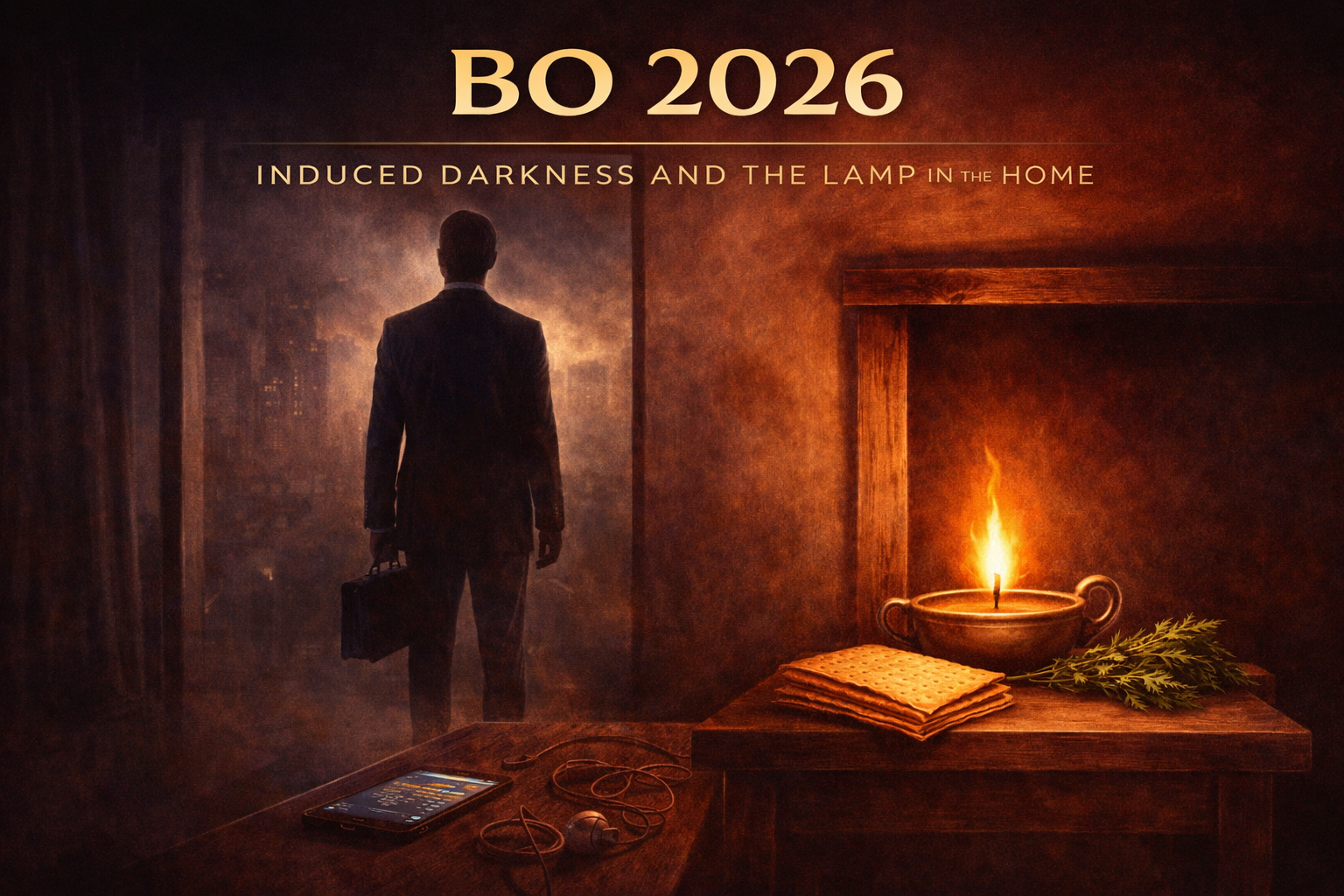
And that is the key to contemporary Exodus: exit does not begin in the street. It begins at home. Not in discourse, not in ideology — but with a lamp, a table, a ritual, a concrete decision that creates edge.
In 2026, a house with light is not a house with light bulbs. It is a place where the feed does not rule. Where there is space without induction. Where conversation does not fight notifications. Where breathing becomes possible again.
A home where the soul is not being administered by algorithms.
And that sounds simple. It isn’t.
Because the modern system wants every home to become a terminal — a place where bodies rest so minds can return online, so attention can be harvested again.
Bo 2026 means something extremely simple and extremely difficult:
Build a home that is an altar, not a terminal.
Not an anaesthetic refuge — a space of truth. A home where you know who you are again when stimuli switch off. A place where life is not content. Where the other person’s face becomes real again. Where the body regains dignity.
Where time has an owner again.
The calendar: reclaiming time as holiness
“This month shall be for you.”
Today time is not ruled by Pharaoh with a whip. It is ruled by metrics, urgency, infinite availability, productivity without closure. The smartphone is the new overseer. It never sleeps. It never falls silent. It never lets you finish.
It trains you to feel that stopping is dangerous.
Bo breaks this with a sacred law: reclaim time as holiness.
Count days from consciousness.
Create real beginnings.
Create real limits.
A clean “up to here” the system cannot bargain with.
HaShem does not only free bodies. He frees time. And in 2026 that is one of the most radical liberties left: deciding your days are not measured by how much you produce, but by what you choose to remember.
The blood-marked threshold: a visible boundary
Then comes blood on the threshold.
In 2026 that image is almost unbearable: a visible boundary. In a world where everything is liquid, negotiable, editable, reversible — the marked threshold is a revolution.
It means: this house has law.
This soul has limit.
This life is not available to every force.
In modern language: there are things you do not argue with an algorithm. There are things you do not hand over to the feed’s emotional marketplace. There are decisions you mark as an ontological cut — not moralism, but survival.
Blood on the post is not superstition. It is the visible mark of a consciousness saying: “I do not belong anymore.”
Border between the devouring system and the protecting home.
First act of inner sovereignty in external chaos.
Matzah: truth without inflation
Matzah is also 2026: bread without rising. Truth without branding. Life without performance. Identity without spectacle.
In a civilization where everything inflates — opinions, egos, dramas, narratives — matzah is the opposite act: reduce to the essential so you can walk.
You do not need to show.
You need to leave.
The one who exits inflated returns enslaved. Only the one willing to walk light — with what is necessary, without pretending to control the road — can leave.
Entering in order to leave
Bo 2026 is not about hating technology. It is about seeing the mechanism. Recognizing induction. Reclaiming inner sovereignty.
Lighting a lamp at home while the world darkens.
Creating a threshold.
Resetting time.
And above all: entering where you do not want to look — because the most refined Pharaoh is not in government or economy. It is in your automatic reflex, your avoidance, your need for immediate comfort.
The Torah ends Bo with an order: “And you shall tell your son.” Not because God needs memory, but because human beings forget — and when they forget, they return.
In 2026, telling the story is not nostalgia. It is resistance. Keeping alive the memory of the day you decided the night could roar outside…
…but inside would no longer have a throne.
Because in 2026 Exodus does not mean crossing a physical sea. It means crossing induced darkness. And the first exit does not happen in a public square or in a brilliant argument.
It happens at a small table.
With a domestic lamp.
In a home that decides to mark its threshold while the system devours what remains of attention, orientation, truth.
True exit begins when you light a lamp in your home and decide that darkness may touch your door — but it no longer enters.