
Board of Peace Meeting: Phased Disarmament, Shared Hope
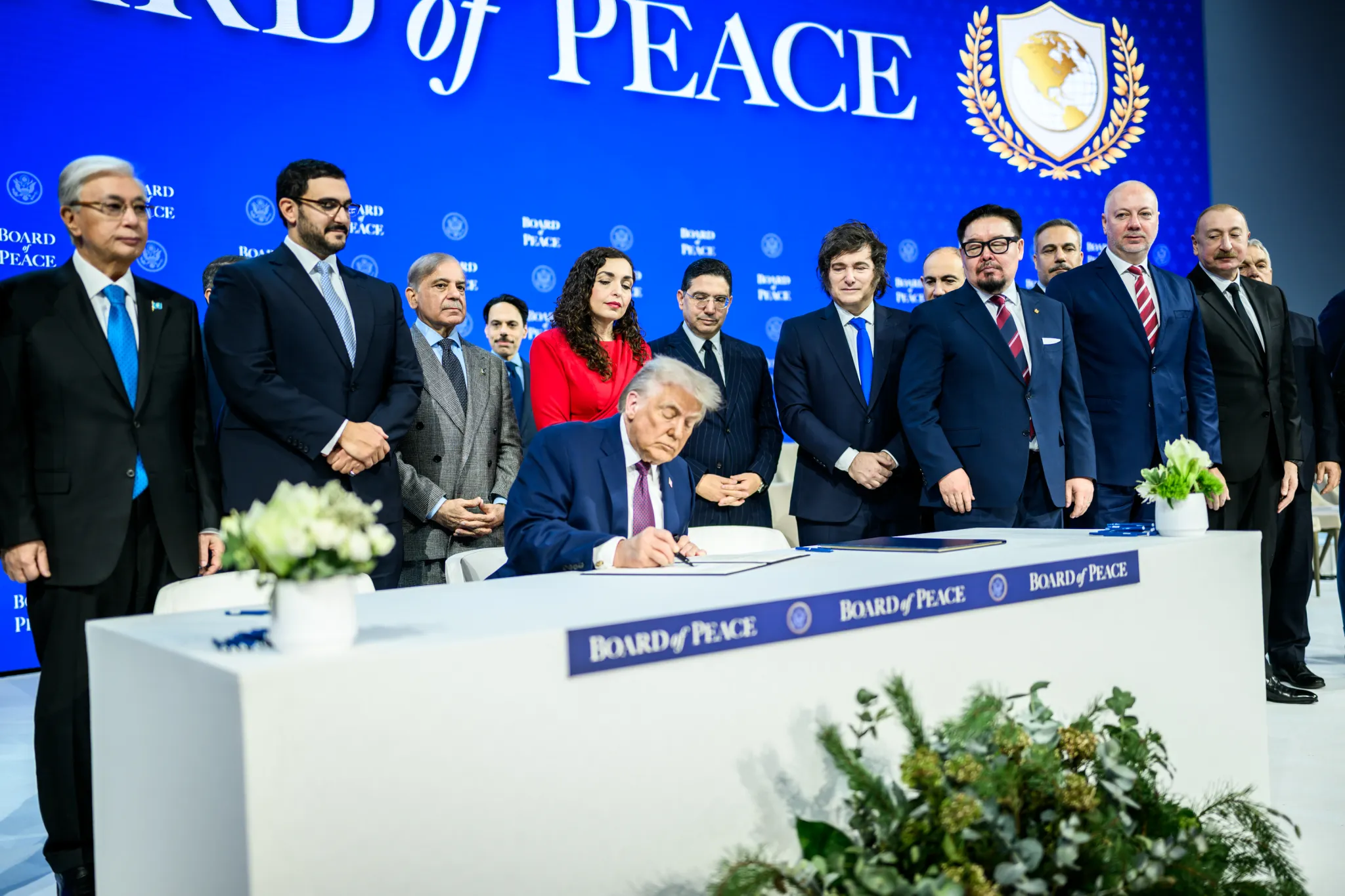
The Board of Peace meeting in Washington on February 19 arrives at a moment when Gaza stands delicately balanced between fragility and forward movement. While tensions surrounding the ceasefire have not disappeared, officials involved in the initiative insist that the broader stabilization plan is progressing methodically. That distinction is important. In a region accustomed to abrupt escalation, steady implementation can be a quiet but powerful sign of progress.
Several early milestones have already been reached. Hostage releases have helped ease immediate humanitarian pressure. The reopening of the Rafah crossing has restored a critical artery for movement and aid. Meanwhile, a technocratic administrative committee is expected to enter Gaza in the coming weeks — a signal that governance reform is being approached pragmatically rather than rhetorically. These steps may seem incremental, but together they form the scaffolding of a larger transition.
At the heart of the discussions is a structured framework for disarmament. A senior official connected to US President Donald Trump’s Board of Peace initiative revealed to Ynet in an exclusive report on Wednesday that the efforts to dismantle Hamas’ military infrastructure in Gaza are on track, despite the ongoing tensions related to the ceasefire. The plan starts with taking down tunnels, then moves on to weapons production sites, followed by heavier munitions such as RPGs and mortars, and finally, small arms. The sequence is important; it allows for verification, fosters confidence, and lowers the risk of sudden destabilization.
Attention is now shifting toward finalizing the framework for Hamas’ disarmament, with the first phase scheduled to begin in March. Reports suggesting that some weapons might be permitted to remain have been clarified by officials: small arms are simply addressed last in the sequence, not excluded.
US plan to disarm Hamas allows the temporary retention of light weapons in exchange for surrendering arms that threaten Israel. pic.twitter.com/clEeGUkqKE
— Al Arabiya English (@AlArabiya_Eng) February 12, 2026
Peace activists focused on Gaza are increasingly worried about the suggested phased disarmament of Hamas. Critics are making it clear that anything less than an immediate and total disarmament is simply unacceptable. The White House insists it’s working hand-in-hand with all parties to implement this 20-point plan, but many voices—especially on social media—are calling for a more straightforward strategy. The consensus among these concerned individuals is strong: to achieve lasting security, Hamas must be completely disarmed from the very beginning, leaving no space for any compromise that would allow a military presence to stick around.
According to a @nytimes report – Hamas will be able to keep small arms in the first phase of denuclearization, according to the plan being formulated by Wittkoff, Kushner and Mladenov.
White House spokesman – US working with all parties to ensure implementation of the 20-point… pic.twitter.com/XrP8Vv6wVM— Iris (@streetwize) February 11, 2026
As disarmament progresses, efforts are ramping up to enhance an international stabilization presence with the backing of the UN. Indonesia’s commitment to contribute up to 8,000 troops highlights the seriousness of this initiative, and several other nations have shown their willingness to join in once a solid and enforceable framework is established. The participation of Muslim-majority and regional countries not only adds credibility but also reassures everyone that stabilization is a collaborative effort rather than something being forced upon them.
Indonesia is preparing to send up to 8,000 TROOPS to Gaza as part of a PEACEKEEPING FORCE under Trump’s Middle East PLAN
Army chief of staff says TRAINING has begun for engineering and medical units pic.twitter.com/zKUPLxut4M
— RT (@RT_com) February 10, 2026
The meeting, chaired by US President Donald Trump, is expected to bring together representatives from over 20 countries. Officials are emphasizing that the spotlight will be on Gaza, particularly regarding its reconstruction, governance transition, and security arrangements. A major point of discussion will be the launch of a multi-billion-dollar reconstruction fund, with contributions likely to come from countries stepping up voluntarily. This approach—where nations willingly offer support instead of being coerced—highlights a collective commitment to the recovery of Gaza.
Israel has formally joined the Board of Peace, reinforcing that security concerns are being addressed alongside reconstruction. Israeli Prime Minister Benjamin Netanyahu confirmed on February 12, 2026, that Israel has formally joined US President Donald Trump’s “Board of Peace” initiative.
Met with U.S. Secretary of State @marcorubio at Blair House in Washington.
Ahead of my meeting at the White House with President Trump, I signed Israel’s accession as a member of the “Board of Peace.”
We will continue strengthening the unbreakable alliance between Israel and… pic.twitter.com/CJ4Lw92WdX
— Benjamin Netanyahu – בנימין נתניהו (@netanyahu) February 11, 2026
However, PM Benjamin Netanyahu’s office says he will not fly back to the US next week as initially planned, which means he will not attend the Board of Peace’s inaugural meeting.
Pakistan’s Prime Minister Shehbaz Sharif will attend the meeting, joined by Foreign Minister Ishaq Dar. This move places Islamabad within a larger coalition of Islamic and Arab nations supporting the initiative under the UN Security Council framework. This collective action shows that the stabilization of Gaza is evolving from a simple bilateral matter into a more complex multilateral effort.
The Pakistan Foreign Office has confirmed that Prime
Minister Shehbaz Sharif and Deputy Prime Minister
Ishaq Dar will attend the upcoming Gaza Board of
Peace summit in Washington, describing their
participation as an engagement in good faith.https://t.co/6K8mLsPDqi#TDI… pic.twitter.com/8mMR9V2t0n— The Diplomatic Insight (@DiplomaticIns) February 13, 2026
Discussions are also taking place with private sector actors regarding logistical and security support during the stabilization phase. While such arrangements will require transparency and accountability, their consideration suggests that planners are looking beyond immediate ceasefire management toward durable implementation.
The disarmament phase starting in March is a significant turning point, marking the shift from a history of conflict to a future filled with promise. By aligning security, governance, and reconstruction into one unified plan, the Board of Peace is transforming a once-distant dream into a reality. This isn’t merely about removing obstacles; it’s about clearing the way for Gaza’s vibrant revival.
The upcoming commitments for funding and troop support are the vital energy needed to speed up this progress, while independent monitoring guarantees that each step taken is grounded in trust and transparency. Rebuilding civilian systems and restoring public confidence is a long journey, not a quick fix, but having this framework in place offers a deep sense of shared hope. For the first time in ages, the story is changing: we’re moving away from the echoes of conflict and toward the steady, nurturing rhythm of a society being thoughtfully and lovingly rebuilt.